
Good furniture usually reveals itself before you ever look at the brand name. It feels stable. The drawers move cleanly. The joints make sense. The finish is even. The materials are described honestly. Nothing creaks, twists, snags or hides behind vague wording.
That does not mean every good piece has to be expensive. Some mid-range furniture is honest and useful. Some expensive furniture is mostly branding, styling or markup. The real skill is knowing what to inspect before you buy.
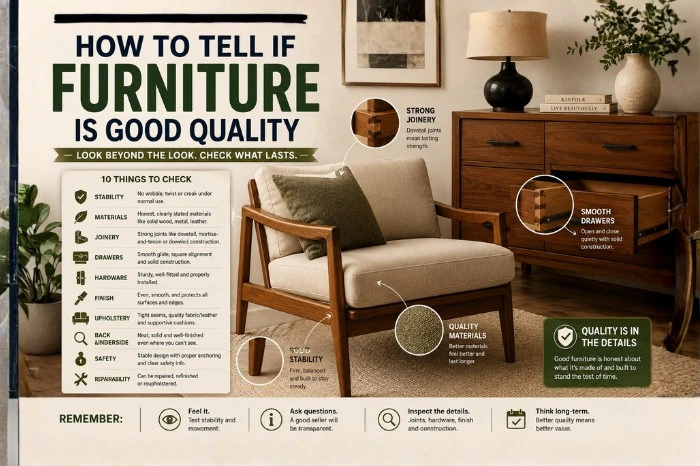
This guide explains how to tell if furniture is good quality by checking structure, materials, joinery, drawers, hardware, finish, upholstery, safety and long-term repairability.
Quick Answer: How Can You Tell If Furniture is Good Quality?
You can tell if furniture is good quality by checking how stable, honest and repairable it is. A well-made piece should not wobble, twist, creak or feel flimsy under normal pressure. Look for clear material details, strong joinery, smooth drawers, secure hardware, even finishing and upholstery that suits the way the piece will be used. Solid wood, quality veneer, kiln-dried frames, dovetail joints, sturdy drawer slides and clean seams are usually better signs than vague words like “premium” or “luxury.” Price alone is not proof. Good furniture should feel stable, work smoothly, be described accurately and make sense for daily life.
The Simple Rule: Good Furniture Feels Honest
The easiest way to judge furniture is to ask one question: does the piece behave like it was built to last, or does it only look good from one angle?
Quality furniture does not rely on mystery. A good seller should be able to explain the main materials, frame, finish, upholstery, hardware and care needs. A good piece should also feel stable when used normally. If a chair rocks, a table twists, a drawer scrapes, or a cabinet leans when lightly pressed, the problem is not only cosmetic.
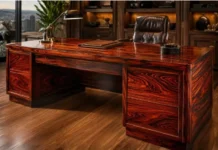
For rare or collector-grade furniture, the standard is even higher. A cocobolo desk, for example, should be judged by construction, material honesty, condition and provenance, not by the wood name alone.
Furniture Quality Checklist
| What to check | Good sign | Warning sign |
|---|---|---|
| Stability | The piece stands level and does not wobble, twist or creak under normal pressure. | Loose legs, rocking, flexing, uneven feet or movement at the joints. |
| Materials | The seller clearly states solid wood, veneer, plywood, metal, stone, fabric or leather type. | Vague wording such as “wood look,” “premium finish” or “designer-inspired.” |
| Joinery | Dovetail, mortise-and-tenon, dowel, corner blocks or well-executed mechanical joinery. | Staples, weak glue lines, visible gaps or joints that move when touched. |
| Drawers | Drawers glide smoothly, sit squarely and do not tilt when extended. | Grinding, sticking, crooked gaps, thin bottoms or weak runners. |
| Hardware | Handles, hinges, slides and screws feel secure and properly aligned. | Loose handles, squeaky hinges, cheap slides or hardware pulling out of the material. |
| Finish | Surface feels smooth, even and protected, including edges and corners. | Cloudy finish, rough patches, bubbling veneer, chips or uneven staining. |
| Upholstery | Seams are straight, fabric suits the use, cushions recover well and the frame feels firm. | Puckering, sagging, weak foam, loose stitching or fabric that already looks strained. |
| Back and underside | Hidden areas are still neat, stable and thoughtfully assembled. | Messy staples, exposed rough panels, thin backing or unfinished weak points. |
| Safety | Storage pieces feel stable and include proper anchoring or safety information where needed. | Tall, lightweight dressers or cabinets that tip easily or lack clear warnings. |
| Repairability | The piece can be tightened, refinished, reupholstered or repaired. | Disposable construction, glued-only panels or parts that cannot be replaced. |
Start With the Stability Test
Before studying wood species or fabric names, test stability. A good table should not rock when you press near the corners. A chair should not twist when you shift your weight. A dresser should not feel loose when drawers open. A sofa should not creak when you sit down or push on the arms.
Do this gently and reasonably. You are not trying to break the piece. You are looking for early signs of weak construction: loose joints, uneven legs, poor assembly, frame movement or hardware that is already failing.
For online buying, look for reviews that mention wobbling, squeaking, missing hardware, difficult assembly or drawers that do not line up. Those are quality warnings, not minor inconveniences.
Know What the Furniture Is Actually Made From
Material language can be confusing because many pieces are described to sound better than they are. “Wood finish” is not the same as solid wood. “Walnut color” is not walnut. “Leather match” is not full leather. “Stone look” is not stone.
The USDA Forest Products Laboratory’s Wood Handbook treats wood and wood-based products as engineering materials, with properties that affect design, moisture movement, strength and use. That is the practical reason material honesty matters. Furniture is not only about appearance. It has to remain stable while being moved, loaded, cleaned and used.
Solid wood is often repairable and refinishable, but it can move with humidity. Veneer can be excellent when it is real wood over a stable core, especially on large flat surfaces. Plywood can be strong and useful. MDF and particleboard can work for lower-stress pieces, but they are usually less forgiving with water damage, loose screws or rough moving.
Compared with common types of wood used in furniture, engineered materials are not automatically bad. The issue is whether the seller describes them clearly and prices the piece honestly.
Check the Joinery, Not Just the Surface
Joinery is where furniture tells the truth. A glossy finish can make weak construction look impressive for a while, but the joints decide how the piece handles weight, movement and time.
For wood furniture, look for clean dovetail joints on drawers, mortise-and-tenon construction on chairs and tables, dowels that are aligned properly, corner blocks in heavier pieces, and joints that fit tightly without obvious gaps. Screws are not always bad, especially in modern furniture, but screws should not be doing all the work in a piece that is supposed to last for years.
Weak signs include staples carrying structural load, glue squeezed unevenly from joints, legs that move when nudged, and panels that separate from the frame. If a new piece already feels loose, it will usually age worse.
Open Every Drawer and Door
Drawers and doors are some of the best quality tests because they combine construction, alignment and hardware. A good drawer should open smoothly, close cleanly and sit square in the frame. It should not scrape, drop, bind or shift side to side.
Look at the drawer box itself. Solid or well-made plywood drawer boxes are usually stronger than very thin bottoms that flex under light pressure. Dovetail joints are a positive sign, but even simpler drawers can be good if the box is square, the slides are secure and the bottom is properly supported.
For cabinets, check door gaps. They should be even. Hinges should feel secure. Doors should not swing open by themselves, rub the frame or sit crooked. Poor alignment often points to rushed assembly, weak hardware or a frame that is not square.
Inspect the Finish Closely
A good finish protects furniture as much as it beautifies it. Run your hand across the surface. It should feel smooth, not sticky, gritty or patchy. Corners and edges should be protected, not raw or carelessly stained.
On wood furniture, look for even color, natural grain continuity and no bubbling veneer. On painted furniture, check corners and high-touch areas where thin paint often chips first. On stone, glass or metal, look for clean edges, secure attachment and no sharp unfinished points.
A few marks on a vintage piece may be acceptable if the structure is strong. A poor finish on a new piece is different. It can signal rushed production or weak quality control.
For Sofas and Chairs, Judge the Frame Before the Fabric
With upholstered furniture, fabric gets most of the attention because it is what people see first. The frame, suspension and cushion construction matter more for long-term comfort.
Press on the arms and back. They should feel firm, not hollow or wobbly. Sit down and shift your weight. A good sofa should not creak, sag immediately or feel as if the frame is bending. Cushions should recover their shape after use. Seams should be straight and tight without puckering.
Fabric durability also needs nuance. The Association for Contract Textiles warns that Wyzenbeek and Martindale abrasion tests measure flat abrasion resistance, but do not capture every real-world cause of fabric failure, such as poor cleaning, misuse, maintenance issues or edge wear. That means a high rub count is useful, but it should not be treated as the only proof of upholstery quality.
For busy households, performance fabrics, tight weaves and removable cushion covers can matter more than delicate fabric that looks beautiful in a showroom but struggles with pets, children or daily use.
Match Quality to the Piece You Are Buying
Not every piece needs the same standard. A coffee table, sofa, dresser and desk fail in different ways, so inspect each one differently.
| Furniture type | What matters most | Best quality signs |
|---|---|---|
| Sofa or sectional | Frame strength, suspension, cushion recovery and fabric durability | Firm frame, no creaking, straight seams, cushions that recover, fabric suited to use |
| Dining table | Stability, top material, leg attachment and finish protection | No wobble, secure base, smooth surface, protected edges, repairable top |
| Desk | Work surface, stability, drawer quality and cable or storage practicality | Level top, firm legs, smooth drawers, finish that can handle daily touch |
| Dresser | Drawer movement, frame stability, anti-tip safety and case construction | Square drawers, secure slides, stable frame, clear safety hardware or anchoring guidance |
| Cabinet or sideboard | Door alignment, hinges, shelving strength and back-panel construction | Even door gaps, strong shelves, secure hinges, neat back and underside |
| Chair | Leg joints, seat comfort, back support and weight handling | No twisting, strong joints, comfortable angle, stable legs and clean upholstery |
| Vintage or designer piece | Condition, maker, originality, repair history and provenance | Labels, stamps, invoices, original hardware, stable repairs and honest age marks |
Do Not Ignore Safety on Dressers and Storage Furniture
Quality is not only about beauty or durability. Tall storage furniture also has a safety dimension, especially in homes with children.
The U.S. Consumer Product Safety Commission explains that the STURDY law applies to certain clothing storage units manufactured after September 1, 2023. The CPSC’s guidance covers products such as dressers, chests, bureaus and armoires that meet the rule’s size and storage criteria, and it describes required stability tests, anti-tip devices and warning labels.
For a buyer, the practical takeaway is simple. A dresser or cabinet should feel stable, but it should also include proper anchoring hardware and clear safety information where relevant. A beautiful storage piece that tips easily is not good quality.
Price Alone Does Not Prove Quality
A higher price can be justified by better materials, skilled labor, strong construction, original design, fair production, repairability or provenance. It can also be inflated by trend demand, showroom styling, vague luxury language or a brand name doing too much of the work.
This is especially true with rare woods and collector pieces. Cocobolo, ebony, rosewood, walnut burl and other premium materials can influence value, but even the most expensive woods in the world cannot rescue bad construction. A poorly built object made from rare material is still a poor object.
Use price as a clue, not a verdict. The piece still needs to pass the basics: stable frame, honest materials, clean joinery, good hardware, suitable finish and a clear reason it costs what it does.
Vintage Furniture Can Be Excellent, But Check It Carefully
Vintage furniture can be some of the best value available because older pieces often used stronger materials and better joinery than many low-cost modern options. But age alone is not proof of quality. A vintage piece can also be warped, poorly repaired, refinished badly, infested, unstable or missing important parts.
Check labels, stamps, drawer construction, hardware, underside, back panels and repair history. If the piece is being sold as designer, antique or rare, ask for provenance. In that world, the value logic is closer to valuable collectibles than ordinary home shopping.
Small flaws can be acceptable if the structure is strong and the price reflects condition. Structural weakness, bad repairs and vague attribution are bigger concerns.
How to Judge Furniture Quality Online
Online shopping makes furniture quality harder to judge because product photos are designed to flatter. You need to read the listing like a buyer, not a browser.
- Look for material specifics. Good listings name the wood, veneer, metal, fabric, leather type, core material and finish.
- Zoom in on joints and edges. Corners, drawer gaps, seams and legs reveal more than styled room photos.
- Check dimensions carefully. A piece can be attractive and still wrong for your room or body.
- Read negative reviews first. Look for repeated complaints about wobbling, peeling, smell, weak hardware or difficult returns.
- Study return terms. Large furniture returns can be expensive even when the seller accepts them.
- Ask for extra photos on vintage pieces. Request the underside, back, labels, drawer joints, hardware and damaged areas.
- Be careful with “style” wording. “Eames-style,” “walnut-style” or “cocobolo-style” is not the same as authentic material or maker.
Quality Furniture Usually Lasts Longer
Better furniture is not only a personal spending decision. It can also be a waste decision. The U.S. Environmental Protection Agency reported that furniture and furnishings generated 12.1 million tons of municipal solid waste in 2018, equal to 4.1 percent of total municipal solid waste generation. That figure was up from 2.2 million tons in 1960.
This does not mean everyone should buy expensive furniture. It means disposable furniture has a hidden cost when it breaks quickly, cannot be repaired and needs to be replaced again. A mid-range piece that lasts ten years can be a better buy than a cheaper piece that disappoints after one move.
Quick Red Flags That Furniture May Be Poor Quality
- The piece wobbles, twists or creaks under light use.
- The listing uses vague material wording.
- Drawers scrape, tilt or feel thin.
- Hinges and handles feel loose before regular use.
- The finish is uneven, sticky, cloudy or bubbling.
- Upholstery seams are crooked, puckered or pulling.
- The back or underside looks carelessly assembled.
- The seller cannot explain the construction.
- The piece has no clear care instructions.
- The price depends mostly on styling or brand language.
The Practical Verdict
Good quality furniture is stable, honestly described, well joined, smoothly finished and suited to the way it will be used. It does not need to be the most expensive option in the room, but it should give you a clear reason to trust it.
Before buying, slow down and inspect the parts that product photos hide: joints, drawers, underside, hardware, frame, seams and labels. If those details are strong, the piece has a better chance of aging well. If they are weak, a beautiful surface will not save it for long.
FAQs About Good Quality Furniture
Good quality furniture feels stable, uses clearly described materials, has strong joints, smooth drawers, secure hardware, even finishing and upholstery suited to the way it will be used. It should not wobble, twist, creak or hide behind vague material claims.
Heavy furniture can be a good sign, especially with solid wood or strong frames, but weight alone does not prove quality. Some heavy pieces use low-grade engineered materials, while some lighter pieces are well designed and durable.
Good wood furniture usually has stable construction, honest material details, clean joinery, smooth drawers, protected edges and a finish that feels even. Check the underside, back panels and drawer boxes because those areas often reveal the real build quality.
No. Good veneer is a thin layer of real wood over a stable core and can be used in fine furniture. The problem is cheap veneer work, bubbling edges, poor cores or sellers describing veneer as if it were solid wood.
Common signs of bad furniture include wobbling, weak joints, loose hardware, rough finish, crooked drawers, thin drawer bottoms, peeling veneer, vague material descriptions, sagging cushions and seams that are already pulling.
Check the sofa frame, arms, cushions, seams and fabric. A good sofa should not creak, sag immediately or feel hollow at the arms. Cushions should recover their shape, and the fabric should suit the amount of daily use it will receive.
No. Expensive furniture can be worth it when the price reflects materials, construction, comfort, repairability or provenance. It is not worth it when the cost is mostly branding, styling or unclear luxury language.
Vintage furniture can be excellent, especially when it has strong materials and joinery, but age alone is not proof of quality. Check condition, repairs, stability, labels, hardware and whether the price reflects the actual state of the piece.