


Bill Gates’ wealth has grown by roughly $4 billion a year on a long-run, smoothed basis. That works out to an estimated $10.96 million per day, or about $456,600 per hour, $7,610 per minute, and $127 per second.
As of July 6, 2026, Forbes pegs Gates at about $106.8 billion in real-time net worth, while its billionaire list places him at around $108 billion, which is a good reminder that these figures move with the market.
This is not salary. It is paper wealth, driven by asset values rather than cash pay.
But that money does not hit a bank account. There is no paycheck and no wire transfer. It is asset appreciation—the daily rise and fall of a large investment base tied to public equities, private holdings, farmland, and other long-term assets. The number is abstract, but the scale is real.
Quick Overview: How Much Does Bill Gates Make a Day?
Bill Gates makes an estimated $10.96 million per day, based on a long-run wealth growth average of roughly $4 billion per year. That breaks down to about $456,600 per hour, $7,610 per minute, and $127 per second. However, this is not a salary or cash income. It is mostly paper wealth created by changes in the value of his investments, stocks, private holdings, farmland, and other assets. Gates does not receive this amount as a daily paycheck, and his net worth can rise or fall with the market.
Bill Gates Daily Estimated Wealth Appreciation at a Glance (2026)
| Time period | Estimated wealth growth |
|---|---|
| Per year | ~$4,000,000,000 |
| Per month | ~$333,333,333 |
| Per week | ~$76,923,077 |
| Per day | ~$10,958,904 |
| Per hour | ~$456,621 |
| Per minute | ~$7,610 |
Source: This is a derived estimate based on Forbes’ 2026 real-time net worth data and a smoothed annual growth assumption. Forbes’ own figures change throughout the day, which is why the estimate should be read as an average, not a fixed income figure.
Bill Gates’ Net Worth Growth: 2020–2026 Year by Year
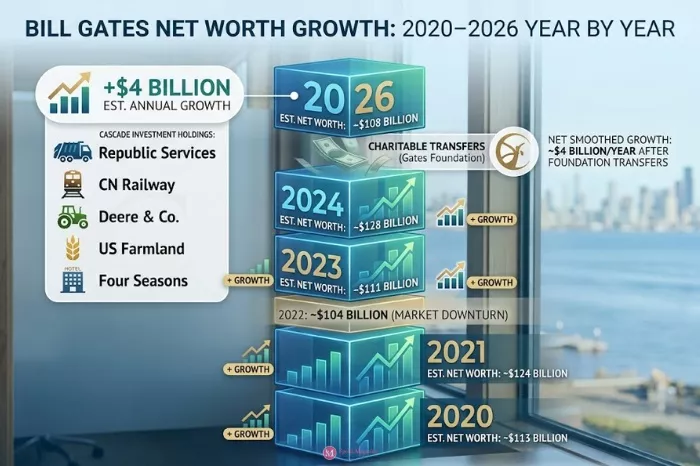
Bill Gates’ estimated daily unrealized investment gain in 2026 sits at roughly $10.96 million, based on a conservative annual wealth growth estimate of $4 billion.
As of early July 2026, Forbes places his net worth at roughly $106.8 billion on its profile page, while its real-time tracker shows a slightly different figure because it updates continuously. He remains among the world’s richest people, but the exact rank can shift from day to day.
That $4 billion annual figure is a smoothing tool, not a salary figure. It is a way to explain the long-run trend in Gates’ wealth without pretending every month looks the same. Over time, the pattern has been shaped by market moves, major charitable transfers, and the gradual repositioning of his assets away from Microsoft and into a broader portfolio.
- 2020: ~$113 billion
- 2021: ~$124 billion
- 2022: ~$104 billion (market downturn)
- 2023: ~$111 billion
- 2024: ~$128 billion
- 2025: ~$108–$118 billion (charitable transfers and portfolio rebalancing)
Approximate year-end or annual Forbes estimates. Values fluctuate throughout the year.
Net it out over five years—after tens of billions transferred to the Gates Foundation— and $4 billion annually is a reasonable, conservative middle ground.
Divide that by 365 days, and you get $10,958,904 per day.
Where Does Bill Gates’ Money Actually Come From?
Most people assume the answer is Microsoft, but that is only partly true. Today, only a small portion of Bill Gates’ wealth is tied directly to Microsoft.
Gates stepped down as Microsoft CEO back in 2000 and left the board entirely in 2020. His Microsoft stake has shrunk from roughly 45% at the company’s 1986 IPO to under 1% today, worth around $12–$13 billion.
The variation in stock price still moves his net worth, but Microsoft is no longer his main source of wealth. That ownership shift also helps explain the widening wealth gap between Bill Gates and Larry Page.
Cascade Investment: The Real Wealth Machine
The actual venture behind Bill Gates’ estimated wealth appreciation is Cascade Investment. It is the family office Gates founded in 1994 and is based in Kirkland, Washington.
Managed by Chief Investment Officer Michael Larson, Cascade oversees more than $115 billion in assets and operates with a strategy that most Wall Street traders would find boring by design: buy quality businesses, hold them for decades, and let them compound. Cascade Investment is now one of the main drivers of Gates’ diversified wealth outside Microsoft.
Cascade’s Confirmed Major Holdings Include:
- Around 35% stake in Republic Services (according to an SEC Schedule 13D filed in February 2026)— one of North America’s largest waste management companies.
- Significant Berkshire Hathaway position — aligning Gates with Warren Buffett’s investment philosophy.
- Canadian National Railway — infrastructure with durable, long-term cash flows.
- Ecolab and Deere & Company — industrial staples with pricing power.
- Joint ownership of Four Seasons Hotels — alongside Saudi Arabia’s Kingdom Holding Company.
Bill Gates’ Farmland Portfolio
Gates is the largest private farmland owner in the United States, holding roughly a quarter-million acres of farmland across Louisiana, Arkansas, Nebraska, Arizona, Washington, and beyond.
Just two major farmland purchases alone total more than $690 million in investment. Agricultural leases generate steady income while the land itself appreciates over time.
Real Estate
His primary residence, a 66,000-square-foot estate in Medina, Washington, is worth over $130 million today.
Add a $43 million oceanfront mansion in Del Mar, California, a 228-acre horse ranch in Rancho Santa Fe, and a horse ranch in Wellington, Florida, and you have a real estate portfolio valued at over $200 million (estimated).
All this shows he is not earning money through his shares in Microsoft. His wealth portfolio is diversified; the slow-compounding machine Gates built generates wealth across dozens of industries simultaneously.
Bill Gates vs. Other Billionaires: Paper Wealth Growth Compared
Here’s where Bill Gates’ paper wealth growth gets genuinely puzzling. If he’s one of the richest people on earth, why does his estimated wealth appreciation look so much smaller than his peers?
| Billionaire | Est Net Worth (2026) | Est Wealth Appreciation | Primary Wealth Source |
|---|---|---|---|
| Elon Musk | ~$839 billion | ~$1.1 billion+ | Tesla, SpaceX, xAI |
| Larry Page | ~$257 billion | ~$300 million+ | Alphabet (Google) |
| Jeff Bezos | ~$224 billion | ~$200 million+ | Amazon |
| Mark Zuckerberg | ~$222 billion | ~$190 million+ | Meta |
| Warren Buffett | ~$149 billion | ~$100 million+ | Berkshire Hathaway |
| Bill Gates | ~$108 billion | ~$11 million | Cascade Investment |
These figures vary daily based on movements in public holdings and private companies and are based on the Forbes Billionaires List (2026).
A closer Bill Gates vs. Warren Buffett comparison shows that the answer is wealth structure, not wealth quality.
The difference becomes clear when you analyze Zuckerberg’s wealth or track how Jeff Bezos’ paper income fluctuates based on Amazon’s stock performance. These founders still keep the majority of their fortunes concentrated in the companies they built.
Consider the massive swings in Musk’s earnings. When Tesla surges 20% in a month, his balance sheet can expand by roughly $100 billion almost overnight. That volatile concentration means a typical single-day Elon Musk wealth appreciation looks like a vertical spike compared to Gates’ much steadier path.
Even a traditional Warren Buffett paper wealth growth period relies on heavy corporate equity movements that often outpace Cascade Investment’s more deliberate rhythm.
Gates chose consistency, while Musk focused on concentration. Both approaches created extraordinary fortunes, but they look completely different from the outside.
How Much Does Bill Gates Make Per Hour, Minute, and Second?
Breaking down the estimated $4 billion annual wealth appreciation:
- Per hour: $10,958,904 ÷ 24 = $456,621
- Per minute: $456,621 ÷ 60 = $7,610
- Per second: $7,610 ÷ 60 = $127
To put the per-second figure into perspective, the U.S. federal minimum wage is $7.25 per hour. Bill Gates’ estimated wealth grows by that amount in less than one-tenth of a second.
The median American household earns roughly $75,000 per year. Gates’ estimated wealth grows by that amount in approximately 10 minutes.
These comparisons are not intended as political statements. They simply illustrate the extraordinary scale of large investment portfolios.
Bill Gates’ Net Worth and Philanthropy: The Number That’s Shrinking on Purpose
Any discussion of Bill Gates’ earnings would be incomplete without addressing what he’s doing with the money.
Being arguably one of the most famous persons alive today who bridges the worlds of enterprise technology and global health, Gates treats his capital as a deployment vehicle.
The Bill & Melinda Gates Foundation, the world’s largest private charitable foundation, has distributed more than $100 billion in grants since its founding. Gates has pledged to give away virtually all of his remaining wealth during his lifetime and has targeted 2045 as the year the Foundation will fully spend down its endowment.
The Foundation Trust also holds a separate investment portfolio worth approximately $35–$38 billion in marketable securities. Many of the assets associated with Gates’ philanthropic work are legally controlled by the Foundation rather than available for personal spending.
The proper way to interpret the estimated $10.96 million per day figure is as gross paper wealth appreciation before charitable giving. Once ongoing philanthropy is considered, the picture of Gates’ personal wealth becomes much more nuanced.
During 2025, Gates’ net worth declined by an estimated $35–$40 billion, driven by planned stock sales, charitable distributions, and weaker performance in parts of the Cascade portfolio.
By design, Gates is actively reducing the amount of wealth he personally controls—an unusual approach among individuals at his level of wealth.
Putting Bill Gates’ Daily Income in Human Terms
To better understand the scale of Bill Gates’ estimated wealth appreciation, consider these comparisons:
- A $5 coffee takes approximately 0.04 seconds to “earn” in wealth growth.
- A $30,000 car represents roughly 4 minutes.
- A $500,000 house equals approximately 66 minutes.
- The average American annual salary ($75,000) — around 10 minutes.
- The median weekly U.S. paycheck ($1,200) — Gates’ weekly wealth gain is equivalent to about 64,000 of those
It is worth noting that none of this represents cash in hand. Instead, it’s the paper appreciation of investment positions that would take considerable time to liquidate, generate major tax consequences, and in many cases move markets just due to their size.
Frequently Asked Questions About Bill Gates’ Estimated Wealth Appreciation
Based on a conservative estimate of $4 billion in annual net worth growth, Bill Gates’ wealth increases by approximately $10.96 million per day. This isn’t a salary but an unrealized asset appreciation across his Cascade Investment portfolio.
Approximately $456,600 per hour, based on the same $4 billion annual growth estimate divided across 8,760 hours per year.
Roughly $127 per second — a figure that’s widely cited but represents long-term average growth, not a guaranteed real-time income stream.
Yes, indirectly. His remaining Microsoft stake — under 1% of the company, worth around $12–$13 billion — still appreciates with the stock price.
Forbes lists Bill Gates’ 2026 billionaire net worth at around $108 billion, while its real-time profile showed about $106.8 billion on July 6, 2026. Bloomberg’s tracker often runs slightly lower, and the number changes daily with market movements.
Musk’s fortune is heavily concentrated in Tesla, SpaceX, and xAI — companies with extreme valuation volatility. and when these companies’ valuations surge, Musk’s net worth can jump by billions in a single session. Alternatively, Gates’ wealth is spread across stable, slower-growing assets like farmland, infrastructure, and waste management companies, which produce consistent but less dramatic growth.
Bottom Line
Bill Gates does not literally earn $10.96 million in cash every day. That figure is a smoothed estimate of long-term paper wealth growth, based on a roughly $4 billion annual increase in asset value.
His financial story is genuinely unusual. The wealth is diversified across industries that most tech billionaires ignore. While historians often compare this level of capital to the peak of Henry Ford’s net worth era, Gates operates in a completely separate lane. A significant portion is already committed to one of history’s largest charitable endeavors. And unlike almost every peer at his wealth level, he’s actively working to spend it all before he dies.
The $127 per second number is real math. The fuller picture is more interesting than the math.