


Billionaires, mostly enjoying high positions in their businesses, do not become rich through salary. They usually build wealth through ownership. Their money comes in the shape of equity stakes in companies, real estate, private businesses, investment portfolios, and inherited assets. The value of these businesses and investments rises or falls over time, and that is why billionaire wealth often looks huge on paper.
According to Forbes’ 2026 list, there are 3,428 billionaires with a combined net worth of $20.1 trillion. But this is not money sitting in their bank accounts. Most of it is tied to assets.
The Billionaire Wealth Formula
You may want to know the secret wealth formula, though it may look very familiar:
Ownership + Appreciation + Reinvestment + Time = Billionaire wealth
Suppose you start a business, it grows slowly and steadily, and becomes more valuable. You invest the business profits into expansion, acquisitions, or building new products and services. Over time, the business’s worth begins to compound.
If this sounds like book talk, the UBS Billionaire Ambition Report shows the same pattern at scale. Total billionaire wealth jumped from $6.3 trillion to $14.0 trillion between 2015 and 2024. That is a growth of 121%, and it is not possible through salary alone. It comes from asset growth, scaling, and compounding.
Most Billionaires Make Money Through Ownership, Not Salary

Yes, some billionaires do have a salary, but that is only a small piece of their wealth. The real wealth comes from assets that appreciate, particularly company equity.
Forbes’ billionaire lists are based on approximate asset values, stock prices, exchange rates, and other public valuation signals. That is why billionaire wealth changes as the value of their assets changes.
Equity matters because it represents ownership in a business after liabilities. In simple words, if you own a big share in a company and that company becomes more valuable, your wealth rises with it. That is why founders and major shareholders can become extremely rich even if their salaries are modest.
If you think billionaires become rich because they have the highest salaries in a company, that is not how it usually works. Stock ownership is the real money puller. Even among S&P 500 CEOs, average total pay in 2025 was $17.7 million, and stock awards made up a major part of that compensation. That is very high executive pay, but billionaire wealth is still many levels above it.
Take example of Elon Musk, Jeff Bezos, and Mark Zuckerberg. Their main wealth source is company ownership through stocks. Elon Musk is the richest person in the world currently, the first to cross $500 billion and now $1 trillion net worth. He makes more money every day than Bezos and Zuckerberg do.
In just a day (1st July, 2026) Musk’s net worth increased by $37.6 billion, according to Forbes real-time index. Is it possible through salary? Never!
How Billionaire Wealth Actually Compounds
The wealth of billionaires grows with the compounding of valuable assets.
Equity Growth
A founder or investor having shares in a company sees a jump in their net worth with an increase in the business valuation. We have seen many tech founders and finance moguls joining the billionaires list through equity growth in public companies like Tesla, Google, Amazon, Meta, Oracle, and Nvidia, and they mostly are the richest persons in the world.
Reinvesting Profits
Wealthy individuals often reinvest profits by expanding their core business, buying competitors, backing startups, or entering new markets. UBS found that many new self-made billionaires became richer by creating businesses across marketing software, genetics, restaurants, infrastructure, and LNG.
Acquisitions and Expansion
Once a business becomes a platform, it can make acquisitions to increase revenue streams, gain more market share, and improve pricing power. This is one reason fast-scaling sectors like finance, technology, manufacturing, and retail create many billionaires.
Compounding Over Decades
Most of us think people become billionaires in a quick time, but the reality is it usually takes decades. Elon Musk did not become a trillionaire in a year or two; it took him 14 years after his debut on the Forbes World’s Billionaires list in 2012.
According to UBS report of 2025, 196 self-made entrepreneurs became new billionaires with total wealth of $386.5 billion, while 91 heirs inherited a record $297.8 billion. When we dive deep into the lives of these billionaires, we come to know that the time, ownership, and asset growth are the real compounding factors
7 Primary Sources of Billionaires’ Wealth
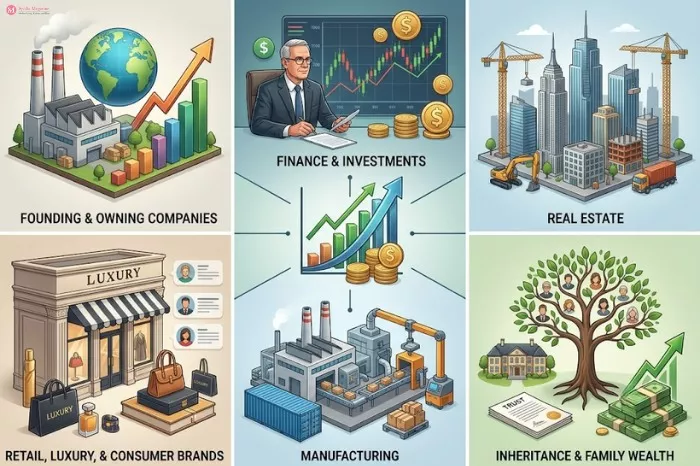
1. Founding and Owning Companies
The classic path is founding a business, keeping the equity, building value, and letting ownership create wealth. This is what we have seen from the founders of SpaceX, Google, Amazon, Meta, Oracle, Nvidia, and LVMH.
2. Finance and Investments
According to Forbes, finance and investments is one of the biggest billionaire-producing industries. It produced 464 billionaires in 2025, or about 15% of the list. Finance is a common route because owners can deploy, reinvest, and compound capital across assets.
3. Real Estate
Real estate is another common wealth builder because property can generate rent, appreciation, leverage, and collateral. Forbes data lists 206 real estate billionaires in 2025. A property in a prime location is not just an asset. It can also be an income stream and a financing tool.
4. Retail, Luxury, and Consumer Brands
Retail and luxury brands can make owners rich because of pricing power and global demand. Fashion and retail added 297 billionaires in the index, showing how premium brands and consumer businesses can create lasting fortunes. Bernard Arnault and family are one of the clearest examples.
5. Manufacturing and Industrial Businesses
Manufacturing made 342 billionaires in 2025 through scale, export reach, automation, and industrial moats. Henry Ford is a classic example from history because he used modern production methods to scale Ford Motor Company at a phenomenal pace.
6. Inheritance and Family Wealth
Inheritance is creating more billionaires than ever. According to UBS, 91 heirs inherited $297.8 billion in 2025, a record level and 36% more than 2024. The report also says there are now 860 multi-generational billionaires with total assets of $4.7 trillion.
7. Alternative Assets
Billionaires also build and preserve wealth through private equity, infrastructure, sports franchises, art collections, and other alternative assets. These are not always easy to value, but they can become important parts of a billionaire’s total net worth.
How Billionaires Use Assets to Generate More Wealth
You may not find billionaires keeping most of their wealth in idle cash because they know cash alone does not usually compound. Instead, they use cash to buy assets that can appreciate, produce income, or support borrowing.
Stocks and Equity Holdings
A rise in public company stock can move billionaire rankings faster than almost any other asset. Forbes’ real-time billionaire list updates frequently, while Bloomberg’s billionaire index tracks changes daily. A billionaire with a large stock position in one company can add billions to paper wealth after one strong trading session.
Private Businesses
Private firms are also powerful wealth-building instruments, but their value is harder to measure. Bloomberg uses public and private data, disclosed holdings, and estimated values for private companies. Funding rounds, acquisitions, and valuation changes can all affect net worth.
Real Estate Portfolios
Billionaires buy real estate in prime locations and use it to borrow, refinance, or simply hold while it appreciates. Many billionaires own expensive real estate across different markets, and this pattern has continued for years.
Venture Capital and Early-Stage Bets
A founder, angel investor, or private equity backer may buy into a company before the wider market gets access. If the company grows, gets listed, or raises funding at a higher valuation, those early stakes can become extremely valuable.
Alternative Assets
Billionaires also make money through art, private equity, infrastructure, sports franchises, and similar alternatives. Alongside investing, many wealthy individuals also build foundations, support philanthropy, and maintain art collections.
Why Billionaires Rarely Sell Their Biggest Assets
If you owned an asset with strong appreciation potential, would you sell it quickly? Most billionaires do not. Selling can mean giving up control, voting power, and future upside.
Borrowing, on the other hand, may allow them to preserve ownership while unlocking liquidity. According to Yale Budget Lab, current tax law may favor borrowing against appreciated assets over selling them.
This is where the “buy, borrow, die” strategy comes in. The idea is to keep an appreciating asset, borrow against it, and avoid realizing gains through selling. Whether someone likes or dislikes this system, it explains why billionaire wealth often stays parked in certain assets for years.
Billionaire Income vs Net Worth vs Liquid Cash
These are some of the most misunderstood financial terms, and they are often mixed up.
- Income is money earned in a year through salary, dividends, interest, or business distributions.
- Net worth is assets minus liabilities.
- Liquid cash is money available for immediate spending.
A billionaire may have a very large net worth but relatively little cash available for daily spending. That is because their wealth is usually tied to stocks, private businesses, land, real estate, and other assets.
Which Industries Create the Most Billionaires?
According to Forbes’ 2025 industry breakdown, finance and investments leads in the number of billionaires, followed by technology, manufacturing, retail, healthcare, real estate, food and beverage, media, and energy.
| Industry | Billionaires | Why It Works |
|---|---|---|
| Finance & Investments | 464 | Capital compounds directly, and large portfolios scale fast. |
| Technology | 401 | Software, platforms, AI, and chips can grow globally with low marginal cost. |
| Manufacturing | 342 | Industrial scale, automation, and exports create durable margins. |
| Fashion & Retail | 297 | Brands with pricing power can turn consumer demand into lasting wealth. |
| Healthcare | 230 | Large systems, services, and intellectual property can produce big fortunes. |
| Food & Beverage | 223 | Consumer staples and chain scale can generate long-running cash flow. |
| Real Estate | 206 | Property combines leverage, rent, and appreciation. |
| Media & Entertainment | 116 | Audience scale and rights ownership can be extremely profitable. |
| Energy | 106 | Commodity exposure and asset ownership can create vast fortunes. |
The most important thing is not only which industries create billionaires, but why they do. These industries grow through ownership, scale, and repeatable cash generation without labor being the main limit.
Why Billionaire Wealth Changes So Quickly
Billionaire net worth changes as the stock’s values change and that could happen due to various reasons such as positive or negative market news. Forbes examines this trend minute by minute while Bloomberg takes a different approach for asset coverage, update frequency, valuation methods, and treatment of debt.
Due to these factors, we witness swings in stocks of big companies like SpaceX, Meta, Oracle, Amazon, Google, Nvidia, etc. According to sources, billionaire’s wealth increased and dropped by tens of billions in a short time in 2025 owing to AI shuffles, stock rallies, and other reasons.
Self-Made vs Inherited Billionaires
Self-made billionaires become wealthy through businesses, investments, and ownership. Inherited billionaires receive wealth from family assets, trusts, company stakes, or other holdings.
The UBS 2025 report shows that nearly 200 self-made entrepreneurs became billionaires in 2025 with $386.5 billion in total wealth. At the same time, 91 heirs inherited $297.8 billion. The report also revealed that the number of multi-generational billionaires rose to 860, with $4.7 trillion in assets.
Entrepreneurship remains one of the strongest paths to billionaire status, but inheritance is also a powerful wealth-transfer engine. The world’s youngest billionaire, Johannes von Baumbach, became rich through inheritance.
How Billionaires Protect and Preserve Wealth
If someone makes money but does not protect it, they can lose control over it. Billionaires often use family offices, trusts, foundations, and succession plans to keep assets organized.
A family office may support wealth management, family affairs, philanthropy, tax planning, art collections, and long-term asset control. Billionaire money survives because it is not only invested. It is also structured.
Has the Path to Billionaire Status Changed Over Time?
Yes, the path has changed over time.
The industrial era created massive wealth through manufacturing. Henry Ford is a famous example because he transformed assembly-line production and helped make cars affordable for a mass market.
The current era is dominated by technology, finance, AI, ecommerce, software, semiconductors, capital markets, and space exploration. That is why names connected to SpaceX, Google, Amazon, Meta, Oracle, Nvidia, and Berkshire Hathaway appear so often in billionaire discussions.
People can become billionaires faster in the tech era than in many earlier periods because companies can scale globally with fewer physical limits. Software, platforms, AI infrastructure, and capital markets can create enormous value in a shorter time.
Key Takeaway
Billionaires get rich by owning assets that grow in value over time. Salary rarely makes them wealthy. Equity, compounding, reinvestment, and time are the biggest money-making factors.
Forbes data shows that finance and investments create more billionaires than any other industry, followed by technology, manufacturing, retail, and real estate. Inheritance also creates many billionaires because wealthy families hold assets for a long time and pass them to the next generation. Billionaire wealth rises and falls daily based on business growth, equity prices, markets, and valuations.
How Billionaires Make Money – FAQs
Their money comes through ownership of appreciating assets like company equity, investments, real estate, and inherited holdings.
A few of them do have a salary, particularly founders and CEOs, but that is a very small part of their total wealth. The biggest factor is ownership value.
Both are different things as net worth is calculated after deducting liabilities from assets, whereas cash is only the liquid money you can use right away to purchase anything. Billionaire’s wealth is mostly invested in stocks, private firms, land, and holdings.
Finance and investments with 464 billionaires is the industry making the highest number of billionaires followed by technology with 401, manufacturing with 342, and fashion and retail with 297, according to Forbes data.
A report from UBS informs us that 91 heirs inherited $297.8 billion in 2025, and there were 860 multi-generational billionaires with $4.7 trillion in assets.
The reason is their assets linked to public markets or valuation updates that change every minute. We can see net worth of top billionaires on Forbes and Bloomberg, though both use different metrics to evaluate the net worth.
Borrowing may result in unlocking liquidity for them without selling valued assets immediately. According to Yale’s Budget Lab, the present tax law may be beneficial for borrowing compared to selling.
Surely, it is possible but it requires excellent handling of huge amounts of capital, risking big on a few main holdings, or jumping into volatile opportunities right at the start.
These include company shares they own from the start, pieces of private businesses, real estate, publicly traded stocks, various funds, in addition to stuff like art collections or big infrastructure projects.
The price of a stock can compound far quicker than salary. Equity in a business that is growing fast can increase your wealth immediately after a strong market run. If you see Forbes billionaire tracker, you will know how some rich people add billions to their net worth in just a few hours. One prime example is Elon Musk’s net worth, depicted through image above.