

Billionaire net worth figures change with public markets, donations, stock sales, investment portfolios and tracker updates. This article uses the latest Forbes real-time billionaire snapshot reviewed for this update and treats all figures as dated estimates, not fixed personal balances.
Bill Gates and Warren Buffett are two of the few billionaires whose friendship became almost as famous as their fortunes. One built Microsoft into the software company that changed personal computing. The other turned Berkshire Hathaway into a compounding machine. But their shared legacy is not only how much money they made. It is how much of it they decided not to keep.
In the latest Forbes snapshot reviewed for this article, Warren Buffett is richer than Bill Gates. But this comparison is not just a ranking story. It is a story about ownership, patience, software wealth, investing discipline, philanthropy and the unusual friendship behind the Giving Pledge.
Is Warren Buffett Richer Than Bill Gates?
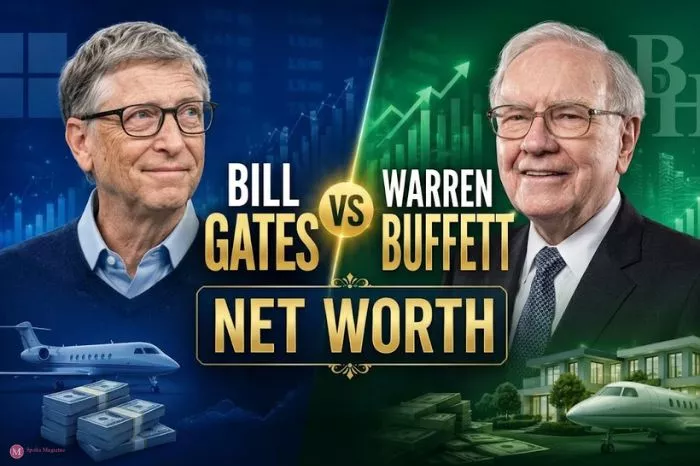
Warren Buffett is richer than Bill Gates in 2026. In the Forbes real-time billionaire snapshot reviewed for this article, Buffett was listed at about $148 billion, while Gates was listed at about $108.9 billion. That gives Buffett a lead of roughly $39 billion.
But the better story is not just who ranks higher. Buffett’s fortune remains closely tied to Berkshire Hathaway and decades of compounding, while Gates’ fortune has been reshaped by Microsoft stock reduction, diversification, the Gates Foundation and long-term philanthropy.
Bill Gates vs Warren Buffett Net Worth at a Glance
The latest ranking gives Buffett a clear lead, but the numbers only explain part of the comparison. The table below shows how their fortunes differ before we get into the deeper story.
| Category | Warren Buffett | Bill Gates |
|---|---|---|
| Estimated net worth | About $148B | About $108.9B |
| Main wealth source | Berkshire Hathaway | Microsoft and investments |
| Current ranking direction | Higher than Gates | Lower than Buffett, but still among the world’s richest people |
| Wealth style | Long-term ownership and compounding | Software wealth, diversification and philanthropy |
| Major company | Berkshire Hathaway | Microsoft |
| Philanthropy role | Giving Pledge co-founder and major donor | Gates Foundation chair and Giving Pledge co-founder |
| Key difference | Buffett’s wealth remains closely tied to Berkshire | Gates reduced Microsoft ownership and gave away large sums |
On paper, Buffett leads Gates by roughly $39 billion in this snapshot. That gap can move, but the broader pattern is clear. Buffett’s ranking is still powered by Berkshire Hathaway ownership, while Gates’ ranking reflects a fortune that has been deliberately reduced, diversified and redirected over time.
Who Is Richer, Bill Gates or Warren Buffett?
Warren Buffett is richer than Bill Gates in 2026, at least in the public billionaire snapshot reviewed for this article. Buffett was listed at about $148 billion, while Gates was listed at about $108.9 billion.
That puts Buffett ahead by roughly $39 billion. In billionaire-list terms, that is a major lead. In legacy terms, the comparison is more complicated.
Gates was once the default face of modern technology wealth. Buffett was the face of long-term investing. Both men became symbols of a different path to billionaire status. Gates built software at scale. Buffett bought and held businesses for decades. One changed personal computing. The other turned patience into one of the most powerful financial stories in American history.
How Warren Buffett Built His Fortune
Warren Buffett’s wealth is not built around salary. It is built around ownership.
Berkshire Hathaway remains the center of Buffett’s fortune. The company’s own public filings show a sprawling business built around insurance, railroads, energy, manufacturing, service businesses, retail operations and a large investment portfolio. That structure matters because Buffett’s wealth has always been tied less to annual pay and more to the long-term value of the company he built. Berkshire Hathaway’s annual filing gives the cleanest non-promotional view of that business base.
The powerful part of Buffett’s story is that it never depended on looking flashy. He did not build his image around luxury, speed or celebrity. He built it around compounding. Money stayed invested. Businesses produced cash. Berkshire reinvested. Over time, that discipline created one of the largest fortunes in the world.
That is why Spolia’s breakdown of how much Warren Buffett makes a day treats the number as wealth growth, not normal income. Buffett’s fortune is a compounding story before it is a daily-income story.
How Bill Gates Built His Fortune
Bill Gates built his fortune in a very different way. He co-founded Microsoft with Paul Allen and helped turn personal-computer software into one of the most valuable business models of the modern era.
Microsoft’s own history traces the company’s beginning to 1975, when Gates and Allen developed BASIC for the Altair 8800, the early personal computer that helped set the company’s story in motion. Microsoft’s official history is useful here because it shows how Gates’ wealth began with software before Microsoft became a global platform.
Microsoft made Gates one of the richest people alive for decades. Windows, Office and enterprise software gave the company extraordinary reach. For a long time, Gates was the name people thought of first when they thought about the richest person in the world.
But Gates’ current fortune is no longer a pure Microsoft story. He reduced his Microsoft ownership over time, diversified into other investments and moved enormous wealth toward philanthropy. That one shift explains a lot. Gates did not simply sit on his Microsoft position forever. He changed what his fortune was for.
Why Philanthropy Changed Both Rankings
This is where the Gates-Buffett comparison becomes more than a rich-list story.
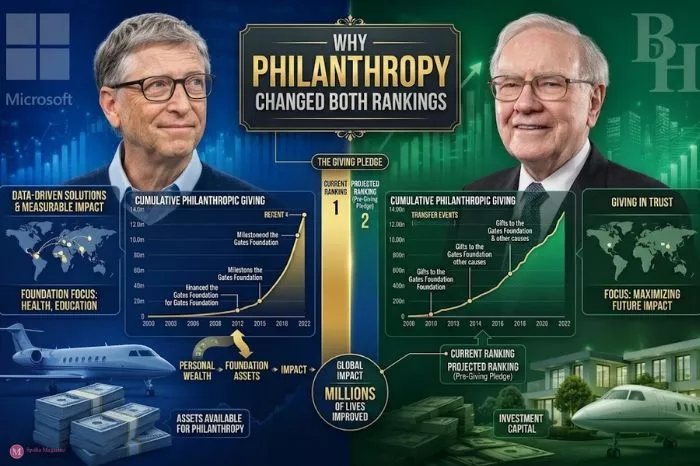
Bill Gates and Warren Buffett are both billionaires, but both also became central figures in modern philanthropy. Gates built the Gates Foundation into one of the largest private foundations in the world. Buffett pledged to give away more than 99% of his wealth and directed huge Berkshire Hathaway share gifts toward philanthropic causes.
The Gates Foundation FAQ says Bill and Melinda’s combined giving to the foundation totaled $60.2 billion by the end of 2024, while Buffett contributed $47.9 billion to the foundation’s endowment by the end of 2025.
That means both men would likely look even larger on billionaire rankings if they had kept more of what they built. Their current net worth figures show what remains after decades of ownership, giving, transfers and investment changes. They do not fully capture the amount of wealth they created or redirected.
The Gates Foundation Connection
The Gates Foundation is one of the strongest links between Bill Gates and Warren Buffett.
Gates and Melinda French Gates created the foundation in 2000 with a focus on global health, poverty, education and development. Buffett later became one of its most important outside contributors. The foundation’s endowment has been funded by Bill Gates, Melinda French Gates and Warren Buffett, which makes it more than a background detail in this comparison.
This connection matters because it changed how people understood billionaire wealth. Gates and Buffett did not only talk about giving. They built systems around it. Gates gave through an operating foundation. Buffett gave through Berkshire shares and a long-term commitment to move wealth away from himself and toward charitable work.
The emotional part is simple: two men who spent decades building some of the largest fortunes in history became linked by the decision to move much of that wealth out of private hands.
The Giving Pledge: Their Shared Billionaire Legacy
Giving Pledge is the clearest public symbol of their shared legacy.
The Giving Pledge was founded by Bill Gates, Melinda French Gates and Warren Buffett and launched in 2010 to encourage the ultra-wealthy to commit the majority of their wealth to philanthropy during their lifetimes or in their wills.
That idea was direct: people with extraordinary fortunes should publicly commit to giving away most of that wealth. It did not erase debates about billionaire philanthropy, but it did make giving a visible part of the billionaire conversation.
That is why Gates vs Buffett is different from most billionaire comparisons. With many rich-list matchups, the question is who has more. With Gates and Buffett, the deeper question is what wealth is for after a certain point.
Berkshire Hathaway Wealth vs Microsoft Wealth
Berkshire Hathaway and Microsoft created wealth in completely different ways.
Microsoft scaled through software. It built products used by individuals, businesses, governments and institutions around the world. Gates’ fortune came from creating a company that became essential to personal computing and enterprise technology.
Berkshire Hathaway scaled through capital allocation. Buffett bought businesses, held stocks, controlled insurance float and built a company that rewarded patience. Berkshire did not need to look like a technology giant to create an extraordinary fortune. It needed discipline, cash flow and time.
That difference explains the personalities too. Gates’ wealth came from building a platform. Buffett’s came from owning and compounding businesses. Gates became the symbol of software power. Buffett became the symbol of patient capital.
Why Buffett Is Still Ahead Today
Buffett is ahead of Gates today because more of his current fortune remains tied to Berkshire Hathaway’s long-term value. Gates, by contrast, owns far less Microsoft than he once did and has directed vast amounts of wealth toward the Gates Foundation and other philanthropic work.
That does not make Gates’ wealth story weaker. It makes it different. Gates traded some billionaire-list dominance for philanthropic scale. Buffett also gave away enormous sums, but Berkshire’s compounding kept his remaining fortune higher in the latest snapshot.
In simple terms, Buffett’s money stayed closer to the company that made him rich for longer. Gates’ money moved farther from Microsoft and deeper into giving, diversification and foundation work.
How They Compare With Elon Musk, Larry Page and Jeff Bezos
Gates and Buffett now sit inside a billionaire landscape that looks very different from the one they once dominated. The top of the list is increasingly shaped by technology platforms, AI infrastructure, cloud computing, private space, digital advertising and founder-controlled ownership.
That is why the richest people in the world ranking now places names like Elon Musk, Larry Page, Jeff Bezos and Mark Zuckerberg near the center of the wealth conversation.
Musk’s fortune is far more volatile because it is tied to SpaceX, Tesla and other high-growth companies. That is why Elon Musk’s net worth and Musk’s per-second wealth calculation need careful date labeling.
Larry Page is another useful comparison because he now sits far ahead of Gates in current billionaire rankings. Spolia’s Bill Gates vs Larry Page net worth analysis explains why Alphabet-linked ownership has kept Page higher while Gates’ wealth became more philanthropy-shaped.
Jeff Bezos and Mark Zuckerberg show the same modern pattern: founder ownership in giant technology companies can create extreme net worth swings. Gates and Buffett are steadier, older billionaire stories. Their rankings matter, but their legacy is bigger than market movement.
Who Had the Bigger Cultural Impact?
This part is harder to measure than net worth.
Bill Gates helped change how people used computers. Microsoft made software part of everyday life, office work and global business. Even people who never followed business news still felt Microsoft’s reach through Windows, Office and the personal-computer era.
Warren Buffett changed how people thought about investing. He made patience feel powerful. He turned annual shareholder letters, long-term business ownership and plain-spoken financial discipline into a kind of cultural language. For many investors, Buffett became proof that wealth did not have to look loud to be enormous.
So if the question is cultural impact, Gates shaped the digital workplace. Buffett shaped the way generations think about compounding, investing and restraint.
Final Verdict
Warren Buffett is richer than Bill Gates in 2026. In the public billionaire snapshot reviewed for this article, Buffett was listed at about $148 billion, while Gates was listed at about $108.9 billion.
But this comparison should not be treated like a simple scoreboard. Buffett leads in current net worth. Gates helped define the software era. Buffett built one of the greatest compounding machines in business history. Together, they helped reshape modern philanthropy through the Gates Foundation and the Giving Pledge.
Buffett has more money in the current snapshot. Gates and Buffett together changed the conversation about what billionaires should do with money once they have more than they could ever spend.
FAQs About Bill Gates vs Warren Buffett Net Worth
Warren Buffett is richer than Bill Gates in the billionaire snapshot reviewed for this article. Buffett was listed at about $148 billion, while Gates was listed at about $108.9 billion.
Warren Buffett’s net worth was listed at about $148 billion in the billionaire snapshot reviewed for this update. His main wealth source is Berkshire Hathaway.
Bill Gates’ net worth was listed at about $108.9 billion in the billionaire snapshot reviewed for this update. His fortune is linked to Microsoft, investments and decades of diversification and philanthropy.
Buffett remains richer because much of his fortune is still tied to Berkshire Hathaway, while Gates reduced his Microsoft ownership over time and gave away large amounts through philanthropy.
Yes. Bill Gates, Melinda French Gates and Warren Buffett founded the Giving Pledge, which launched in 2010 to encourage billionaires to commit the majority of their wealth to philanthropy.
The Gates Foundation says Warren Buffett contributed $47.9 billion to the foundation’s endowment as of the end of 2025. He also served on the foundation’s board of trustees for 15 years.
The Gates Foundation says Bill and Melinda’s combined giving to the foundation totaled $60.2 billion by the end of 2024. Gates has also pledged virtually all of his remaining wealth to the foundation before it closes in 2045.
Yes. Gates and Buffett have had a long public friendship and philanthropic partnership. Their relationship became especially visible through the Gates Foundation and the Giving Pledge.