
Elon Musk is currently richer than Jeff Bezos by a remarkable margin. Musk also has the stronger position in the commercial space race, while his control over companies involved in rockets, satellite internet, artificial intelligence, electric vehicles and social media gives him broader direct influence.
Bezos is not exactly fading into the background, though. Amazon remains one of the world’s most important commerce and cloud-computing businesses. Blue Origin is developing rockets and lunar hardware for NASA, while Amazon Leo is steadily building a satellite network to challenge Starlink.
So, is this rivalry already over? Not quite. Musk is clearly ahead today, but Bezos is playing a slower game. The tortoise may be some distance behind the hare, yet it is still moving.
Elon Musk vs Jeff Bezos Overview
- Elon Musk is richer than Jeff Bezos in 2026, mainly because of SpaceX, Tesla, Starlink and xAI-linked valuations. “`
- SpaceX is currently ahead of Blue Origin in the billionaire space race, with more orbital launches, stronger rocket reuse, a larger satellite internet business and deeper NASA experience.
- Jeff Bezos still holds enormous business power through Amazon, AWS, Blue Origin, Amazon Leo and long-term infrastructure investments.
- Musk has broader direct influence today because his companies operate across electric vehicles, rockets, satellite internet, artificial intelligence and social media.
- Bezos is not out of the race. Blue Origin is slower than SpaceX, but it remains a serious NASA-backed competitor with lunar ambitions and billionaire-level funding.
- The biggest difference is speed versus patience. Musk builds fast, tests publicly and takes bigger risks. Bezos builds more quietly, focusing on infrastructure and long-term scale.
- Overall winner in 2026: Musk leads in wealth, space, public visibility and emerging-tech influence, while Bezos remains stronger in e-commerce, cloud infrastructure and corporate stability.
Elon Musk vs Jeff Bezos at a Glance
| Category | Elon Musk | Jeff Bezos | Current leader |
|---|---|---|---|
| Age in June 2026 | 54 | 62 | Not applicable |
| Estimated net worth | Around $980 billion on Forbes, with some filing-based calculations exceeding $1.1 trillion | Around $250 billion on Forbes | Elon Musk |
| Main source of wealth | SpaceX and Tesla | Amazon | Elon Musk |
| Space company | SpaceX | Blue Origin | Elon Musk |
| Satellite internet business | Starlink | Amazon Leo | Elon Musk |
| Artificial intelligence exposure | xAI within the SpaceX business group | Amazon and other investments | Elon Musk |
| E-commerce and cloud infrastructure | Limited direct exposure | Amazon and AWS | Jeff Bezos |
| Social media ownership | X | None directly comparable | Elon Musk |
| Major 2026 development | SpaceX completed a record-breaking IPO | Blue Origin advanced its lunar work but suffered New Glenn setbacks | Elon Musk |
| Current space-race position | Established market leader | Serious but significantly smaller challenger | Elon Musk |
Important: Billionaire net-worth figures are estimates rather than bank balances. They can change quickly as stock prices, private-company valuations, ownership structures and analyst methodologies change.
Who Is Richer, Elon Musk or Jeff Bezos?
Elon Musk is considerably richer than Jeff Bezos in 2026.
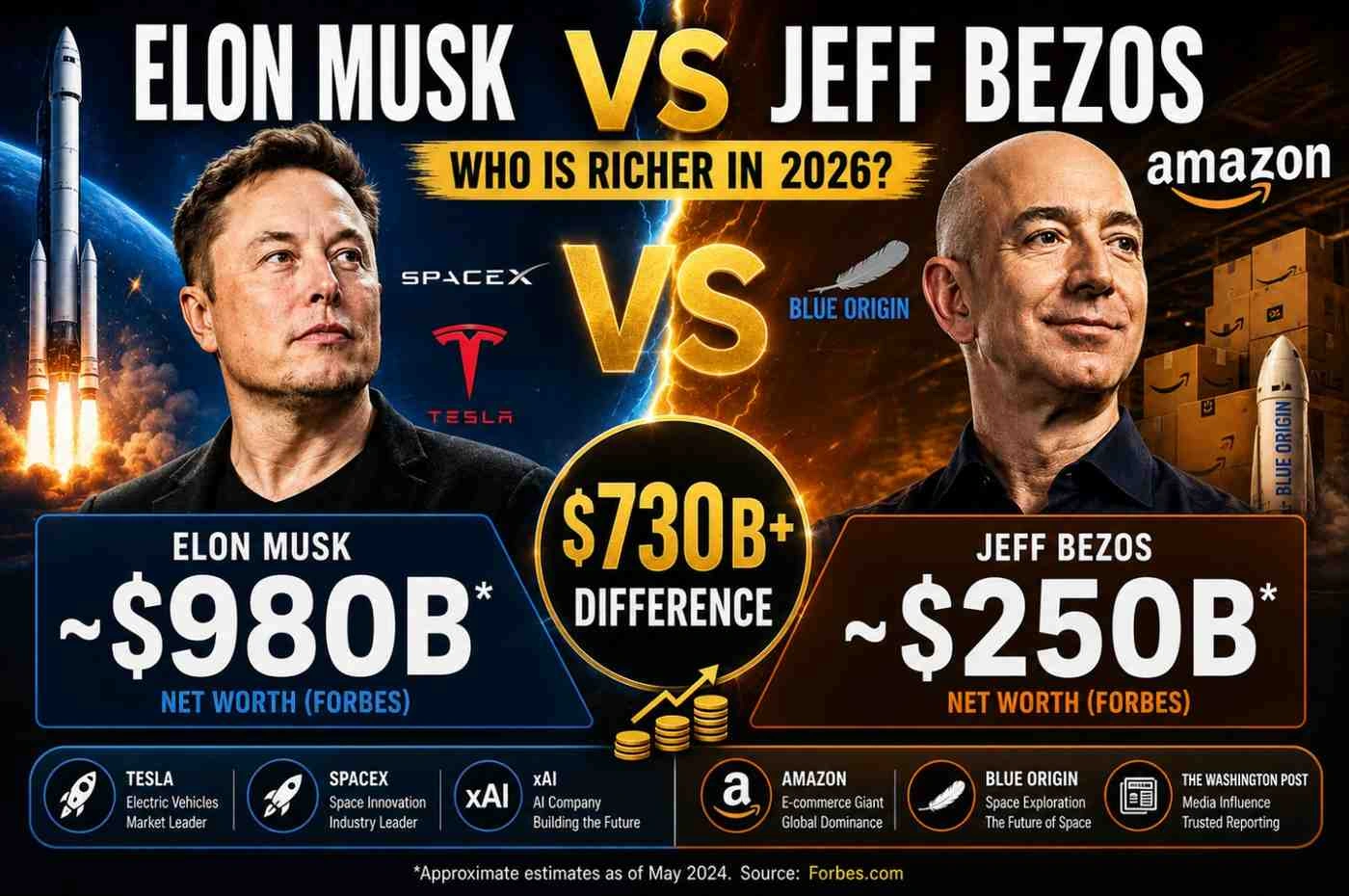
When checked on June 12, Forbes placed Musk’s real-time fortune at approximately $980 billion and Bezos’s fortune at around $250 billion. That creates a gap of more than $700 billion between them.
The exact figure attached to Musk’s name depends on how his SpaceX ownership and future stock awards are calculated. Reuters estimated that Musk’s fortune would exceed $1.1 trillion following the SpaceX IPO, including stock components scheduled to vest over time.
That does not necessarily mean Musk has more than a trillion dollars sitting in cash. Most of his fortune consists of ownership interests in companies. The value can rise or fall sharply without him selling a single share.
Bezos’s fortune works in a similar way, although it is far more closely connected to Amazon. Amazon’s public share price gives analysts a clear way to estimate much of his wealth, while Blue Origin is privately held and therefore more difficult to value precisely.
You Might be interested:
- How much money does Elon Musk make a second?
- Elon Musk Net Worth 2026
- How much does Jeff Bezos make a day?
Why Elon Musk’s Net Worth Is So Much Higher
For years, Tesla was the most visible engine behind Musk’s wealth. In 2026, SpaceX became even more important.
The SpaceX IPO changed the billionaire race
SpaceX priced its public offering at $135 per share on June 11, 2026. The company raised $75 billion and entered the market at a valuation of approximately $1.77 trillion, making it the largest initial public offering recorded in the United States.
When trading began on Nasdaq on June 12, the shares opened at $150, approximately 11% above the IPO price. That briefly pushed SpaceX’s public market value beyond $2 trillion.
Reuters calculated that Musk’s SpaceX-related interest was worth roughly $866 billion following the offering, although that estimate included stock components that would vest over time. The company’s filing also left Musk with overwhelming voting control, allowing him to retain authority even after selling shares to public investors.
This explains why Musk’s fortune has moved so far beyond Bezos’s. SpaceX is no longer valued as a promising private rocket company. Public investors now place it in the same financial league as the largest corporations in the world.
Starlink is becoming SpaceX’s commercial backbone
SpaceX is not valued only for launching rockets.
Starlink accounted for about 60% of SpaceX’s $18.67 billion in sales in 2025 and had approximately 10.3 million users by the time of the IPO. SpaceX also conducts more than two launches per week, giving it a level of operational experience that no other private launch company currently matches.
That combination matters:
- Falcon rockets generate launch revenue.
- Starlink creates recurring subscription revenue.
- Starship offers the possibility of transporting much heavier payloads.
- Government and NASA contracts provide another source of business.
- The integration of xAI adds a speculative artificial intelligence angle.
Investors are effectively betting on a connected Musk ecosystem rather than one isolated company.
Reuters has described this network as the “Muskonomy,” a group of businesses that can support, promote and potentially buy services from one another. Tesla provides manufacturing knowledge, SpaceX provides launch and communications infrastructure, xAI provides artificial intelligence capabilities, and X gives Musk direct access to a huge public audience.
Musk’s fortune is enormous, but it is not risk-free
The same concentration that makes Musk’s wealth rise quickly can also make it volatile.
SpaceX reported a net loss of approximately $4.94 billion in 2025 after recording a profit the previous year. Its spending on artificial intelligence, Starship and other capital-intensive projects remains substantial. Investors are also paying a very high price relative to the company’s current revenue.
Other risks include:
- Starship development delays
- Dependence on ambitious future technologies
- Corporate-governance concerns
- Musk’s influence over several connected companies
- Fluctuations in Tesla and SpaceX shares
- Dependence on government and commercial contracts
Musk is the clear wealth winner today, but much of that lead is tied to market confidence in what his companies could become.
How Jeff Bezos Built His Fortune
Jeff Bezos’s wealth is more straightforward.
He founded Amazon in 1994 as an online bookstore. It eventually expanded into retail, logistics, streaming, advertising, smart devices and cloud computing through Amazon Web Services.
Bezos stepped down as Amazon’s chief executive in 2021 but remains its founder and executive chairman. His Amazon shareholding is still the largest identifiable source of his fortune.
Blue Origin is important to his long-term ambitions, but it does not yet contribute to his public wealth in the same transparent way that SpaceX now contributes to Musk’s.
Because Blue Origin remains private:
- Its valuation is not updated continuously by a public market.
- Its financial results are less visible.
- Its contribution to Bezos’s fortune must be estimated.
- Rocket setbacks do not instantly affect his wealth in the way public share movements can.
This gives Bezos a more stable-looking wealth profile, but it also means Blue Origin has not produced a SpaceX-style jump in his fortune. he wealth gap widened further after Musk crossed the $1 trillion mark. For the full context, read our breakdown of Elon Musk becoming a trillionaire.
Read Also: Richest People in the World
Could Jeff Bezos Become Richer Than Elon Musk Again?
It is possible, but it would require a major change in the value of their business empires.
Bezos could narrow the gap if:
- Amazon shares experienced an exceptional long-term rise
- Amazon Leo became a valuable global satellite network
- Blue Origin developed into a major commercial launch provider
- Blue Moon secured additional government and private contracts
- SpaceX or Tesla suffered a deep and lasting valuation decline
Musk’s fortune could also fall if public markets became less enthusiastic about SpaceX’s long-term plans. A substantial decline in SpaceX shares would affect his estimated wealth far more than a normal movement in one of Bezos’s smaller private investments.
Even so, the present gap is so large that Bezos is unlikely to catch Musk through an ordinary Amazon rally. He would need either a breakthrough of his own or a severe reversal across Musk’s companies.
For the near future, Musk’s lead looks secure. Over a period of ten or twenty years, making a confident prediction would be much harder.
Elon Musk and Jeff Bezos’s Business Empires Compared
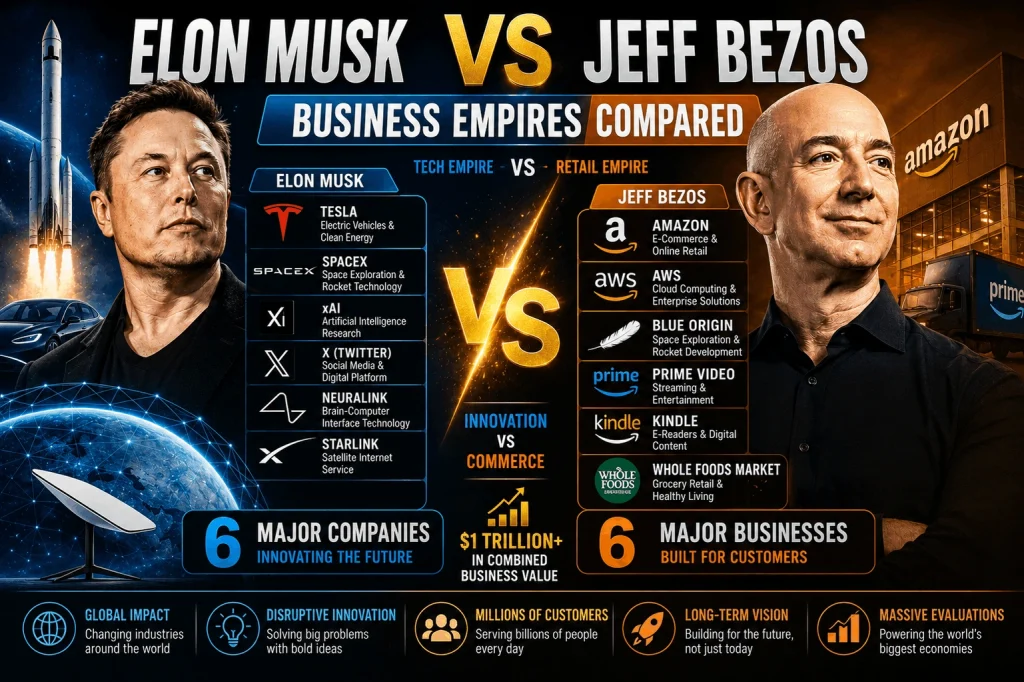
Musk and Bezos did not create the same type of business empire.
Bezos built a huge operating machine around commerce, logistics and cloud infrastructure. Musk created a more interconnected group of technology companies focused on transportation, communications, artificial intelligence and space.
| Industry | Elon Musk | Jeff Bezos |
|---|---|---|
| E-commerce | No major direct competitor to Amazon | Amazon |
| Cloud computing | Exposure through xAI and external partnerships | Amazon Web Services |
| Electric vehicles | Tesla | No directly comparable company |
| Artificial intelligence | xAI | Amazon AI operations and outside investments |
| Space launch | SpaceX | Blue Origin |
| Satellite internet | Starlink | Amazon Leo |
| Social media | X | No directly comparable platform |
| Media | X as a public communication platform | Ownership of The Washington Post |
| Robotics | Tesla Optimus and related work | Amazon warehouse and logistics robotics |
| Space tourism | Limited current focus | New Shepard program, currently deprioritized |
| Lunar systems | Starship human landing system | Blue Moon lunar lander |
| Other ventures | Neuralink and The Boring Company | Bezos Expeditions and other investments |
Who has the stronger business empire?
The answer depends on what “stronger” means.
Bezos has the more mature commercial institution. Amazon serves consumers, businesses, sellers, advertisers and cloud customers around the world. AWS is deeply embedded in the modern internet, while Amazon’s logistics network took decades to build.
Musk has the broader collection of high-growth and strategically important technologies. His companies are involved in transportation, rockets, satellite communications, artificial intelligence, robotics, brain-computer interfaces and social media.
Bezos built the more conventional corporate giant. Musk built the more unusual and personality-driven ecosystem.
At present, investors are rewarding Musk’s ecosystem with the higher valuation.
SpaceX vs Blue Origin: Who Is Winning the Space Race?
SpaceX is winning the commercial space race by a wide margin.
That conclusion is not based only on publicity or Musk’s larger fortune. It is supported by launch frequency, operational history, reusable-rocket performance, satellite deployment, customer scale and revenue.
Blue Origin has made meaningful progress, but it remains the challenger.
SpaceX’s biggest advantages
SpaceX has several advantages that would be difficult for any competitor to reproduce quickly.
1. Launch experience
Falcon 9 has become a workhorse for commercial, military, scientific and Starlink missions. SpaceX launches more than twice per week and has repeatedly reused first-stage boosters.
This cadence produces something money alone cannot buy instantly: operational experience.
Every launch gives SpaceX more information about manufacturing, refurbishment, scheduling, ground operations and risk management.
2. Starlink’s scale
Starlink is already a commercial service with millions of users. It supports households, ships, aircraft, businesses, governments and customers in areas poorly served by traditional internet infrastructure.
Amazon Leo, previously known as Project Kuiper, is building a competing low-Earth-orbit network. Amazon reported that it had deployed more than 330 satellites as its constellation expanded, but it remains far behind Starlink in satellite count, subscribers and commercial maturity.
Amazon’s resources and cloud expertise mean Leo should not be dismissed. However, it is entering a market where SpaceX has already created a powerful lead.
3. Vertical integration
SpaceX builds rockets, engines, satellites, terminals and much of its software internally.
It can launch its own Starlink satellites rather than relying entirely on an outside provider. Amazon Leo, in contrast, uses several launch companies, including Blue Origin and other providers.
This creates an awkward twist in the rivalry: Blue Origin is expected to help launch a satellite network designed to compete with a SpaceX business, but delays at Blue Origin can also slow Amazon’s deployment.
4. Government and NASA experience
SpaceX transports astronauts and cargo for NASA and works with the United States government on national-security missions.
Blue Origin has secured important NASA and defense contracts, but it has not yet achieved SpaceX’s scale of completed orbital work.
Is Blue Origin Catching SpaceX?
Blue Origin is making real progress, even though recent setbacks have widened the gap.
New Glenn reached orbit on its first flight in January 2025. That was an important milestone because Blue Origin had spent years developing the heavy-lift rocket.
In April 2026, a reused New Glenn booster landed successfully following the rocket’s third mission. However, the upper stage failed to place an AST SpaceMobile satellite into its intended orbit. The satellite was left too low to operate and later re-entered the atmosphere. The Federal Aviation Administration ordered an investigation.
A more damaging incident followed on May 28, when a New Glenn rocket exploded during a hot-fire test at Blue Origin’s Florida launch site. No one was injured, and the planned Amazon Leo satellites had not yet been installed. However, the rocket was destroyed and the launchpad was damaged.
Blue Origin said it intended to return New Glenn to flight before the end of 2026. The repair schedule and investigation will determine whether that target is realistic.
This does not mean Blue Origin has failed as a company. Developing a reusable heavy-lift rocket is extremely difficult, and SpaceX has suffered dramatic failures of its own. The difference is that SpaceX already has an established Falcon launch business to rely on while developing Starship. Blue Origin does not have the same operational cushion.
Who Is Ahead in the Race to the Moon?
The lunar race is more competitive than the general commercial launch market.
NASA is supporting both SpaceX and Blue Origin as it develops the next generation of human lunar landers.
SpaceX is building a lunar version of Starship. Blue Origin is developing its Blue Moon system.
NASA’s updated plan for Artemis III, scheduled for 2027, involves testing lander pathfinders from both companies in low-Earth orbit. Under the planned sequence, astronauts aboard Orion will dock with a Blue Origin test article and later with a SpaceX Starship test article to evaluate systems before future lunar landing missions.
NASA selected SpaceX for its original human landing system contract in 2021. Blue Origin challenged the decision, but the protest was rejected. NASA later selected Blue Origin in 2023 to develop another lunar landing system, giving the agency a second provider and reducing its dependence on one company.
NASA has also identified Blue Origin’s uncrewed Blue Moon Mark 1 lander for a planned Moon Base I cargo mission no earlier than fall 2026, although Blue Origin’s launchpad damage could affect schedules.
SpaceX’s lunar strengths
- More orbital launch experience
- A larger engineering and testing operation
- Greater launch frequency
- Existing NASA crew-transport experience
- Starship’s planned heavy-payload capacity
- Stronger access to capital after the IPO
Blue Origin’s lunar strengths
- A lander designed specifically around lunar operations
- Strong financial backing from Bezos
- Direct support through NASA contracts
- A more focused lunar strategy
- New Glenn and Blue Moon systems designed to work together
- A patient development philosophy
Neither company has completed the human lunar-landing systems required for a full Artemis Moon landing.
SpaceX is ahead overall, but Blue Origin could still achieve an important lunar milestone first. That is one reason the rivalry has intensified again.
SpaceX vs Blue Origin Scorecard
| Measure | SpaceX | Blue Origin | Winner |
|---|---|---|---|
| Orbital-launch history | Extensive | Limited but growing | SpaceX |
| Launch frequency | More than two per week | Far lower | SpaceX |
| Reusable orbital boosters | Operational at scale | Demonstrated with New Glenn but not at comparable scale | SpaceX |
| Satellite network | Starlink with millions of users | Amazon Leo under deployment | SpaceX |
| Human spaceflight | NASA orbital crew missions | New Shepard suborbital flights | SpaceX |
| Heavy-lift future system | Starship | New Glenn | SpaceX currently |
| NASA lunar role | Starship lander | Blue Moon lander | Both selected |
| Recent reliability | Proven Falcon fleet, ongoing Starship development risks | New Glenn upper-stage failure and launchpad explosion | SpaceX |
| Financial resources | Record IPO and public investor access | Backed by Bezos and government contracts | SpaceX |
| Overall position | Market leader | Serious challenger | SpaceX |
How the Elon Musk and Jeff Bezos Rivalry Began
The rivalry did not start in 2026. It has been developing for more than two decades.
2000 to 2002: Two space companies emerge
Bezos founded Blue Origin in 2000. Musk founded SpaceX in 2002.
Both men wanted to reduce the cost of reaching space, but their long-term visions were different.
Musk focused on making humanity a multiplanetary species, with Mars as the central destination for much of SpaceX’s history.
Bezos spoke about moving heavy industry away from Earth and supporting large human populations living and working in space.
2004: An uncomfortable meeting
Musk and Bezos reportedly met for dinner in 2004, when both space companies were still young. Later accounts suggest the discussion revealed how differently the two men thought about rocket development.
Whatever happened at that dinner, it did not lead to collaboration.
2013 and 2014: Launchpad and patent disputes
Their competition became more formal as SpaceX and Blue Origin fought over access to launch infrastructure and reusable-rocket technology.
The companies competed over the use of NASA’s historic Launch Complex 39A. They also became involved in a patent dispute concerning the landing of rocket boosters on platforms at sea.
SpaceX eventually became the user of Launch Complex 39A and developed drone-ship landings into a regular part of its Falcon program.
2015: Who landed first?
Blue Origin successfully landed its New Shepard booster after a suborbital flight in November 2015.
SpaceX landed a Falcon 9 first stage following an orbital-class mission the following month.
Both were major achievements, but they were not technically identical. New Shepard completed a suborbital flight, while Falcon 9 delivered payloads toward orbit before its booster returned.
That distinction produced another round of public one-upmanship.
2019: Starlink meets its future rival
Amazon announced Project Kuiper, now called Amazon Leo, as a planned low-Earth-orbit broadband constellation.
Musk responded publicly by accusing Bezos of copying the Starlink concept. The competition had expanded beyond rockets into satellite internet.
2021: The NASA lander fight
NASA selected SpaceX to develop the initial lunar human landing system for Artemis.
Blue Origin protested the decision and later pursued a legal challenge. The challenge was unsuccessful, while Musk publicly mocked Bezos’s attempt to overturn the award.
NASA later selected Blue Origin as a second lander provider in 2023.
2026: The tortoise returns
The rivalry regained attention in early 2026 after Bezos posted an image of a tortoise.
Space observers interpreted it as a reference to the tortoise and the hare, as well as Blue Origin’s Latin motto, Gradatim Ferociter, commonly translated as “step by step, ferociously.”
The message was difficult to miss. SpaceX may be the faster company, but Bezos wants Blue Origin to be judged over a much longer race.
Musk, meanwhile, shifted more attention toward establishing a self-growing settlement on the Moon while maintaining that Mars remained part of SpaceX’s future.
Musk vs Bezos: Two Very Different Business Styles
The contrast between Musk and Bezos is not simply fast versus slow, although that is part of it.
Elon Musk’s approach
Musk tends to:
- Announce ambitious goals publicly
- Set aggressive timelines
- Accept visible testing failures
- Integrate his businesses around shared technology
- Use social media to influence public attention
- Make the founder central to the brand
His companies frequently test hardware in public, learn from failures and move quickly into the next version.
This can accelerate innovation, but it also creates uncertainty. Timelines slip, priorities change and the companies remain closely associated with Musk’s personality.
Jeff Bezos’s approach
Bezos has traditionally emphasized:
- Long-term investment
- Process and operational discipline
- Infrastructure before expansion
- Patience with projects that take years to mature
- Building systems that can operate beyond the founder
Amazon is the strongest evidence for this approach. It absorbed years of investment before becoming the enormous commercial platform it is today.
Blue Origin has followed the patient side of that model, but not always the operational success. Moving slowly is valuable only when it eventually produces reliable hardware. The pressure on Blue Origin in 2026 is to prove that patience can translate into a repeatable launch business.
A useful way to describe the contrast is this:
Musk gets attention through collision. Bezos gets it through contrast.
Musk makes noise, changes direction and pulls several industries into the same conversation. Bezos speaks less often and allows Amazon’s scale or Blue Origin’s milestones to carry more of the message.
Who Is More Powerful, Elon Musk or Jeff Bezos?
“Power” is harder to measure than wealth.
To compare it fairly, we need to look at control over important systems, public influence, political access, commercial reach and the ability to direct capital toward new industries.
Where Musk has more influence
Musk has direct influence across:
- Electric vehicles through Tesla
- Orbital launches through SpaceX
- Satellite communications through Starlink
- Artificial intelligence through xAI
- Social media through X
- Emerging brain-interface technology through Neuralink
- Public policy discussions through his political involvement
The combination of X and his enormous online following also allows Musk to shape news cycles directly instead of depending on traditional media.
SpaceX’s relationships with NASA, the United States military, telecommunications customers and foreign governments increase his strategic importance. Starlink can be particularly influential because communications infrastructure matters during emergencies, conflicts and natural disasters.
Where Bezos has more influence
Bezos remains deeply influential through:
- Amazon’s global retail marketplace
- Amazon Web Services
- Logistics and delivery infrastructure
- The Washington Post
- Blue Origin
- Amazon Leo
- Investments made through Bezos Expeditions
- Climate and philanthropic initiatives
AWS alone supports a vast number of businesses and online services. Amazon also affects how products are sold, advertised, stored and delivered.
Bezos therefore has extraordinary institutional influence. Much of it operates through a mature corporation rather than his daily public personality.
Influence scorecard
| Type of influence | Current leader |
|---|---|
| Personal wealth | Elon Musk |
| Space-launch infrastructure | Elon Musk |
| Satellite communications | Elon Musk |
| Social-media reach | Elon Musk |
| Artificial intelligence visibility | Elon Musk |
| Electric vehicles | Elon Musk |
| E-commerce | Jeff Bezos |
| Cloud infrastructure | Jeff Bezos |
| Logistics infrastructure | Jeff Bezos |
| Public and political visibility | Elon Musk |
| Current overall direct influence | Elon Musk |
My conclusion is that Musk currently has broader direct power because he controls or strongly influences more systems at the center of emerging technology and public debate.
Bezos may have the more stable institutional base. Musk has the larger ability to alter markets and conversations quickly.
Read Also: Most Famous People in the World
Education and Early Background
Their educational paths also reflect their contrasting public images.
Musk studied physics and economics at the University of Pennsylvania. He later entered Stanford University but left the graduate program after only a short period to pursue opportunities connected to the early internet.
Bezos graduated from Princeton University in 1986 with a degree in electrical engineering and computer science. Princeton records show that he graduated with high honors and was elected to Phi Beta Kappa.
Musk’s story is usually told as one of migration, experimentation and risk. Bezos’s early career followed a more structured route through engineering, finance and eventually Amazon.
Neither route alone explains their success, but the contrast fits the businesses they later built.
Final Verdict: Is Elon Musk or Jeff Bezos Winning?
Elon Musk is winning the billionaire rivalry in 2026.
He is richer by more than $700 billion under Forbes’s current estimates. SpaceX has a commanding lead over Blue Origin in launch frequency, reusable-rocket operations, satellite internet and commercial scale. Musk also has broader direct influence through Tesla, SpaceX, Starlink, xAI and X.
Jeff Bezos still wins in two major areas: established e-commerce and cloud infrastructure. Amazon is a more mature and institutionally developed company than any single Musk business. Bezos also has the patience, capital and NASA relationships required to keep Blue Origin in the space race.
But this article is about who is ahead now, not who may be ahead several decades from now.
The present score is clear:
- Richer: Elon Musk
- More publicly influential: Elon Musk
- Stronger space company: Elon Musk
- Leading satellite network: Elon Musk
- Stronger e-commerce and cloud empire: Jeff Bezos
- Overall 2026 winner: Elon Musk
Bezos may identify with the tortoise, but Musk’s hare is not sleeping under a tree. It has just taken SpaceX public, raised $75 billion and built a lead that will be extremely difficult to close.
Frequently Asked Questions
Elon Musk is much richer than Jeff Bezos in 2026. Forbes estimated Musk’s real-time net worth at roughly $980 billion and Bezos’s at around $250 billion when checked on June 12. Reuters calculated that Musk’s fortune could exceed $1.1 trillion when certain SpaceX stock components were included.
Most of Musk’s current lead comes from the extraordinary valuation of SpaceX, combined with his ownership in Tesla and other companies. The SpaceX IPO valued the company at approximately $1.77 trillion before its shares opened above the offering price.
They are better described as business rivals than friends. Their companies have competed over launch facilities, reusable-rocket patents, NASA contracts, satellite internet and lunar missions. They have also exchanged public criticism and jokes over the years.
Yes, based on current commercial and operational measures. SpaceX launches far more frequently, has completed many more orbital missions, operates Starlink and transports astronauts for NASA. Blue Origin has made progress with New Glenn and Blue Moon but remains considerably behind.
It is possible for Blue Origin to complete a particular lunar milestone before SpaceX, especially because both companies are developing different systems under changing NASA schedules. However, SpaceX has the stronger overall launch operation and more orbital experience.
Starlink is SpaceX’s operational satellite internet service with millions of users. Amazon Leo, previously called Project Kuiper, is Amazon’s developing low-Earth-orbit broadband network. Amazon has deployed hundreds of satellites, but Leo remains much smaller than Starlink.
The tortoise was widely interpreted as a reference to the fable of the tortoise and the hare and Blue Origin’s gradual development philosophy. It also fits the company’s motto, Gradatim Ferociter, or “step by step, ferociously.”
Both have strong academic backgrounds. Musk earned degrees in physics and economics from the University of Pennsylvania. Bezos graduated from Princeton with a degree in electrical engineering and computer science. Their education differs, but there is no objective basis for saying one is categorically better.
Last fact-checked: June 12, 2026