

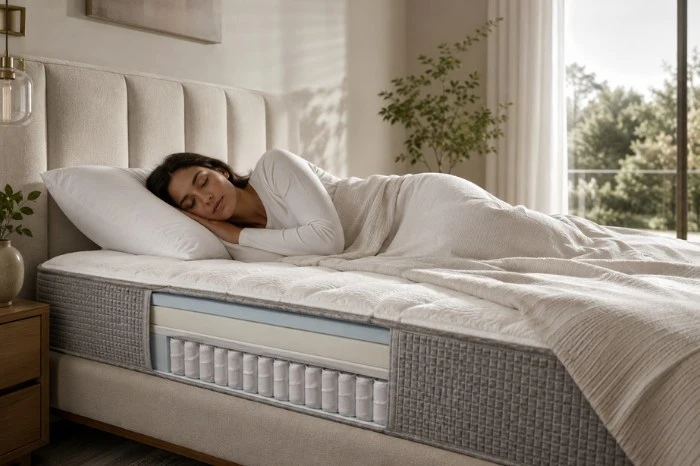
A mattress can feel right in a showroom and wrong overnight. Comfort depends on how you sleep, how deeply your body compresses the surface, and whether the bed supports your spine without creating pressure at the shoulders, hips, or lower back.
The best mattress is not automatically the softest or firmest. It is the one that fits your sleep position, body weight, temperature preferences, and bedroom setup. A comfortable bed also works best inside a cool, quiet environment supported by broader healthy lifestyle habits.
Which Mattress Is Best for Your Sleep Position?
Side sleepers need cushioning for the shoulders and hips. Back sleepers need balanced support beneath the waist and pelvis. Stomach sleepers generally need a firmer surface that limits hip sink. Combination sleepers benefit from a responsive mattress that makes turning easy.
| Sleeper type | Starting firmness | Useful materials | Main need |
|---|---|---|---|
| Side | Medium-soft to medium | Memory foam, softer hybrid | Pressure relief |
| Back | Medium to medium-firm | Hybrid, latex, adaptive foam | Lumbar support |
| Stomach | Medium-firm to firm | Dense foam, latex, firm hybrid | Hip support |
| Combination | Medium | Responsive hybrid or latex | Easy movement |
| Couples | Medium or split firmness | Pocket-coil hybrid, foam | Motion isolation |
These are starting points. A heavier sleeper may experience the same mattress as softer, while a lighter sleeper may find it firmer because the comfort layers compress less.
Best Mattress for Side Sleepers
Side sleeping concentrates weight around the shoulders and hips. A mattress that is too firm can create pressure; one that is too soft may let the midsection collapse.
Start with a medium-soft or medium mattress with a conforming comfort layer. Memory foam offers close pressure relief, while a hybrid adds airflow and stronger edges. Higher-weight side sleepers may prefer a supportive medium-firm model with a thicker comfort layer.
Best Mattress for Back Sleepers
Back sleepers usually do well on a medium to medium-firm surface. The mattress should fill the natural curve of the lower back without allowing the pelvis to sink too far.
Hybrids, latex, and responsive foam can all work. Look for even support rather than relying on vague “orthopedic” claims. Johns Hopkins Medicine notes that sleep-position comfort is individual and recommends experimenting with supportive mattresses and pillows.
Best Mattress for Stomach and Combination Sleepers
Stomach sleepers typically need firmer support because excessive hip sink can increase the arch in the lower back. A medium-firm or firm latex, dense foam, or hybrid mattress is a sensible starting point. A thinner pillow may also reduce neck extension.
Combination sleepers need responsiveness. Slow-sinking foam can make turning harder, while latex and coil-supported hybrids recover faster. Choose a balanced medium feel unless one position clearly dominates your night.
What If You Have Back Pain?
A mattress may influence comfort, but cannot treat every cause of back pain. A randomized trial indexed by PubMed found that medium-firm mattresses performed better than firm mattresses for adults with chronic, nonspecific low-back pain. This supports medium-firm as a starting point, not a universal prescription.
Seek medical advice for pain that persists, worsens, follows an injury, or appears with weakness, numbness, fever, or bladder or bowel changes.
Mattress Materials Compared
Memory foam contours closely and isolates movement well, but it can retain heat and feel slow to respond.
Latex feels buoyant and breathable. It suits combination sleepers and people who dislike deep sink, although it is often heavy and expensive.
Hybrid mattresses combine foam or latex with coils. They can balance pressure relief, airflow, edge support, and movement, but quality varies.
Traditional innersprings feel bouncy and ventilated, yet thin comfort layers may provide less pressure relief.
Before paying more, apply the same material-honesty checks used to identify good-quality furniture. A high price does not automatically prove better construction, as SpoliaMag’s guide to why furniture can be so expensive explains.
How to Buy a Mattress Without Regret
Check the sleep-trial rules, including break-in periods, pickup fees, exchange limits, and opened-product returns. Read the warranty exclusions and confirm which bed base is required.
Measure the room, doorway, stairs, and frame. This matters in a tiny bedroom, where an oversized mattress can reduce walking space and storage.
Check the permanent manufacturer label. The U.S. Consumer Product Safety Commission explains that mattresses sold in the United States must meet federal flammability and labeling requirements.
Common Mattress-Buying Mistakes
Do not treat firmness numbers as universal; one brand’s “6” may feel different from another’s. Avoid buying solely from a five-minute showroom test, a dramatic discount, or the word “orthopedic.”
Also consider your pillow, foundation, partner, and room temperature. Research on nighttime temperature and sleep shows that the wider sleep environment affects rest, so a “cooling” mattress cannot fix an overheated bedroom.
Final Recommendation
Choose by function, not hype. Start with your dominant sleep position, adjust for body weight and temperature, compare material behavior, and use a meaningful home trial. Once the mattress is right, breathable bedding, softer lighting, less clutter, and other simple bedroom makeover ideas can help the room support better rest. Since every sleep position creates different pressure points, it can also help to look beyond position alone. General mattress buying guides often cover firmness, support, body type, and comfort needs together, which makes the final choice easier to compare.
Frequently Asked Questions
Medium to medium-firm is a practical starting range because it balances cushioning and support. Sleep position, body weight, pain, and preference may shift the ideal feel.
Memory foam usually contours more closely. A hybrid can offer similar pressure relief with greater airflow, bounce, edge support, and easier movement.
Not automatically. Evidence has favored medium-firm over firm mattresses for chronic nonspecific low-back pain, although individual needs differ.
Latex and coil-based hybrids are useful starting points because they generally allow more airflow. Breathable bedding and a comfortably cool room matter too.
Yes. Consider a medium hybrid, split firmness, or two Twin XL mattresses together. Motion isolation and edge support are especially useful.
A topper can add cushioning, but it cannot repair deep sagging, broken coils, weak support, or a mattress that is fundamentally too soft.