

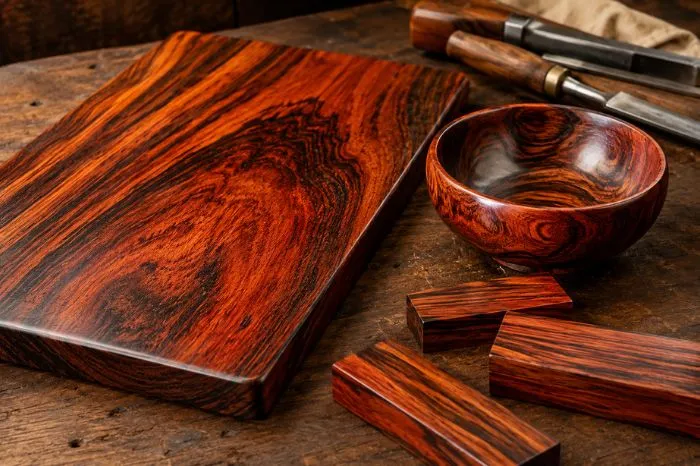
Cocobolo wood is one of the most striking rosewoods in the world. It comes from Central American trees in the Dalbergia family, most often Dalbergia retusa, and is known for its dense body, natural oils, dark dramatic grain and deep reddish-brown color.
For woodworkers, collectors, furniture lovers and instrument makers, cocobolo sits in a rare category. It is beautiful enough for luxury objects, hard enough for long-lasting use, and scarce enough to raise serious questions about sourcing, legality and conservation.
That is why cocobolo is not just another exotic hardwood. It is a wood with a complicated story: admired for its beauty, prized by artisans, restricted in trade, and increasingly difficult to buy responsibly.
What Is Cocobolo Wood?
Cocobolo is a dense tropical hardwood produced by trees in the Dalbergia genus. The species most commonly linked with the commercial name cocobolo is Dalbergia retusa, a Central American rosewood known for its rich color, heavy weight and oily surface.
The heartwood is the part that gives cocobolo its reputation. It can appear orange, red, reddish-brown, golden brown, dark brown or almost black, often with irregular streaks running through the grain. Some pieces also show purple or yellow tones, especially when freshly cut or sanded.
Over time, the color usually deepens. That aging process is one reason old cocobolo pieces often have a warm, serious look that feels different from newly cut wood. A polished cocobolo surface can look almost glassy, not because it is coated heavily, but because the wood itself contains natural oils and has a strong luster.
This is also why cocobolo is often grouped with rare, expensive and decorative woods rather than ordinary construction lumber. It is not the kind of material most people use for a basic shelf or budget desk. It is usually reserved for pieces where the wood itself is part of the story.
| Detail | Answer |
|---|---|
| Main species | Dalbergia retusa |
| Wood family | Dalbergia / rosewood group |
| Native region | Central America |
| Main colors | Orange, red, brown, black, sometimes purple streaks |
| Finish | Naturally glossy because of oils |
| Common uses | Fine furniture, desks, musical instruments, pens, knife handles, bowls |
| Main issue | Rare, regulated, difficult to source responsibly |
| Trade status | CITES Appendix II |
| Buyer warning | Ask for provenance and documentation |
Where Cocobolo Wood Comes From
Cocobolo is native to Central America. It is associated with dry tropical forest regions and is most often discussed in connection with countries such as Costa Rica, Panama, Nicaragua, Guatemala and Mexico.
The tree is not enormous compared with many commercial hardwoods. That matters because small or medium-sized trees do not always produce the wide, clean boards needed for large furniture pieces. For this reason, cocobolo is more commonly seen in smaller luxury objects than in full-size furniture.
A small pen, knife handle, instrument part or bowl can display the beauty of cocobolo with relatively little material. A full cocobolo desk, however, requires larger, more carefully selected stock. That difference helps explain why cocobolo furniture can become expensive so quickly.
Why Cocobolo Wood Is Rare
Cocobolo is rare because demand has historically moved faster than responsible supply. The wood’s color, density and luxury appeal made it desirable for furniture makers, instrument makers, turners and collectors. That demand placed pressure on wild trees, especially in regions where enforcement was weak or illegal logging became profitable.
Another reason is slow replacement. Cocobolo does not behave like a fast plantation softwood that can be grown, harvested and replaced quickly. Large, usable heartwood takes time. When mature trees are removed from the wild, the forest does not simply replace them within a few seasons.
There is also the issue of board size. A cocobolo tree may produce beautiful wood, but not every log gives wide, clear, furniture-grade boards. That makes large pieces more selective, more waste-sensitive and more expensive.
This is why responsible buyers should treat cocobolo differently from ordinary hardwood. Its rarity is not just a marketing phrase. It is connected to conservation pressure, sourcing difficulty and the limited amount of suitable material available for high-end work.
Why Cocobolo Wood Is So Expensive
Cocobolo is expensive because several price-driving factors meet in one material. It is visually dramatic, naturally dense, difficult to source in large pieces, legally sensitive to trade, and still wanted by collectors and makers who appreciate rare wood.
The color alone gives it strong market value. Cocobolo can show red, orange, brown, black and purple streaks in the same board. That kind of figure makes even small pieces feel decorative. When used in desks, cabinets, instruments or presentation objects, the wood becomes a design feature rather than a hidden structural material.
Density also plays a role. Cocobolo is heavy and hard. That makes it feel substantial in the hand and gives it long-lasting appeal, but it also makes the wood harder on tools and less forgiving for inexperienced workers.
The biggest cost factor, however, is supply. Cocobolo is limited, regulated and not easy to source responsibly. If a seller is offering a large new cocobolo item at a surprisingly low price, buyers should slow down and ask questions.
Color, Grain, Density and Natural Oils
The first thing people usually notice about cocobolo is the color. It can look fiery when freshly cut, with bright orange or red tones, then become darker and richer with age. The grain can move from straight to interlocked, with dark lines that make the surface look layered and almost liquid.
Cocobolo also has a fine texture and natural luster. When properly worked and polished, it can develop a smooth sheen that feels more refined than many ordinary hardwoods.
The natural oils are part of this beauty, but they also create practical challenges. They help the wood resist moisture movement and contribute to its glossy surface, but they can interfere with gluing and finishing. A woodworker has to understand the material before treating it like walnut, maple or oak.
That combination of beauty and difficulty is central to cocobolo’s reputation. It is not popular because it is easy. It is popular because, when handled well, it can produce objects that look and feel unusually rich.
Is Cocobolo Wood Legal to Buy?
Cocobolo is not automatically illegal to own. If someone already has a vintage cocobolo box, desk, instrument or decorative object, ownership by itself is not the issue. The more important question is how the wood was sourced and whether it is being moved across borders.
International trade in cocobolo and other Dalbergia woods can be regulated under CITES rules. In practical terms, that means buyers and sellers may need documentation, permits or proof of legal origin depending on the item, the country, the date, the shipment route and the amount of regulated wood involved.
This matters most when buying newly made pieces, expensive furniture, raw lumber, veneer, or any item that will be imported or exported. A large cocobolo desk is not the same as a small souvenir. The bigger, newer and more expensive the item, the more seriously documentation should be taken.
For ordinary buyers, the safest rule is simple: do not buy high-value cocobolo without asking where it came from. A responsible seller should be able to discuss species, provenance and legal sourcing without becoming vague.
CITES, IUCN and Ethical Sourcing
Cocobolo’s legal and ethical status is one of the most important parts of its story. The same qualities that make the wood desirable have also made it vulnerable to overharvesting. This is why cocobolo appears in conservation and trade discussions around rosewood.
Buyers should avoid thinking in simple labels such as “legal” or “illegal.” A vintage documented piece may be perfectly reasonable to own. A newly made item with no origin details may be more concerning. A small finished object may be treated differently from raw wood or a large furniture shipment.
Ethical sourcing means looking beyond the beauty of the finished object. Ask whether the wood is old stock, salvaged, plantation-grown, legally imported, or part of a documented vintage piece. If the seller cannot answer, that uncertainty should affect the price and your willingness to buy.
For collectors, vintage cocobolo with clear provenance is often the more defensible choice. It preserves an existing object without encouraging fresh undocumented harvesting. For makers, small legally sourced pieces are easier to justify than large undocumented boards.
Common Uses of Cocobolo Wood
Cocobolo is rarely wasted on ordinary objects. Because the wood is expensive and often available in smaller pieces, it is most often used where color, density and touch matter.
In furniture, cocobolo appears in desks, cabinets, decorative panels, drawer fronts and statement pieces. In music, it is valued for selected instruments and components where dense hardwood can add beauty, feel and tonal character. In smaller luxury objects, it is used for pens, knife handles, bowls, chess pieces, cue sticks, boxes, jewelry and other cocobolo wood collectibles.
That smaller scale is part of its modern identity. A full cocobolo table or desk is rare because wide, clean boards are difficult to source. A pen, handle, ring or instrument part can show the same dramatic grain with far less material.
Cocobolo Desks and Furniture
A cocobolo desk is one of the most recognizable cocobolo furniture pieces today. It combines the material’s visual drama with the status of a large office object. That is also why the phrase became familiar to many people through Better Call Saul, where a cocobolo desk works as a symbol of ambition, status and expensive professional taste.
In the real furniture market, cocobolo desks are not common. Some are solid wood, some use veneer, and some are vintage or designer pieces where maker, condition and provenance matter as much as the material itself.
Collectors should be especially careful with large furniture. A seller may describe a desk as cocobolo when it is actually cocobolo veneer, rosewood-style veneer, or another dark figured wood. Veneer is not automatically bad, but it should not be priced like a full solid cocobolo piece.
Cocobolo Wood Collectibles
Cocobolo’s rarity makes it attractive to collectors, but the best collectibles are not always the largest ones. In fact, smaller objects often make more sense because they use less wood while still showing the material’s color and figure.
Pens, chess boards, knife handles, guitar parts, bowls, rings and boxes can all give a collector the pleasure of cocobolo without the cost, weight and legal complexity of a large furniture item.
The buyer’s responsibility remains the same: ask what species was used, whether the piece is old or newly made, and whether the seller can explain the origin of the material. A beautiful object should still have a responsible story behind it.
Famous Cocobolo Wood Designers and Artisans
Cocobolo has been used by artists and designers who understood that rare wood can carry more than function. In the right hands, it becomes sculpture, furniture, craft and cultural object at the same time.
Don S. Shoemaker and Mexican Modernist Furniture
Don S. Shoemaker is one of the names most closely associated with collectible cocobolo furniture. An American-born designer who built much of his career in Mexico, Shoemaker became known for furniture that blended modernist forms with richly figured tropical woods.
His cocobolo desks, tables, chairs and decorative objects are now part of the high-end vintage design market. When a Shoemaker piece includes labels, invoices or strong provenance, the value can rise well beyond the material cost of the wood itself.
This is an important lesson for collectors. With cocobolo furniture, price is not only about the wood. It is also about designer, period, condition, originality, documentation and market demand.
Wharton Esherick and Sculptural Woodwork
Wharton Esherick is another name that belongs in a serious conversation about wood as art. Known for sculptural furniture and expressive carved forms, Esherick helped push American woodworking beyond simple utility.
His work shows why a wood like cocobolo can appeal to artists as much as furniture makers. The material has color, density and presence. It can become an object of use, but it can also become an object of attention.
For a premium magazine audience, this is the deeper appeal of cocobolo. It is not merely expensive. It belongs to the world where material, craft, scarcity and taste meet.
Why Cocobolo Is Difficult to Work With
Cocobolo is admired by experienced makers, but it is not an easy beginner wood. Its density can dull tools. Its interlocked grain can tear during planing. Its natural oils can interfere with glues and finishes. Its color can also bleed into surrounding wood if a finish is applied carelessly.
Those oils are part of what makes cocobolo beautiful, but they demand patience. A maker may need careful surface preparation, sharp tools, proper sealing and finishing methods designed for oily tropical hardwoods.
There is also a health issue. Cocobolo dust is known to irritate some woodworkers. Cutting, sanding or turning cocobolo should be done with proper dust collection, respiratory protection, eye protection and gloves where appropriate.
This is why many high-quality cocobolo pieces are made by specialists. The wood can reward skill, but it does not forgive careless work.
How to Care for Cocobolo Wood
Caring for cocobolo is mostly about restraint. Because the wood already contains natural oils, heavy treatments are not always necessary and may even cause problems if used without understanding the finish already on the piece.
For a finished cocobolo object, start with a soft dry cloth. Avoid harsh cleaners, soaking water, direct sunlight and extreme humidity swings. If the item is valuable, vintage or designer-made, do not sand, oil or refinish it casually.
For furniture, the safest approach is to treat it like a collectible, not a disposable surface. Use coasters, avoid heat marks, keep it away from standing water and ask a furniture conservator before attempting major restoration.
For small objects such as pens, handles or bowls, gentle cleaning is usually enough. The goal is to preserve the wood and the finish, not to make it look newly manufactured forever.
Best Cocobolo Wood Alternatives
Cocobolo is beautiful, but it is not always the most practical or responsible choice. If you want a premium look without the same cost, rarity or sourcing concerns, several alternatives may work better.
| Cocobolo alternative | Best for | Why it works |
|---|---|---|
| Walnut | Desks, cabinets, premium furniture | Dark, elegant, easier to source |
| Cherry | Warm furniture and traditional interiors | Reddish tone deepens with age |
| Maple | Durable desktops and work surfaces | Hard, clean-looking, practical |
| Pau ferro | Rosewood-style appearance | Similar grain character without the same fame |
| Purpleheart | Dense decorative projects | Striking color and strong visual identity |
| Mahogany | Classic luxury furniture | Warm, stable, traditional |
| Premium veneer | Budget luxury look | Gives visual richness with less rare material |
If your goal is a practical office surface, compare the best woods for desktops before choosing cocobolo. Walnut, cherry, maple and premium veneer will usually be easier to buy, easier to maintain and easier to justify for everyday use.
If your goal is rarity, cocobolo still has a special place. But rarity should not be the only reason to buy it. Documentation, condition, craftsmanship and ethics matter just as much.
Is Cocobolo Better Than Other Rosewoods?
Cocobolo is not simply “better” than every other rosewood. It is different. Its strength lies in its color, density, luster and dramatic figure. Other rosewoods may be better for certain instruments, larger furniture projects, easier sourcing or specific design traditions.
The better question is what the wood needs to do. For a collectible pen or box, cocobolo can be exceptional. For a full-size desk, it may be expensive and difficult to verify. For a daily-use work surface, walnut or maple may be the wiser choice.
This is why cocobolo should be viewed as a specialist material. It is best when the object truly deserves it.
Frequently Asked Questions
Cocobolo wood is a rare tropical hardwood from Central America, most often linked with Dalbergia retusa. It is known for its heavy density, natural oils, glossy finish and dramatic red, orange, brown, black and purple grain.
Yes, cocobolo is commonly treated as a Central American rosewood because it belongs to the Dalbergia genus. This is the same broad genus associated with several valuable rosewoods used in furniture, instruments and decorative objects.
Cocobolo is expensive because it is limited in supply, visually striking, dense, hard to source in large boards, difficult to work with, and legally sensitive to trade. Designer furniture and vintage pieces with provenance can cost much more than raw material alone.
Cocobolo is not automatically illegal to own, but international trade can be regulated. Buyers should ask for provenance and legal sourcing documents, especially when buying new lumber, expensive furniture, veneer or items being imported or exported.
Cocobolo is treated as a conservation-sensitive wood because of overharvesting, slow regeneration and international demand for rosewood products. Responsible buyers should avoid undocumented new pieces and look for vintage, salvaged, plantation-grown or legally sourced material.
Cocobolo is used for fine furniture, desks, musical instruments, pens, knife handles, cue sticks, bowls, boxes, rings, chess pieces, veneer and decorative objects. Smaller items are more common because large furniture-grade boards are harder to source.
Cocobolo is hard to work with because it is dense, oily and sometimes interlocked in grain. The oils can interfere with gluing and finishing, while the density can dull tools. Its dust can also irritate skin, eyes and breathing for some workers.
Cocobolo is not usually discussed as toxic in finished objects, but its dust can be irritating and allergenic during cutting, sanding or turning. Woodworkers should use dust control, respiratory protection, eye protection and gloves when working with it.
Walnut is one of the best practical substitutes for furniture because it is dark, elegant and easier to source. Cherry, maple, pau ferro, purpleheart, mahogany and premium veneer can also work depending on the desired color, budget and use.
Cocobolo can make a beautiful and valuable desk, but it is rarely the most practical everyday choice. A real cocobolo desk is expensive, heavy, difficult to source responsibly, and should be checked carefully for solid wood, veneer, provenance and condition.
Real cocobolo usually has dramatic reddish, orange, brown or black grain with a dense, oily feel and strong natural luster. However, appearance alone is not enough. For expensive items, ask for the scientific name, provenance, maker details and expert verification.
Sources and Methodology
This guide was prepared as a wood-history and buyer-awareness article. We reviewed botanical references, wood property databases, conservation/trade references and live high-end furniture listings to separate stable facts from seller claims.
- The Wood Database was used for cocobolo’s scientific name, distribution, density, Janka hardness, color, grain, workability, toxicity, pricing and sustainability notes.
- High-end design marketplaces were reviewed for examples of Don S. Shoemaker cocobolo furniture and current market positioning.
- The Hot Bid/AuctionZip for Wharton Esherick’s cocobolo sculpture sale record.
Editorial note: Cocobolo laws, import rules and exemptions can vary by country, item type, date and shipment details. This article is for general education and buyer awareness. For legal imports, exports or high-value purchases, consult the relevant CITES authority, customs office or qualified antiques/furniture specialist.