
Long before sustainability became a design slogan, builders were already reusing the past. In architecture, that practice has a name: spolia.
Spolia refers to stones, columns, capitals, carvings, inscriptions, marble slabs, bricks, or other architectural elements taken from older buildings and reused in new ones. Sometimes the reason was practical. Reusing stone saved labor, cost, transport, and time. Sometimes the reason was symbolic. A ruler, church, city, or empire could borrow the authority of the past by placing older fragments inside a new structure.
That is what makes spolia more than simple recycling. It is reuse with memory. A reused column is not just a column. A carved relief taken from an older monument does not arrive empty. It brings age, status, craftsmanship, political meaning, religious memory, and historical tension into the new building.
At a Glance: What Is Spolia Architecture?
Spolia architecture is the practice of reusing architectural pieces from older buildings in new construction. These pieces may include columns, capitals, carved stones, marble panels, reliefs, inscriptions, bricks, doors, tiles, façade pieces, or decorative fragments.
Ancient and medieval builders used spolia for practical, economic, political, religious, and artistic reasons. Today, the idea matters again because it connects historic architecture with circular design, material reuse, deconstruction, and more thoughtful ways of building with what already exists.
| Quick Point | What It Means |
|---|---|
| Meaning | Spolia means reused architectural or artistic fragments from older structures. |
| Origin | The word comes from Latin and is often translated as “spoils.” |
| Common materials | Columns, capitals, marble, stone blocks, reliefs, inscriptions, bricks, tiles, and carved panels. |
| Famous example | The Arch of Constantine in Rome is one of the clearest and most discussed examples. |
| Modern value | Spolia now connects with salvage, embodied carbon, circular architecture, and sustainable reuse. |
What Does Spolia Mean?
The word spolia comes from Latin and is usually connected with “spoils” or “booty.” In architectural history, it describes building materials or decorative fragments removed from one structure and reused in another. The Harvard Graduate School of Design describes spolia as the repurposing of art and architectural elements from previous constructions or demolished structures.
The word can sound simple, but the practice is layered. Spolia can be a practical solution when good stone is already available nearby. It can also be a statement of power, especially when a new ruler or institution reuses fragments connected with an older empire, city, monument, or sacred place.
That is why historians, archaeologists, and architectural scholars pay close attention to spolia. A reused stone can reveal how people treated the past, how cities changed, and how new buildings borrowed meaning from older ones.
Spolia in Architecture: More Than Reused Stone
In architecture, spolia can appear in many forms. Some examples are easy to notice, such as mismatched columns, old capitals, carved reliefs, or ancient blocks placed into later walls. Others are quieter, such as old bricks, reused marble slabs, inscriptions turned sideways, or fragments hidden inside a new structure.
Common forms of architectural spolia include:
- Columns taken from temples, basilicas, palaces, or public buildings
- Capitals reused at the top of new columns
- Reliefs and carved panels placed into triumphal arches, churches, or civic buildings
- Marble slabs cut down and reused as flooring, wall facing, or decoration
- Inscriptions embedded into later buildings, sometimes still readable
- Bricks and stone blocks reused in walls, towers, houses, and fortifications
- Doors, tiles, timber, and metalwork recovered from older buildings and given another life
The result can feel visually mixed, but that mixture is part of the story. Spolia often makes a building look layered because the building is layered. It holds more than one period of history in one place.n makes a building look layered because the building is layered. It holds more than one period of history in one place.
Why Did Ancient Builders Use Spolia?
Spolia was rarely used for one reason only. In many buildings, practical reuse and symbolic meaning worked together. A stone could be reused because it was available, but it could also be reused because it carried the prestige of an earlier world.
| Reason | What It Means |
|---|---|
| Practical reuse | Good stone, marble, and columns were already quarried, shaped, and available. |
| Economic value | Reusing material could reduce the cost of quarrying, carving, and transporting new stone. |
| Speed | Older fragments could help builders complete projects faster. |
| Political symbolism | Earlier imperial or civic fragments could give authority to a new ruler or building. |
| Religious transformation | Older pagan, imperial, or civic materials could be placed into churches, mosques, or sacred buildings with new meaning. |
| Aesthetic contrast | Different stones, colors, and carved details could create a rich, layered appearance. |
| Memory and continuity | Spolia allowed a city or culture to carry visible traces of its older life into new spaces. |
Famous Examples of Spolia Architecture
Some of the clearest examples of spolia are found in Roman, late antique, Byzantine, medieval Christian, Islamic, and Renaissance architecture. These buildings show how reused materials could be practical, symbolic, and visually powerful at the same time.
The Arch of Constantine
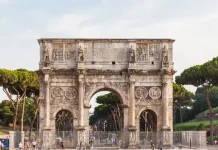
The Arch of Constantine is one of the most famous examples of spolia in Roman architecture. Built in the early fourth century, it reused sculptural material from earlier imperial monuments associated with emperors such as Trajan, Hadrian, and Marcus Aurelius.
For a deeper art-historical explanation of the monument, Smarthistory’s guide to the Arch of Constantine explains how the arch combines earlier imperial imagery with Constantine’s own political message.
This was not only a shortcut. It was also a message. By reusing older imperial imagery, Constantine’s monument connected his rule with Rome’s earlier golden age. The arch shows how spolia could turn old art into new political language.
The Colosseum as a Source of Reused Materials
The Colosseum also belongs in the story of spolia, but in a different way. Instead of being mainly a building made from spolia, it later became a source of reusable material. In the Middle Ages and later periods, stone from the Colosseum was removed and reused in churches, palaces, and other Roman buildings.
This makes the Colosseum important for understanding the full cycle of architectural reuse. A monument can begin as a symbol of empire, survive as a ruin, and then become a quarry for later generations.
Medieval Churches and Reused Roman Columns
Many medieval churches reused columns, capitals, and stone from older Roman buildings. Sometimes these pieces matched. Often they did not. A church might include columns of different heights, different stone types, and different decorative styles.
For a long time, this visual mixture was treated as disorder. Today, many architects and historians see it differently. The mixture can show resourcefulness, adaptation, and the ability of a building to carry many lives at once.
A Washington Post climate feature on Rome’s reused architecture makes this point beautifully through churches such as San Giorgio in Velabro, where mismatched columns and capitals now feel less like a flaw and more like a lesson in material intelligence.
Best Examples of Spolia in Architecture
Spolia is not limited to one building or one city. It appears across the Mediterranean and beyond, often wherever older empires, sacred buildings, and later construction met each other.
| Example | Location | Why It Matters |
|---|---|---|
| Arch of Constantine | Rome, Italy | One of the clearest political uses of spolia, reusing earlier imperial sculptures in a new triumphal monument. |
| San Giorgio in Velabro | Rome, Italy | A medieval church with visibly mismatched reused Roman columns and capitals. |
| Santa Maria in Trastevere | Rome, Italy | Known for reused ancient columns that carry Roman material memory into a Christian setting. |
| The Colosseum | Rome, Italy | Later became a source of reusable stone and metal for other Roman buildings. |
| Basilica Cistern | Istanbul, Turkey | Its reused Medusa-head column bases show how older fragments could be placed into new structural roles. |
| Hagia Sophia and Byzantine buildings | Istanbul and the Byzantine world | Byzantine architecture often reused precious columns, marble, and decorative pieces from earlier sites. |
| Great Mosque of Córdoba | Córdoba, Spain | Uses columns and capitals associated with earlier Roman and Visigothic material traditions. |
| St. Mark’s Basilica | Venice, Italy | Contains fragments and artworks brought from the eastern Mediterranean, especially after the Fourth Crusade. |
| Medieval city walls | Across Europe and the Mediterranean | Older inscriptions, stones, and sculptural fragments were often embedded into later walls and towers. |
| Renaissance Rome | Rome, Italy | Ancient materials and ruins were often reused, reinterpreted, or absorbed into newer architectural projects. |
Spolia Across Cultures: Roman, Byzantine, Medieval and Islamic Reuse
Roman spolia is the easiest to recognize because Rome was full of monuments, temples, baths, arches, tombs, and public buildings that later generations could reuse. But the practice was much wider than Rome.
In the Byzantine world, older columns, capitals, marble revetments, and sculptural fragments could move from one building into another. Sometimes they were reused because they were valuable materials. Sometimes they carried the prestige of empire. Sometimes they helped a new sacred space feel older, richer, and more connected to inherited authority.
In medieval Christian architecture, reused Roman columns and capitals often became part of churches. Their earlier identity did not disappear completely. It was softened, absorbed, and reinterpreted inside a new religious setting.
Islamic architecture also has important examples of reuse. The Great Mosque of Córdoba is one of the most discussed cases because its forest of columns reflects a layered material history. Some fragments came from earlier Roman and Visigothic contexts, giving the building a visual rhythm shaped partly by reuse.
This is why spolia is so interesting. It does not belong to one style. It appears wherever buildings, power, memory, economy, and belief overlap.
Is Spolia the Same as Recycling?
Spolia is related to recycling, but it is not exactly the same thing.
Recycling usually breaks a material down and turns it into something else. Spolia often keeps the original object recognizable. A column remains a column. A carved panel remains a carved panel. A stone block may still show traces of its first life.
That difference matters. Spolia preserves both material and memory. It does not only save resources. It also allows the past to remain visible inside a new design.
Spolia vs Architectural Salvage vs Adaptive Reuse
Several terms overlap with spolia, but they do not mean the same thing. The difference is useful because modern architects now use many forms of reuse, from salvaged materials to entire building conversions.
| Term | Meaning |
|---|---|
| Spolia | Architectural pieces from older buildings reused in new construction or decoration. |
| Architectural salvage | Recovered building materials saved for reuse, resale, repair, or restoration. |
| Adaptive reuse | The process of giving an existing building a new function instead of demolishing it. |
| Deconstruction | Carefully taking a building apart so that useful materials can be recovered. |
| Recycling | Breaking down materials and processing them into new usable material. |
| Material reuse | A broad modern term for using existing components again instead of replacing them with new ones. |
Spolia is usually more specific than these broader terms. It focuses on reused architectural fragments and the meaning those fragments carry when placed into a new setting.
Why Scholars Still Debate Spolia
Spolia can look simple from a distance: old material placed into a new building. But scholars still debate it because reuse can mean very different things depending on the building, period, and intention.
Sometimes spolia preserves heritage. A reused column may survive precisely because a later builder found a new place for it. Sometimes spolia also damages heritage, especially when fragments are stripped from older monuments and removed from their original setting.
It can be practical, but it can also be political. It can be respectful, but it can also be an act of domination. It can keep memory alive, but it can also rewrite that memory for a new ruler, religion, or city.
This tension is part of its power. Spolia asks us to look at architecture not only as design, but as inheritance. Every reused fragment carries a question: was it saved, taken, transformed, honored, or absorbed?
Modern Spolia and Sustainable Architecture
Spolia is ancient, but the idea feels surprisingly modern. Today, architects and designers are again asking what should happen to materials from demolished buildings. Should they be crushed, wasted, and replaced? Or can they be harvested, cataloged, and given another life?
This is where spolia connects with the circular economy. Modern construction uses huge amounts of energy, concrete, steel, stone, glass, timber, and transport. Reusing existing materials can reduce waste and lower demand for new extraction and manufacturing.
This older practice also feels newly relevant because modern architecture is under pressure to reduce demolition waste, lower embodied carbon, and reuse materials more intelligently. ArchDaily’s feature on modern spolia connects the old idea with today’s practice of harvesting materials from demolition sites and treating buildings as material banks rather than disposable objects.
Modern spolia can include reclaimed brick, salvaged timber, reused stone, old doors, steel beams, tiles, façade panels, concrete elements, windows, and decorative fragments. The challenge is not only technical. It is also cultural. Reused materials often come with irregularities, marks, weathering, and visible age. Instead of hiding those marks, modern designers can let them become part of the building’s character.
In that sense, spolia offers a design lesson: the future does not always need to erase the past. Sometimes, it can build with it.
Modern Spolia: From Ancient Reuse to Material Banks
One of the strongest modern ideas connected with spolia is the idea of the material bank. A building is not seen only as a fixed structure. It is also seen as a storehouse of useful materials that may one day be taken apart and reused.
This way of thinking changes the life of a building. Doors, beams, tiles, bricks, panels, fixtures, and structural pieces are no longer treated as future waste. They become resources with another possible chapter.
Organizations such as Rotor DC in Brussels and Material Index in London show how modern architectural salvage can work in practice. They audit buildings before demolition, recover reusable components, and help architects treat old materials as design resources rather than leftover debris.
This does not mean every old fragment should be reused without thought. Modern spolia works best when reuse is careful, safe, legal, well documented, and honest about where materials came from. The goal is not to decorate a building with random old pieces. The stronger goal is to make reuse meaningful, visible, and responsible.
What Spolia Teaches Modern Architects
Spolia offers several quiet lessons for modern design. It reminds architects that newness is not the only form of beauty. It shows that irregularity can have character. It also proves that buildings do not need to belong to only one moment in time.
For modern architects, spolia can encourage:
- Less waste by keeping useful materials in circulation
- Lower embodied carbon by reducing demand for newly manufactured materials
- More local sourcing by using materials from nearby demolition or renovation sites
- Stronger storytelling by allowing old surfaces and fragments to remain visible
- Design honesty by showing where materials came from instead of pretending everything is new
- Cultural continuity by keeping fragments of older places inside new ones
This is why spolia feels so timely. It is not just a historical curiosity. It is a way of thinking about design, memory, waste, and responsibility at the same time.
Can Modern Buildings Use Spolia Today?
Yes, modern buildings can use spolia, but the process needs care. Ancient builders often reused what was available. Modern builders also need to think about structure, safety, codes, documentation, ownership, and environmental performance.
A modern project might reuse old stone on a façade, reclaimed brick in an interior wall, timber beams in a ceiling, salvaged tiles in a floor, or older doors inside a new home. Larger projects may reuse steel, concrete panels, façade systems, or modular components from buildings that are carefully deconstructed instead of quickly demolished.
The best modern spolia does not feel like a gimmick. It feels natural to the place. It lets old material speak without making the new building look confused.
Why Spolia Still Matters
Spolia matters because it changes how we look at old materials. A broken column, a carved block, or a reused stone is not merely leftover construction waste. It can be a record of movement, memory, power, survival, and reinterpretation.
In ancient Rome, spolia could connect a new ruler with old imperial authority. In medieval cities, it could give new religious buildings access to the material grandeur of the ancient world. In modern architecture, it can help designers rethink waste, carbon, beauty, and continuity.
That is why spolia is not only an architectural technique. It is a way of seeing culture itself: not as something discarded when it grows old, but as something that can be reassembled into new meaning.
FAQs About Spolia Architecture
In architecture, spolia means reused building materials or decorative fragments taken from older structures and placed into new construction. These can include columns, stones, capitals, reliefs, marble slabs, inscriptions, or carved panels.
The Arch of Constantine in Rome is one of the most famous examples of spolia. It reused sculptural material from earlier imperial monuments and turned those older fragments into a new political statement.
Spolia is related to recycling, but it is more specific. Recycling often transforms material into something new, while spolia usually keeps older architectural pieces visible and recognizable inside a new building.
Ancient builders reused materials because stone and marble were expensive to quarry, shape, and transport. They also reused older fragments for symbolic, political, religious, and aesthetic reasons.
Spolia connects to sustainability because it shows an old model of material reuse. Modern architects are interested in similar ideas today, including salvaged materials, deconstruction, circular design, and reducing construction waste.
Spolia usually refers to reused fragments from older buildings. Adaptive reuse refers to giving an entire existing building a new purpose, such as turning a factory into apartments or a church into a library.
Yes. Modern buildings can use spolia by incorporating salvaged stone, brick, timber, metal, tile, doors, façade panels, or decorative fragments from older structures. The key is to reuse materials thoughtfully rather than treating them as waste.