
Spain draws millions of visitors each year, with journeys ranging from major cities and Mediterranean coastlines to rural villages and island destinations.
For modern travelers, reliable mobile data can be useful for navigation, public transport information, accommodation details, digital tickets, translation tools, and communication while moving between destinations.
Before traveling, it is worth reviewing Spain’s official tourism guidance on mobile and internet connectivity, particularly because roaming arrangements and potential charges can vary depending on where a mobile contract was issued.
Travelers should also compare data allowances, plan validity, network availability, hotspot policies, and device compatibility rather than choosing a service on price alone.
For those considering prepaid digital connectivity, available options include travel eSIM Spain from 4.99 per GB. An eSIM can be installed digitally before departure on a compatible device, allowing travelers to use mobile data in Spain without physically replacing their primary SIM card.
Modern Connectivity for the Smart Traveler
Standard international roaming is not always the most practical option for every traveler. Costs and allowances depend on the home operator, the traveler’s country of origin, and the terms of the mobile plan. Visitors should therefore check roaming conditions before departure instead of assuming that their normal domestic data allowance will apply.
Buying a physical plastic SIM card is another option, although it may require finding a retailer after arrival and replacing the SIM already installed in the phone. Travelers who rely on their primary number for calls, banking alerts, or authentication may also prefer to keep their existing SIM active when possible.
Digital SIM technology provides an alternative. An eSIM is a digital mobile profile supported by many newer smartphones. Instead of inserting a physical card, travelers install a mobile plan electronically. This can make it possible to prepare data connectivity before arriving in Spain, although device compatibility and installation requirements should always be checked in advance.
Exploring Spain’s Top Regions
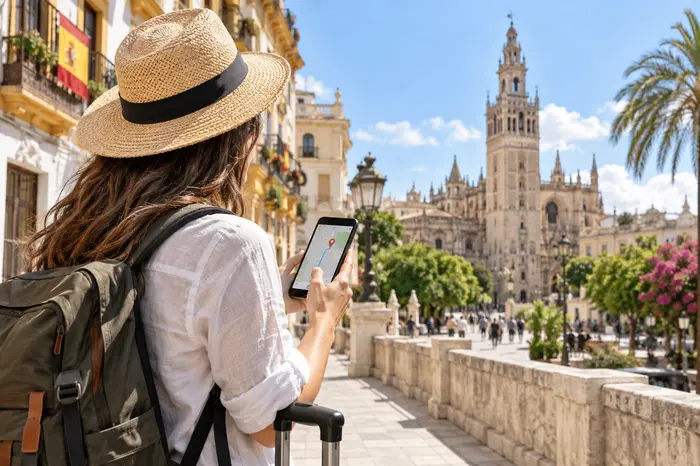
Madrid moves fast. The subway network is extensive, and mobile connectivity can make it easier to check routes, locate stations, view opening hours, and access digital tickets while exploring the city. Travelers can also use maps to move between museums, neighborhoods, restaurants, and accommodation without relying entirely on printed directions.
Barcelona features dense historic streets where navigation tools can be especially useful. The Gothic Quarter contains narrow streets and interconnected squares that may be unfamiliar to first-time visitors. Internet access can help travelers locate landmarks, check public transport, arrange a taxi, and translate menus or signs written in Catalan or Spanish.
Smart urban trips require:
- fast map loading;
- instant location tracking;
- mobile ticket access;
Coastal Escapes & Hidden Gems
Travel outside Spain’s largest cities can make dependable navigation even more useful. Andalusia is known for white villages, mountain roads, historic towns, and rural landscapes. Drivers may need real-time navigation to locate parking areas, confirm routes, or adapt when roads are closed or access is restricted.
Costa Brava includes coastal towns, rocky coves, beaches, and smaller communities where public Wi-Fi may not always be available. Mobile data can help travelers check restaurant opening hours, find walking routes, monitor weather conditions, or research local attractions while away from major urban centers.
Streamlining Your Trip With an eSIM
An eSIM can be one option for travelers who want mobile data without purchasing and installing a physical SIM after arrival. The plan can usually be purchased before the journey and installed on a compatible device, although activation procedures vary between providers.
| Feature | Old Roaming | Travel eSIM |
|---|---|---|
| Purchase | Automatic | Online store |
| Registration | Passport needed | No documents |
| Card swap | Required | Fully digital |
| Costs | Unpredictable | Prepaid packages |
Coverage and performance depend on the networks available to the chosen plan, as well as location, network congestion, device capabilities, and local signal conditions. Travelers moving between regions such as Catalonia and Andalusia should check the provider’s coverage information before purchasing rather than assuming identical performance everywhere.
Essential Tips for a Stress-Free Spanish Adventure
Smart habits can help reduce unnecessary mobile data usage. Downloading offline maps before leaving a hotel or other Wi-Fi connection can preserve data for situations where live information is more important. Travelers can also download transport information, reservation details, and destination guides in advance.
Local apps make things easier:
- train schedule checks;
- rapid taxi booking;
- live menu translation;
Digital storage can also make important travel information easier to access. Boarding passes, hotel reservations, train tickets, and attraction bookings can be stored on a phone, while screenshots or offline copies provide a useful backup in areas where mobile coverage is weak.
Technical Integration and Setup
Setting up a digital SIM generally begins with checking eSIM compatibility in the device settings or manufacturer documentation. Travelers can then download the relevant provider application from the App Store , choose an appropriate data package, and follow the installation instructions provided for the device. Depending on the service and phone model, installation may involve scanning a QR code or using an automated setup process. It is usually sensible to complete installation while connected to reliable Wi-Fi and to confirm when the plan should be activated so that its validity period is not used unnecessarily before the trip begins.
Real-World Performance Analysis
Mobile internet performance in Spain can vary considerably by location. Large cities and heavily populated areas generally provide stronger network infrastructure, while signal quality may change when traveling through mountains, rural communities, coastal areas, or other less populated locations.
A device may move between 5G and 4G depending on network availability. For everyday travel tasks such as navigation, messaging, checking reservations, and browsing transport information, either connection may be sufficient when signal strength is stable.
Personal hotspot availability is another point worth checking before purchasing a data plan. Travelers who intend to connect laptops, tablets, or additional devices should confirm whether tethering is permitted and whether any provider-specific limits apply.
The main benefits are:
- stable 5G access;
- unlimited hotspot sharing;
- wide country coverage;
Conclusion
Spain welcomes exploration across cities, coastal regions, historic towns, and rural landscapes. Reliable mobile connectivity can make that travel easier by providing access to maps, transport information, reservations, translation tools, and communication when they are needed.
An eSIM is one of several ways to stay connected while traveling, alongside home-network roaming, physical prepaid SIM cards, and public Wi-Fi. The best choice depends on the traveler’s device, data requirements, trip length, itinerary, and existing mobile plan. Comparing these factors before departure can make the overall travel experience more predictable and reduce connectivity problems after arrival.