

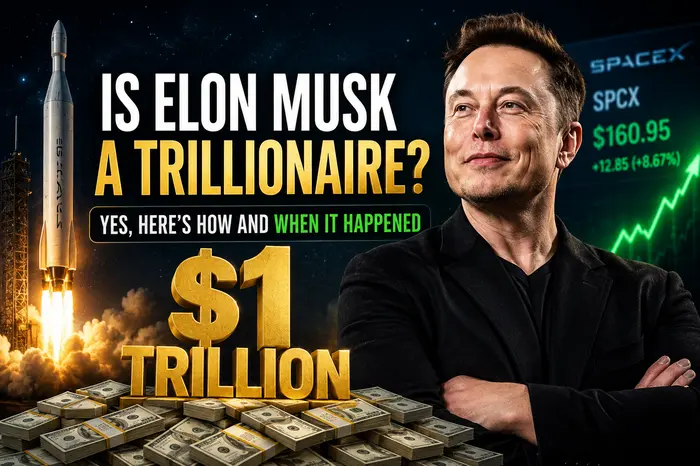
Elon Musk first crossed $1 trillion on June 21, 2026, after SpaceX began public trading, and Forbes estimated his fortune at roughly $1.1 trillion at that point. As of Forbes’ latest real-time estimate on July 21, 2026, Musk was worth about $786.4 billion, which places him below $1 trillion at the latest dated estimate used for this article.
That trillion-dollar milestone makes more sense when you look at how Elon Musk made his money, beginning with Zip2 and PayPal before his ownership in Tesla and SpaceX transformed the scale of his fortune.
Last fact-checked: July 21, 2026. Elon Musk’s estimated net worth can change substantially with SpaceX and Tesla share prices.
Elon Musk’s Trillionaire Status at a Glance
| Fact | Current information |
|---|---|
| Latest estimated net worth | $806.1 billion, Forbes real-time estimate as of July 17, 2026 |
| Current status | Below $1 trillion |
| Estimate date | July 17, 2026 |
| First crossed $1 trillion | June 12, 2026 |
| Estimated fortune at milestone | About $1.1 trillion |
| Largest wealth source | SpaceX ownership interest |
| Other major wealth source | Tesla shares and stock awards |
| Main cause of volatility | SpaceX and Tesla share prices |
| Primary tracker used | Forbes |
What Is Elon Musk’s Current Net Worth?
There is no permanent net-worth number for Elon Musk because most of his wealth sits in equity, not cash. Forbes’ real-time tracker is the main source for this article, and its July 17, 2026 estimate put Musk at $806.1 billion. Bloomberg can show a different number because wealth trackers do not always value the same holdings at the same moment, and private assets are modeled rather than audited.
That distinction is vital. Musk does not have $1 trillion sitting in a bank account. His estimated fortune comes from public shares, ownership interests, options, stock awards and other business stakes, minus whatever liabilities trackers believe apply. When SpaceX or Tesla falls, his estimated wealth can drop by tens or even hundreds of billions without him selling anything.
When Did Elon Musk First Become a Trillionaire?
Forbes first estimated Elon Musk’s net worth above $1 trillion on June 12, 2026, after SpaceX began public trading. Reuters reported that SpaceX’s stock-market debut pushed Musk past the trillion-dollar mark, and Forbes said his net worth jumped to about $1.1 trillion as the market opened. This huge surge came just months after October 2025, the historic month when Musk crossed $500 billion on paper. Older predictions that he might reach the milestone by 2027 were only forecasts. The actual milestone came earlier, and it was tied to SpaceX’s IPO.
Elon Musk’s Trillionaire Status Timeline
| Date | Estimated status | Main event | Source |
|---|---|---|---|
| June 11, 2026 | Pre-trading context | SpaceX priced its IPO at $135 per share and targeted a $75 billion raise | Reuters |
| June 12, 2026 | Above $1 trillion | SpaceX began public trading under SPCX and Forbes estimated Musk at about $1.1 trillion | Forbes and Reuters |
| June 24, 2026 | Below $1 trillion | Forbes said Musk had lost trillionaire status as SpaceX and Tesla fell | Forbes |
| June 29, 2026 | Above $1 trillion again | SpaceX and Tesla rallied and Forbes said Musk moved back above the threshold | Forbes |
| July 13, 2026 | Below $900 billion | Forbes reported that Musk’s fortune fell below $900 billion | Forbes |
| July 17, 2026 | Below $1 trillion | Forbes’ latest real-time estimate placed him at $806.1 billion | Forbes |
How the SpaceX IPO Pushed Musk Above $1 Trillion
SpaceX’s IPO was the decisive event. Reuters reported that the company priced 555,555,555 shares at $135 each, with the offering raising a record $75 billion and a valuation of about $1.75 trillion. The company began trading on June 12 under ticker SPCX, and Reuters later reported that the gross proceeds rose to $85.7 billion after the underwriters exercised the greenshoe option.
The stock-market debut lifted the estimated value of Musk’s SpaceX stake enough to push his total net worth above $1 trillion. His SpaceX stake was worth roughly $866 billion at the time Forbes put his net worth near $1.1 trillion, as per Reuters. SpaceX’s market cap briefly moved above $2 trillion, but that still did not mean Musk personally owned $2 trillion. Company valuation and personal net worth are different things.
Where Elon Musk’s Wealth Comes From
SpaceX
SpaceX is now the biggest driver of Musk’s estimated fortune. Reuters said most of his wealth rested with SpaceX after the IPO, because the value of his stake rose sharply when the company went public.
Tesla
Tesla remains a major source because Musk still owns Tesla shares and has stock-based compensation interests. Trackers closely follow Tesla’s corporate performance, but what the company reports as Musk’s earnings in quarterly profit does not automatically become his personal income. His estimate changes mainly with the market value of his shares, options and awards. Consequently, any massive Musk wealth increase is usually driven by sharp, positive swings in electric vehicle stock prices rather than cash flowing into his accounts.
xAI and X
xAI acquired X in an all-stock deal in March 2025, then SpaceX acquired xAI in February 2026. Because xAI previously acquired X and was subsequently acquired by SpaceX, X now sits indirectly within the broader SpaceX corporate group. It is better to treat these assets as part of the same Musk network than as separate major sources of wealth.
Neuralink and The Boring Company
Neuralink and The Boring Company still matter inside Musk’s wider portfolio, but they contribute far less to his net worth than SpaceX and Tesla. Reuters’ and Forbes’ coverage of his wealth has consistently placed the spotlight on those two bigger engines, not on his smaller private ventures.
How Elon Musk’s Net Worth Is Estimated
Forbes, Reuters and other trackers do not calculate Musk’s wealth the way an auditor would. IPO price is public, ticker and trading date are public, and market capitalization is calculated from share price and shares outstanding. Musk’s stake value is then estimated from disclosed or inferred ownership. Cash is not publicly known, and private assets and liabilities are only partially visible.
That is why “estimated trillionaire” is more accurate than “confirmed trillionaire.” Forbes is estimating the value of public and private holdings using market prices and available filings, while Bloomberg may use slightly different timing and assumptions. The exact number can shift during the day because public shares trade constantly. Net worth, income, revenue, profit, valuation, market cap and personal stake value all mean different things, and they should not be blended together.
Why His Net Worth Changes So Quickly
Musk’s wealth moves fast because it is concentrated in assets whose prices can change sharply in one trading session. Reuters reported that SpaceX shares later fell below the IPO price, and Forbes then showed Musk slipping back under $900 billion. That kind of move can wipe out enormous paper wealth without him selling a single share.
How Musk’s Milestone Compared With Other Billionaires
When Forbes first estimated Musk’s net worth above $1 trillion, the gap to the next richest person was enormous. Forbes’ July 1, 2026 ranking put Musk at $1.053 trillion and Jeff Bezos at $249 billion. The wealth difference between the two was roughly $804 billion. Musk maintains a huge net worth gap over all the other richest people in the world.
Was Elon Musk the First Trillionaire in History?
Elon Musk became the first person Forbes estimated to have a net worth above $1 trillion, but that is a modern, market-based estimate. Historical comparisons usually point to Mansa Musa, ruler of the Mali Empire, who is widely described as one of history’s wealthiest figures. Even so, medieval royal wealth cannot be translated into a clean modern net-worth figure with any real precision.
Final Verdict
Musk first crossed $1 trillion on June 12, 2026, when SpaceX went public. He is not above that mark, at least by Forbes’ latest real-time estimate on July 17, 2026, which placed him at $806.1 billion. SpaceX is the decisive reason he got there, but the same concentration that made the milestone possible also makes it fragile. That is why “estimated trillionaire” is the right phrase, not “confirmed trillionaire.”
Frequently Asked Questions
Is Elon Musk currently a trillionaire?
No. Forbes’ latest real-time estimate on July 17, 2026 put Musk at $806.1 billion, which is below $1 trillion. He did cross the threshold on June 12, 2026, but that status has since moved with market prices.
Forbes first estimated him above $1 trillion on June 12, 2026, after SpaceX began public trading. Reuters linked the milestone directly to the IPO, and Forbes put his fortune at about $1.1 trillion at the time.
SpaceX pushed him over the line because the IPO sharply increased the estimated value of his stake. Reuters reported that the offering sold 555,555,555 shares at $135 each, and later said gross proceeds rose to $85.7 billion after the greenshoe option. The higher market value of Musk’s SpaceX stake lifted Forbes’ estimate of his personal net worth.
In the material reviewed for this article, his highest Forbes-estimated net worth was about $1.4 trillion on June 21, 2026. Forbes later showed him going back above and below that level as the shares moved.
No. Forbes and Reuters describe his fortune as an estimate built from shares, ownership interests, options and stock awards. That is very different from cash in a bank account. His wealth can rise or fall sharply even if he never sells anything.
They can differ because they do not always use the same valuation timing or the same assumptions for private holdings and vesting awards. Forbes is the primary tracker used here, but any live billionaire index is an estimate rather than an audited balance sheet.
Yes. He has already moved above and below $1 trillion several times since SpaceX’s IPO, so another rebound in SpaceX or Tesla could push him back over the mark. The estimate is volatile, not fixed.
He was the first person Forbes estimated to be worth more than $1 trillion in modern financial history. Historical figures such as Mansa Musa are often described as richer in a broader historical sense, but those comparisons cannot be turned into a clean modern net-worth calculation.
Sources
- Forbes profile for Elon Musk, used for the July 21, 2026 real-time estimate and current status.
- Reuters coverage of SpaceX pricing, listing and the June 12, 2026 trillionaire milestone.
- Reuters reporting on the greenshoe-adjusted IPO proceeds and the effect on SpaceX’s market value.
- Forbes stories on the June 24, June 29 and July 13 estimate swings.
- Reuters reporting on xAI buying X and SpaceX acquiring xAI.
- Historical comparison material on Mansa Musa and the limits of converting medieval wealth into a modern net-worth figure.