

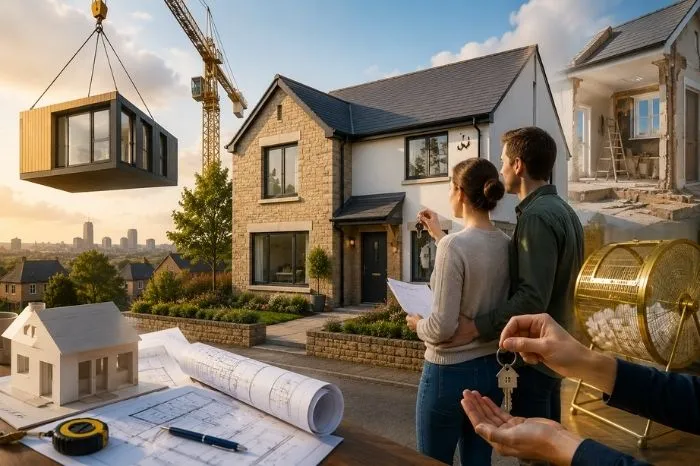
You’ve spent years pinning kitchen islands and knocked-through Victorian terraces to a mood board that never quite becomes a mortgage application.
That gap between inspiration and ownership used to be filled by one thing only: saving until a bank would talk to you. It isn’t any more. Here’s what’s actually changed.
1. Self-Build Has Stopped Being a Fringe Pursuit
Building your own house still sounds like something for the very rich or the very brave, but the appetite for it is far wider than the numbers suggest it should be, with around 7 to 10 per cent of new homes in the UK being self-built.
What’s changed recently is access: serviced plots, mortgage products designed specifically for stage payments, and architects who now specialise in one-off homes rather than treating them as a novelty commission.
2. Modular and Offsite Construction Has Closed the Patience Gap
One of the biggest reasons people stick with existing housing stock is time. Waiting eighteen months for a traditional build is a lot to ask when you’re renting.
Offsite and modular construction, where large sections of a house are built in a factory and craned into place, has started to change that maths, and it’s part of why housebuilders and insurers alike are backing it as a genuine answer to Britain’s housing shortfall, as reported by the BBC. You still need land and planning permission, but the build phase itself can shrink from months to weeks.
3. Renovation-First Thinking Has Replaced “Move When You Can Afford to”
Rather than waiting to trade up, more buyers are taking on a home with obvious flaws and fixing it in stages.
Iit lets you buy in a location you actually want, at a price you can actually stretch to, and shape the finish over several years rather than paying someone else’s premium for work already done.
4. Fractional and Shared Ownership Has Widened Who Gets to Start
Full ownership from day one isn’t the only entry point any more. Shared ownership schemes, where you buy a percentage of a property and pay rent on the rest, have quietly become a normal first step rather than a last resort, particularly for people priced out of their own city.
5. Prize Draws Have Opened an Entirely Different Route in
Perhaps the most unexpected shift is the rise of home prize draws as a legitimate, if longer-odds, way to skip the deposit altogether. Platforms like Raffle House sell entries into draws for actual houses and flats, often mortgage-free and fully furnished, with a share of ticket sales going to a nominated charity, which is a very different proposition from a straightforward property purchase and one worth understanding on its own terms before you buy a ticket.
None of these routes suit everyone, and most people will still end up on a conventional mortgage for a conventional house. But the fact that there’s now a genuine menu of options, rather than one path with a very high bar, says something about how differently people are willing to think about getting the keys.