

A good push day workout trains the muscles responsible for pressing: your chest, shoulders, and triceps. Instead of filling the session with every pressing exercise you know, build it around a few compound movements, add targeted shoulder and triceps work, and manage the total volume so you can recover and progress.
The routine below gives you a practical starting point for choosing push day exercises, ordering them effectively, and adjusting sets and reps to your experience and weekly training schedule.
Push Day in Brief
A balanced push day usually includes four to seven exercises: two chest movements, one or two shoulder exercises, and one or two direct triceps exercises. Start with your highest-priority compound press, use roughly 2–3 repetitions in reserve on most working sets, then progress by adding reps or load while keeping technique and recovery consistent.
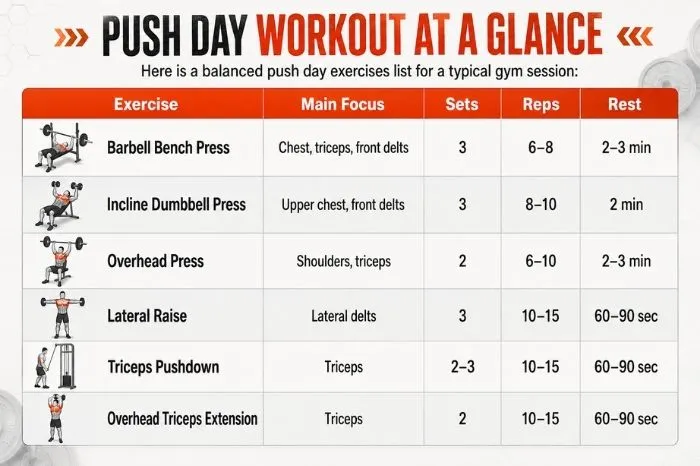
Push Day Workout at a Glance
Here is a balanced push day exercises list for a typical gym session:
| Exercise | Main Focus | Sets | Reps | Effort | Rest |
|---|---|---|---|---|---|
| Barbell Bench Press | Chest, triceps, front delts | 3 | 6–8 | 2–3 RIR | 2–3 min |
| Incline Dumbbell Press | Upper chest, front delts | 3 | 8–10 | 2–3 RIR | 2 min |
| Overhead Press | Shoulders, triceps | 2 | 6–10 | 2–3 RIR | 2–3 min |
| Lateral Raise | Lateral delts | 3 | 10–15 | 2–3 RIR | 60–90 sec |
| Triceps Pushdown | Triceps | 2–3 | 10–15 | 2–3 RIR | 60–90 sec |
| Overhead Triceps Extension | Triceps | 2 | 10–15 | 2–3 RIR | 60–90 sec |
RIR means repetitions in reserve. If you finish a set at 2–3 RIR, you stop when you estimate that you could still perform another two or three good repetitions. The 2026 American College of Sports Medicine Position Stand on resistance training identifies near-failure training, including a target of about 2–3 RIR, as sufficient for producing adaptations without requiring every set to reach momentary muscular failure.
You do not need to follow these numbers rigidly. Treat them as a starting template and adjust volume according to your experience, recovery, goals, and how often you train each muscle group.
What Is a Push Day?
A push day is a resistance-training session centered on movements in which you push weight away from your body. Pressing exercises primarily train the pectoralis muscles of the chest, anterior deltoids of the shoulders, and triceps brachii. The lateral deltoids are not primary movers in most pressing exercises, but they are commonly trained on push day through movements such as lateral raises.
Exercises such as the bench press and overhead press work several of these muscles simultaneously. During a bench press, for example, the chest performs much of the pressing work while the anterior deltoids and triceps assist. An overhead press shifts more emphasis toward the shoulders while still requiring the triceps.
Push day commonly forms one part of a Push/Pull/Legs (PPL) split:
Push trains chest, shoulders, and triceps; pull trains the back and biceps; and legs train the major lower-body muscle groups.
The advantage is organizational simplicity. Muscles that already work together during compound pressing movements get trained in the same session.
Best Push Day Exercises
The best push day exercises are not necessarily the ones that feel the most difficult. Choose movements that cover horizontal pressing, vertical pressing, lateral-delt work, and direct triceps training without unnecessarily repeating the same movement pattern.
1. Barbell Bench Press
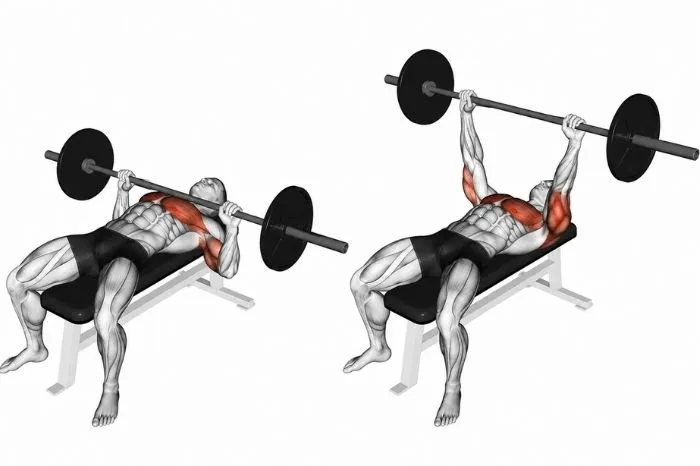
The bench press works well as the main compound movement for a chest-focused push workout.
It primarily challenges the chest while also training the triceps and anterior deltoids. Because you can progressively load it and track performance easily, it also gives you a useful benchmark for upper-body pressing strength.
Place it early in the session if increasing your bench press or chest strength is a priority.
Keep your upper back stable against the bench, control the descent, and use a range of motion you can perform comfortably and consistently.
2. Incline Dumbbell Press
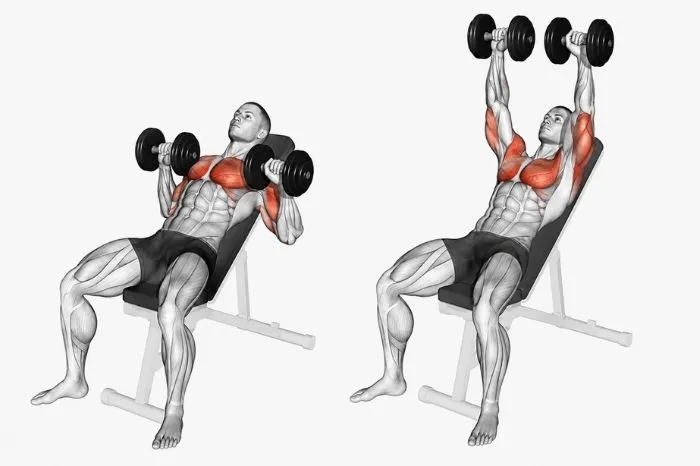
An incline dumbbell press gives you a second chest movement without simply duplicating the flat barbell press.
The incline changes the pressing angle and increases the contribution of the clavicular region of the chest and anterior deltoids. Dumbbells also allow each arm to move independently.
Use it after your main press with a moderate load and controlled repetitions rather than treating it as another maximal-strength exercise.
If your gym setup or personal preference makes dumbbells unsuitable, a machine incline press can fill a similar programming role.
3. Overhead Press
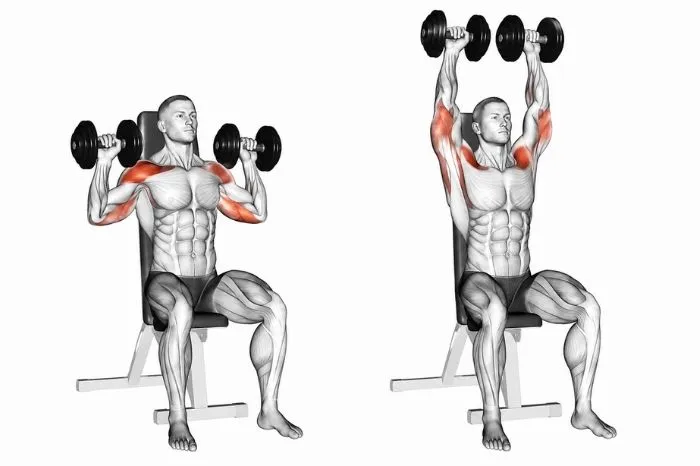
The overhead press provides the main vertical pressing movement in this push day workout.
It places greater emphasis on the shoulders, particularly the anterior deltoids, while the triceps contribute to extending the elbows.
Two hard working sets can be enough in a chest-priority push session because your front delts and triceps have already worked during the first two presses. If shoulder strength is your main priority, you can move the overhead press earlier in the workout.
Research on resistance-training exercise order suggests that strength improvements tend to be greatest for exercises placed earlier in a resistance-training session. That makes your personal priority—not an arbitrary universal sequence—the main reason for deciding which compound lift comes first.
4. Lateral Raise
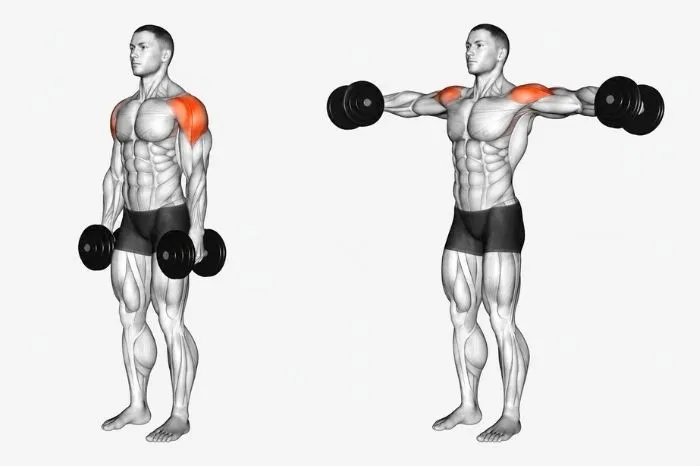
Pressing exercises already give the anterior deltoids considerable work, so adding several more front-delt movements usually provides little programming variety.
Lateral raises fill a different role. They directly emphasize the lateral deltoids without requiring another heavy press.
Perform them with a manageable weight that lets you control the movement rather than turning each repetition into a full-body swing.
5. Triceps Pushdown
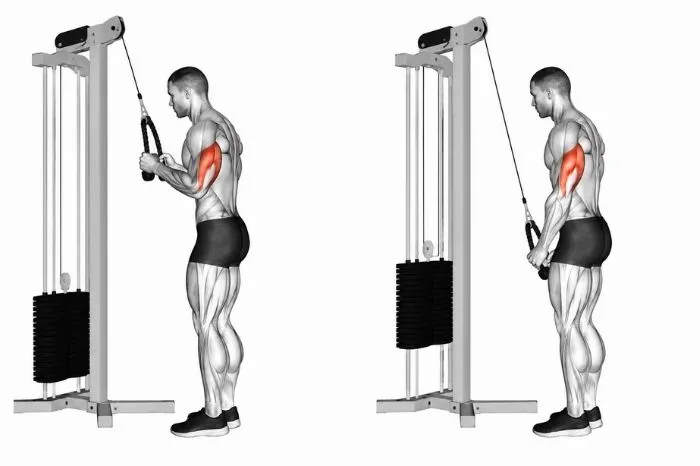
By the time you reach direct triceps work, your triceps have already contributed to the bench press, incline press, and overhead press.
That does not make isolation exercises useless. A pushdown lets you add direct elbow-extension work without adding another demanding compound press.
Keep the upper arm relatively stable and extend the elbow under control.
6. Overhead Triceps Extension
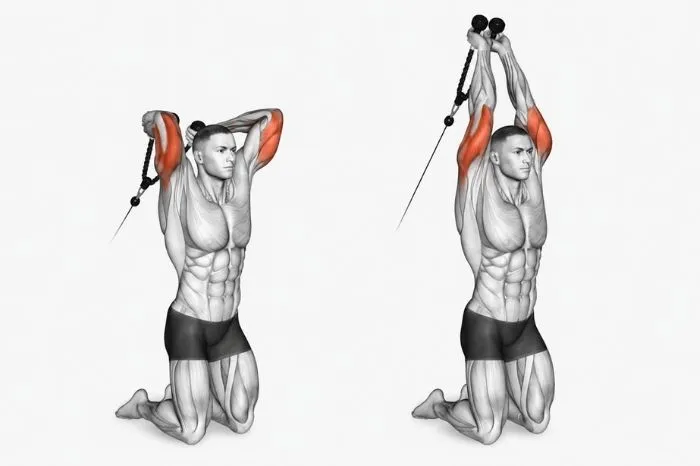
An overhead extension gives you another way to train the triceps after your presses and pushdowns.
You can perform it with a cable, dumbbell, or suitable machine depending on comfort and equipment availability.
If you want more variations and technique guidance, SpoliaMag’s guide to cable tricep exercises covers cable-based options in greater depth.
That separation matters: a push workout needs enough triceps work to complement your presses, not an entire second workout devoted to triceps.
Push Day Exercise Alternatives
You do not need a specific barbell, cable station, or machine to follow the structure of this workout. Choose an alternative that trains a similar movement pattern and fits the equipment you have available.
| Main Exercise | Gym Alternative | Dumbbell or Home Alternative |
|---|---|---|
| Barbell Bench Press | Machine Chest Press | Dumbbell Bench Press or Push-Ups |
| Incline Dumbbell Press | Incline Machine Press | Feet-Elevated Push-Ups |
| Overhead Press | Machine Shoulder Press | Dumbbell Shoulder Press or Pike Push-Ups |
| Lateral Raise | Cable Lateral Raise | Dumbbell or Resistance-Band Lateral Raise |
| Triceps Pushdown | Straight-Bar Cable Pushdown | Resistance-Band Pushdown or Diamond Push-Up |
| Overhead Triceps Extension | Cable Overhead Extension | Dumbbell or Resistance-Band Overhead Extension |
The 2026 ACSM resistance-training guidance also emphasizes that effective resistance training is not dependent on one type of equipment. Free weights, machines, elastic resistance, bodyweight exercises, and home-based training can all play useful roles when the program provides an appropriate training stimulus.
How to Structure Your Push Day
A practical chest-priority exercise order looks like this:
Warm-up → main chest press → secondary chest press → shoulder press → lateral raise → direct triceps work
The logic is simple. Do the movements that demand the most coordination and that matter most to your goals while you are relatively fresh. Move toward smaller isolation exercises as fatigue accumulates.
That does not make the sequence universally “correct.” If overhead pressing is your main goal, for example, placing it first can make more sense.
Warm up progressively rather than exhausting yourself before your working sets. A few lighter sets of your first major exercise can prepare you for heavier work without turning the warm-up into another workout.
Chest Exercises for Push Day: How Many Do You Need?
For many lifters, two chest exercises in one push session are enough, particularly when both are multi-joint presses.
A third chest movement can make sense if chest development is a priority and your weekly training volume and recovery support it. It does not need to be another heavy press. A machine fly, cable fly, or controlled push-up variation can provide additional chest work with less systemic fatigue.
The important distinction is between session volume and weekly volume. More exercises in a single workout are not automatically better.
Recent meta-regression research on resistance-training volume and frequency supports a dose-response relationship between training volume and muscular adaptations while also showing diminishing returns as volume increases.
Shoulder Exercises for Push Day
Shoulder programming requires a little restraint because pressing volume overlaps.
If you already perform flat pressing, incline pressing, and overhead pressing, your anterior deltoids receive repeated exposure throughout the workout. Adding front raises simply because they are a “shoulder exercise” may duplicate work you already performed.
A more balanced approach is to use:
one vertical press + one lateral-delt exercise.
You can increase shoulder-specific work if shoulders are a priority, but account for all the pressing already present in the session.
Rear-delt work often fits more naturally into a pull workout because many rowing and pulling exercises already involve the posterior shoulder.
Triceps Exercises for Push Day
The triceps assist almost every major pressing movement in this routine, which is why direct triceps training belongs near the end rather than automatically taking priority over the bench or overhead press.
For many gym-goers, one or two direct triceps exercises are sufficient after several presses.
A pushdown followed by an overhead extension gives you two straightforward options without requiring excessive additional volume. You could also use a diamond push-up as a bodyweight alternative when appropriate.
Avoid judging your triceps workload only by the number of isolation exercises you perform. Your presses contribute to their total training stress as well.
How Many Exercises Should You Do on Push Day?
For most general gym programs, about four to seven push day exercises gives you enough room to train the chest, shoulders, and triceps without turning one workout into a marathon.
A typical session might contain two chest exercises, one or two shoulder exercises, and one or two direct triceps exercises. Beginners may need fewer, while experienced lifters may use more total work depending on their split and goals.
Frequency changes the equation too. Someone performing one push session per week may distribute volume differently from someone training the same muscles twice weekly.
Research examining resistance-training frequency and hypertrophy suggests that when total training volume is equated, simply increasing frequency does not necessarily produce meaningfully greater muscle growth. Frequency can therefore serve as a practical way to distribute weekly training rather than a goal in itself.
Sets, Reps, Effort and Rest for Push Day
Use lower-to-moderate repetition ranges for your heavier compound exercises and moderate-to-higher ranges for smaller isolation movements.
For example, sets of 6–10 reps work well for presses in this routine, while lateral raises and cable triceps movements can comfortably sit around 10–15 reps.
For most working sets in this routine, aim to finish with roughly 2–3 repetitions in reserve. That means the set should feel challenging, but you should still believe you could perform another two or three controlled repetitions before reaching failure.
You do not need to turn RIR into a perfect measurement. Use it as a practical effort guide. As you gain training experience, your estimate of how many repetitions remain will usually become more useful.
Rest long enough to perform the next set with good technique and useful output. For demanding presses, that often means around two to three minutes. Smaller isolation exercises usually require less.
A systematic review and meta-analysis on inter-set rest intervals found some evidence favoring rest periods longer than 60 seconds for hypertrophy, while differences became less apparent once rest periods extended beyond roughly 90 seconds. Your rest period should therefore support performance rather than follow an arbitrary stopwatch rule.
How to Progress Your Push Day Workout
Progressive overload does not mean adding weight every workout regardless of performance.
A simple method is to use a repetition range.
Suppose your bench press prescription is:
3 sets of 6–8 reps
If you perform 8 good repetitions across all three working sets with consistent technique and remain around your intended effort level, increase the load slightly during a future session and work your way through the range again.
You can apply the same principle to dumbbell presses, overhead presses, lateral raises, and triceps exercises.
The 2026 ACSM Position Stand emphasizes matching resistance-training prescription to the adaptation you want. Heavier loading can favor maximal strength development, while greater weekly training volume can support hypertrophy. You therefore do not need one rigid progression method for every exercise or goal.
Progress can also mean performing an additional repetition with the same weight, improving technique, controlling the movement more consistently, or completing the planned volume with less performance drop-off.
Record your working sets so you know whether you are actually progressing.
Push Day Recovery and Weekly Frequency
Your workout does not exist in isolation.
Before adding more sets, consider how often you train chest, shoulders, and triceps across the entire week. A high-volume push workout performed twice weekly creates a very different workload from the same session performed once.
Recovery also depends on training experience, sleep, nutrition, exercise selection, effort, and other activity.
You do not have to take every working set to complete muscular failure either. The 2026 ACSM resistance-training Position Stand concludes that training to momentary muscular failure is not required for improvements in strength, hypertrophy, or power and identifies near-failure training as a sufficient stimulus.
Use performance as feedback. If repetitions, loads, technique, and recovery consistently deteriorate, adding even more exercises is unlikely to solve the problem.
Common Push Day Mistakes
- Doing too many exercises: More movements can create redundant volume without improving the quality of the session.
- Starting with low-priority isolation work: Save your best energy for the exercises that matter most to your goals.
- Ignoring overlap from pressing: Bench and overhead presses already train the triceps and anterior deltoids.
- Overloading direct triceps work: More pushdowns do not automatically make a better push workout.
- Neglecting lateral delts: Pressing heavily emphasizes the front of the shoulder, so lateral raises can provide useful complementary work.
- Adding weight before mastering the movement: Progress load only when you can maintain your intended technique.
- Changing exercises constantly: Keeping key movements consistent makes progression easier to evaluate.
- Taking every set to maximum effort: Hard training matters, but every set does not need to become an all-out test.
- Ignoring recovery: Judge the workout by what you can recover from and progressively repeat, not by how exhausted you feel afterward.
Example Push Day Workout
Here is the complete routine in one place:
| Exercise | Sets | Reps | Effort | Rest |
|---|---|---|---|---|
| Barbell Bench Press | 3 | 6–8 | 2–3 RIR | 2–3 min |
| Incline Dumbbell Press | 3 | 8–10 | 2–3 RIR | 2 min |
| Overhead Press | 2 | 6–10 | 2–3 RIR | 2–3 min |
| Lateral Raise | 3 | 10–15 | 2–3 RIR | 60–90 sec |
| Triceps Pushdown | 2–3 | 10–15 | 2–3 RIR | 60–90 sec |
| Overhead Triceps Extension | 2 | 10–15 | 2–3 RIR | 60–90 sec |
That gives you approximately 15–16 working sets, with most of the demanding compound work occurring while you are fresh and smaller isolation movements finishing the session.
If recovery becomes difficult, do not immediately remove the major lifts. Start by reducing accessory sets or eliminating a redundant isolation exercise.
Frequently Asked Questions
Around four to seven exercises works well for many gym-goers. The exact number depends on your training experience, weekly frequency, volume, exercise intensity, and recovery.
For most lifters, two chest exercises provide a practical starting point. A third can fit when chest is a priority and your overall weekly volume supports it.
Usually one or two direct triceps exercises are enough after multiple pressing movements. Remember that the triceps already contribute to bench presses and overhead presses.
A well-designed push day can provide substantial triceps training because pressing movements already involve elbow extension. Direct triceps exercises can then supplement that compound work. Whether it provides all the weekly volume you need depends on your program and goals.
Yes. Cable tricep exercises fit naturally near the end of a push workout after your primary chest and shoulder presses. They let you add direct triceps work without requiring another heavy compound movement.
There is no required duration, but a six-exercise session like the one above will commonly take about 60–90 minutes once you include warm-up sets and adequate rest. Focus on completing quality working sets rather than trying to make the workout last a predetermined amount of time.
There is no universal number of push days that everyone needs. In a Push/Pull/Legs routine, you might perform push day once or twice per week depending on your schedule, weekly volume, and recovery. Current ACSM guidance recommends training all major muscle groups at least twice per week as a general starting point, but those sessions do not necessarily have to follow a dedicated push-day format.