

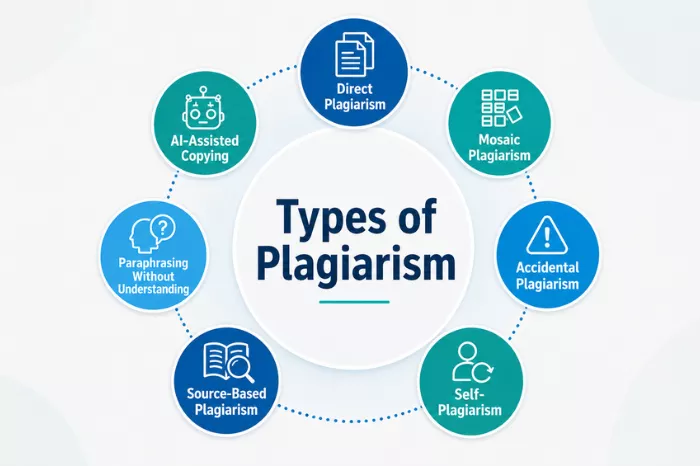
Plagiarism is not limited to copying an entire article from another website. Many people commit plagiarism without realizing it.
- A missing citation
- A poorly rewritten paragraph
- Even reusing personal work can lead to problems
You should be aware of these problems before you publish or submit your article. A plagiarism checker can pick up matching material, but combating plagiarism starts with a grasp of its varied forms. Once the common types become familiar – creating original content becomes much easier.
Direct Plagiarism
This is the simplest and most serious type of plagiarism. Direct plagiarism is copying text from another source and presenting it as one’s own work without proper attribution.
For example:
- Copying a blog paragraph.
- Pasting part of a research paper.
- Using another author’s article without citation.
Search engines and academic institutions take this issue seriously. Even a small copied section can damage credibility.
Mosaic Plagiarism
Mosaic plagiarism is difficult to detect because the writer just alters some words but keeps the original structure.
When you swap a few words with synonyms but keep the structure of the statement the same. The paragraph might look a little different at first glance but the fundamental effort still belongs to someone else. This mistake comes when writers just use a paraphrase tool without adding their own ideas and necessary credits.
A good paraphrasing will need you to understand the idea and explain it in a new way.
- Accidental Plagiarism
Not every plagiarism case is intentional. Many writers simply forget to mention the original source. Others make mistakes while taking notes and later confuse copied text with personal ideas.
Common examples include:
- Missing quotation marks.
- Incorrect citations.
- Forgotten references.
- Copying notes into the final draft.
Careful proofreading reduces these risks considerably.
Self-Plagiarism
You may be surprised to discover that such a thing exists. Self-plagiarism is the act of republishing your own work as if it were new work – without or with little disclosure.
Examples include:
- Reusing an old research paper.
- Republishing a previous blog article.
- Submitting the same assignment twice.
Refreshing an existing article is acceptable when you add:
- New insights
- Updated information
- Revised analysis
Simply recycling old work provides limited value to readers.
Source-Based Plagiarism
Accurate citations are a must. Source based plagiarism occurs when references are misleading or incorrect.
Examples include:
- Citing a source that was never used.
- Referencing inaccurate information
- Listing fake citations.
- Quoting secondary sources as primary sources.
Readers trust content backed by reliable references. Incorrect sourcing can weaken that trust.
Paraphrasing Without Understanding
Many writers believe changing vocabulary solves everything. It does not. Suppose an article explains climate change. Someone replaces several words with synonyms while preserving every idea and sentence pattern. The content still lacks originality.
A paraphrasing tool should help improve writing rather than replace critical thinking.
- Read the information first.
- Understand it fully.
Then explain it using personal language and additional insights.
AI-Assisted Copying
Artificial intelligence has changed content creation dramatically. Writers now generate drafts within minutes. Technology will save your time but responsibility still belongs to you.
Publishing AI-generated content may produce articles that closely resemble existing material without:
- Reviewing facts
- Verifying sources
- Adding original value
Many publishers will run manuscripts through a plagiarism checker and also via an AI detector before they publish. These tools are for different purposes and should not be confused.
How to Avoid Plagiarism
Avoiding plagiarism is easier than fixing it later.
Follow these habits:
- Take notes in your own language.
- Save source links during research.
- Use quotation marks for direct quotes.
- Add proper citations where required.
- Review the final draft carefully.
- Verify originality before publishing.
These simple practices reduce mistakes and improve content quality.
Useful Writing Tools
Modern writers have access to several helpful tools.
- A grammar checker helps to improve sentence structure and fix writing problems before publishing.
- A summarizer makes shorter copies of big materials, helping you to manage research.
- A paraphrasing tool offers many ways to say things but careful editing should always follow.
Even image editing utilities contribute to content production. A remove background feature – for example – helps create cleaner visuals for presentations or product pages without advanced design software. Each tool serves a different purpose. Using the right one at the right stage improves the overall workflow.
A Simple Test Before Publishing
Ask a few questions before clicking the publish button.
- Did this idea come from another source?
- Have all borrowed ideas been credited?
- Does the article add personal analysis or examples?
- Would readers learn something new from this content?
- Positive answers indicate a much stronger piece of writing.
Final Thoughts
Plagiarism is more than copying and pasting someone else’s work. These plagiarisms can all create problems for writers. Understanding these common mistakes helps produce articles that are original and valuable.
A plagiarism checker is an excellent final review tool – but originality begins long before the final scan.
- Research carefully
- Write thoughtfully
- Cite sources correctly
- Contribute fresh ideas
These habits build credibility with readers and support long-term success.