

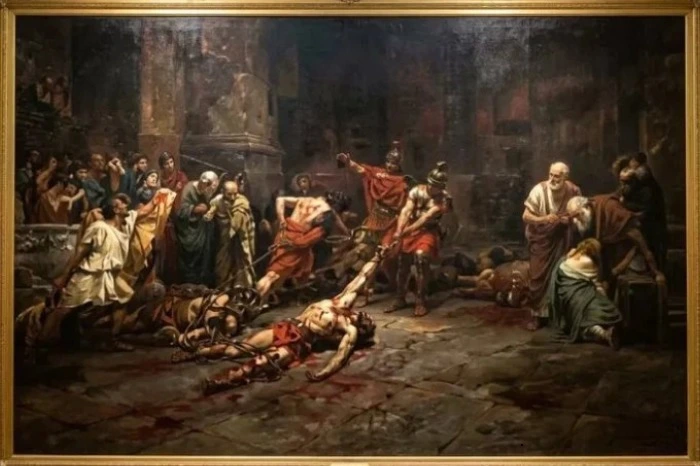
Spoliarium is Juan Luna’s 1884 oil painting showing fallen gladiators being dragged into a Roman chamber after combat. Although the scene is set in Ancient Rome, the painting is widely read as an image of human suffering, lost dignity, and colonial oppression. Luna’s gold-medal win in Madrid made it a landmark moment in Philippine art history because it proved that a Filipino artist could stand beside Europe’s strongest painters.
Quick Answer: Spoliarium is a large 1884 painting by Filipino artist Juan Luna y Novicio. It shows dead and dying gladiators being dragged away after Roman combat. Its meaning goes beyond the ancient scene: many viewers understand it as a powerful image of oppression, suffering, and the loss of human dignity under a brutal system.
Few paintings in Philippine art history carry the same emotional weight as Juan Luna’s Spoliarium. At first glance, it is a dark Roman scene filled with wounded bodies, heavy shadows, and the aftermath of violence. But for many Filipinos, the painting became much more than a historical image. It became a symbol of pain, pride, artistic excellence, and national awakening.
That is why Spoliarium is still discussed more than a century after it was painted. It is admired for its scale and technical mastery, but also for the feeling it leaves behind. The painting does not shout its message. It lets the viewer stand in front of suffering and slowly understand what power can do to the human body and spirit.
Spoliarium by Juan Luna at a Glance
| Detail | Answer |
|---|---|
| Full title | Spoliarium |
| Artist | Juan Luna y Novicio |
| Year completed | 1884 |
| Medium | Oil on canvas |
| Subject | Dead and dying gladiators being dragged into a Roman spoliarium after combat |
| Known for | Its dramatic scale, emotional force, and connection to Filipino national consciousness |
| Major award | Gold medal at the 1884 Exposición Nacional de Bellas Artes in Madrid |
| Current location | National Museum of Fine Arts, Manila |
| Main meaning | Oppression, suffering, lost dignity, and national awakening |
What Is Spoliarium?
Spoliarium is the most famous painting by Filipino artist Juan Luna. It was completed in 1884 and became one of the defining works of Philippine art. The painting shows a scene from Ancient Rome, where the bodies of fallen gladiators are pulled away after entertaining the crowd in combat.
The word “spoliarium” refers to a Roman chamber where defeated gladiators were taken after the spectacle of the arena. In Luna’s painting, that space becomes more than a physical room. It becomes a symbol of what happens after violence has been turned into entertainment and people have been stripped of dignity.
The title also connects loosely to the older idea of spolia, where remnants of the past are reused, carried forward, or given new meaning in another setting. Luna takes a Roman subject and allows it to speak to a much wider human and colonial experience.
Who Was Juan Luna?
Juan Luna y Novicio was one of the most important Filipino artists of the late Spanish colonial period. He was born in Badoc, Ilocos Norte, in 1857 and became known for large historical paintings, portraits, and works shaped by European academic training.
Luna studied and worked in Europe at a time when Filipino artists and intellectuals were trying to prove that the Philippines was not culturally inferior to Spain. His career mattered not only because he painted beautifully, but because his success challenged the way colonial society looked at Filipino talent.
The National Historical Commission of the Philippines records Luna among the major figures of Philippine cultural history and notes that Spoliarium won a gold medal at the 1884 Exposición Nacional de Bellas Artes in Madrid. That recognition turned the painting into more than an artistic success. It became a public moment of Filipino excellence abroad.
Luna’s reputation also belongs to the wider 19th-century European art world. The Museo del Prado places Juan Luna within the broader history of Spanish painting, which helps explain why Spoliarium should be read both as Philippine art and as part of the European academic tradition of its time.
What Is Happening in Spoliarium?
The scene in Spoliarium takes place after the battle, not during it. This is important. Luna does not show the excitement of the arena or the moment of victory. He shows what comes after the crowd has been entertained: broken bodies, blood, exhaustion, and removal.
In the foreground, dead and dying gladiators are dragged across the floor. Their bodies are heavy and powerless. They are no longer fighters, performers. They are human remains being pulled into the shadows after serving the spectacle.
Around them, other figures appear in grief, indifference, or movement. Some seem to mourn. Others seem detached. This contrast gives the painting its emotional pressure. The viewer is not simply looking at violence. The viewer is looking at a society that has learned to accept violence as part of its order.
That is why the painting feels disturbing even when you do not know the full historical context. It shows the cost of power from the side most people prefer not to see.
What Does Spoliarium Mean?
The meaning of Spoliarium begins with the scene itself. Luna painted fallen gladiators being dragged away after combat, stripped of glory after entertaining the crowd. The Roman setting gives the painting historical distance, but the emotion feels much closer: bodies treated as objects, suffering pushed into the shadows, and human dignity lost after public spectacle.
For many Filipino viewers, that is why the painting became so powerful. It was not only a scene from Ancient Rome. It could also be read as an image of people crushed by power, violence, and colonial rule. The painting does not need to show the Philippines directly to speak to a colonial experience.
Oppression and Power
The fallen gladiators suggest people used by a system and then discarded. They fought because the Roman world demanded spectacle. Once they are no longer useful, they are dragged away from public view.
This is one reason the painting is often connected to oppression. It shows what power can do when human life becomes disposable.
Loss of Dignity
The bodies in the painting are not given a heroic farewell. They are pulled across the floor, exposed and powerless. That loss of dignity is one of the most painful parts of the work.
Luna makes the viewer face not only death, but humiliation after death. The painting asks us to look at people at the moment when society has stopped treating them as fully human.
Human Suffering
Spoliarium is not a peaceful tragedy. It is heavy, physical, and uncomfortable. The bodies look weighed down. The shadows feel oppressive. Even the space around the figures seems to press inward.
This gives the painting a feeling that is larger than one Roman scene. It becomes an image of suffering that can be understood across different histories.
Colonial Reading
Although Luna painted an Ancient Roman subject, many Filipinos have read the painting through the experience of Spanish colonial rule. The defeated gladiators can be seen as symbols of a people wounded and dehumanized by a powerful empire.
This reading is not forced by the image in a literal way. It comes from the context around Luna, the Philippines, and the late 19th century. That is what makes the painting so layered: it can be studied as Roman history, European academic art, and Philippine nationalist memory at the same time.
National Pride
The painting also carries a second, very different emotion: pride. Luna’s success in Madrid showed that a Filipino artist could compete in a major European art setting and win. For Filipinos living under colonial rule, that mattered deeply.
So Spoliarium is not only a painting about defeat. Its creation and recognition became an act of cultural victory.
Why Is Spoliarium Important to the Philippines?
Spoliarium is important to the Philippines because it became a symbol of Filipino talent, dignity, and awakening during the Spanish colonial period. Luna’s gold medal in Madrid was not just a personal achievement. It challenged colonial assumptions about Filipinos and gave Filipino intellectuals a reason to speak with pride on an international stage.
The painting’s importance also grew because it was connected to the wider reformist atmosphere of the late 19th century. Filipino writers, artists, and students in Europe were beginning to question colonial inequality more openly. Luna’s victory gave that generation a cultural proof point: Filipinos could create work that Europe had to respect.
This is why Spoliarium is often taught not only as an artwork, but as part of the emotional background of Filipino nationalism. The painting did not start a revolution by itself, but it helped shape a language of pride, grievance, and national consciousness.
The Roman Setting: What Was a Spoliarium?
In Ancient Rome, the spoliarium was associated with the place where fallen gladiators were taken after combat. It was a space behind the spectacle, away from the crowd’s excitement. That idea is central to Luna’s painting.
The arena is where violence is turned into entertainment. The spoliarium is where the result of that entertainment is hidden. By choosing this setting, Luna avoids painting glory. He paints the aftermath.
That is what makes the title so powerful. The painting is not named after the gladiators, the crowd, or the battle. It is named after the place where the defeated are taken when they are no longer useful to the spectacle.
Visual Analysis of Spoliarium
Part of the power of Spoliarium comes from the way Luna controls light, scale, movement, and silence. The painting is not calm. It feels heavy, crowded, and emotionally charged. Yet the strongest feeling comes from the helplessness of the bodies in the foreground.
Light and Shadow
The painting uses dramatic contrast to guide the eye toward the fallen gladiators. The light does not make the scene heroic. Instead, it exposes suffering and makes the surrounding darkness feel even heavier.
This use of light also creates moral tension. The viewer can see enough to understand the violence, but much of the space remains swallowed by shadow. That balance between visibility and darkness gives the painting its haunting force.
Composition
The bodies are placed low and close to the viewer, which makes the scene feel immediate. The viewer is not watching a distant historical event from safety. The viewer is almost placed inside the aftermath.
The movement of the figures also matters. The bodies are being dragged sideways, which creates a sense of removal and disappearance. The eye follows the motion into darkness, as if the painting is showing the moment when human suffering is pushed out of public sight.
Scale
The scale of Spoliarium is part of its meaning. This is not a small, private image. It was made to overwhelm the viewer. Its size turns the scene into something almost physical, especially when seen in person.
That scale helps explain why the painting has such a powerful presence at the National Museum of Fine Arts in Manila. Reproductions can show the subject, but they cannot fully recreate the feeling of standing before a painting that nearly surrounds your field of vision.
Color
The color palette is dark, warm, and heavy. Reds, browns, shadows, and muted flesh tones create an atmosphere of violence and exhaustion. The painting does not use beauty to soften the subject. It uses beauty to make the suffering harder to ignore.
Emotion
Spoliarium does not rely on one clear hero. Instead, it shows grief, exhaustion, violence, and indifference at the same time. That emotional layering is one reason the painting continues to invite interpretation.
You can look at it as a scene of Roman brutality, as a symbol of colonial suffering, or as a Filipino artist’s triumph in Europe. The painting holds all of those meanings without becoming simple.
Spoliarium and Filipino Nationalism
The nationalist meaning of Spoliarium comes from both the image and the moment in which it was recognized. Luna painted a scene of defeat, but his success with that painting became a moment of Filipino pride.
For Filipinos in the late 19th century, this mattered because colonial rule often presented them as inferior. A Filipino artist winning major recognition in Madrid disrupted that idea. It showed that talent, intellect, and artistic discipline were not limited by race or birthplace.
That is why the painting is often discussed alongside the rise of Filipino national consciousness. It gave the reformist generation something powerful to point to: a Filipino had entered the European arena of high art and had not merely participated. He had won.
In that sense, Spoliarium carries a quiet contradiction. The image is filled with defeat, but its history is filled with assertion. The bodies in the painting are dragged into darkness, yet the painting itself brought Filipino genius into the light.
Spoliarium’s Journey From Madrid to Manila
After its success in Madrid, Spoliarium became part of a long and complicated story of movement, memory, and return. The painting was created and recognized in Europe, but its deepest cultural meaning eventually settled in the Philippines.
Its journey matters because it mirrors the story of many colonial-era works: made in one context, praised in another, and later reclaimed as part of national heritage. By the time the painting became a centerpiece of Philippine cultural memory, it was no longer only Luna’s award-winning canvas. It had become a national image.
Today, its presence in Manila gives Filipino viewers direct access to a work that once announced Filipino artistic excellence abroad. That return is part of why the painting feels so deeply connected to national identity.
Where Is Spoliarium Now?
Today, Spoliarium is displayed in Spoliarium Hall at the National Museum of Fine Arts in Manila. The National Museum of the Philippines identifies the hall as the home of one of the country’s most well-known paintings: Spoliarium by Juan Luna y Novicio.
Seeing it in person is very different from seeing it online. The size, darkness, and emotional weight of the painting become much clearer when you are standing in front of it. The viewer is not only reading about suffering. The viewer is physically confronted by it.
Spoliarium by Juan Luna: Common Misunderstandings
Spoliarium Is Not a Literal Painting of the Philippines
The painting does not show a Philippine scene. It shows Ancient Rome. Its connection to the Philippines comes through interpretation, history, and colonial context.
It Is Not Only About Gladiators
The gladiators are the visible subject, but the painting’s meaning reaches beyond them. It speaks about what happens when human lives are used by systems of power.
It Is Not Just a Sad Painting
The mood is tragic, but the history of the painting is also triumphant. Luna’s recognition in Madrid made Spoliarium a symbol of Filipino artistic excellence.
Its Meaning Was Shaped Over Time
Like many major artworks, Spoliarium has gathered meaning over time. Its Roman subject, Luna’s colonial background, its Madrid victory, and its place in the National Museum all shape how viewers understand it today.
Why Does Spoliarium Still Matter Today?
Spoliarium still matters because it remains emotionally legible. Even if a viewer does not know every detail of Roman history or Philippine colonial history, the painting communicates something immediate about violence, dignity, and power.
It also matters because it continues to anchor Filipino cultural memory. For students, it is often one of the first paintings that introduces the relationship between art and nationhood. For museum visitors, it is one of the works that makes Philippine history feel present rather than distant.
And for art history, it remains an example of how one painting can carry more than one identity. It is a European-style academic painting. A Roman historical scene. It is a Filipino cultural landmark. It is also a reminder that art can become more powerful when history keeps returning to it.
Sources and Further Reading
- National Historical Commission of the Philippines — Juan Luna y Novicio
- NHCP — Birthplace of Juan Luna y Novicio
FAQs About Spoliarium by Juan Luna
Spoliarium is an 1884 oil painting by Filipino artist Juan Luna. It shows dead and dying gladiators being dragged into a Roman chamber after combat and is widely understood as a symbol of suffering, oppression, and lost dignity.
The meaning of Spoliarium is often connected to human suffering, oppression, and the way powerful systems can strip people of dignity. In the Philippine context, it is also read as an image of colonial pain and national awakening.
Spoliarium symbolizes oppression, violence, loss of dignity, and the aftermath of spectacle. It also symbolizes Filipino artistic excellence because Juan Luna’s success in Madrid became a major cultural victory for Filipinos under Spanish colonial rule.
Spoliarium is important to the Philippines because it became a symbol of Filipino talent and national consciousness. Luna’s gold-medal win in Madrid showed that a Filipino artist could gain recognition in a major European art competition.
Spoliarium was painted by Juan Luna y Novicio, one of the most important Filipino artists of the 19th century.
Spoliarium was completed in 1884. It won a gold medal at the Exposición Nacional de Bellas Artes in Madrid that same year.
Spoliarium is displayed at the National Museum of Fine Arts in Manila, inside Spoliarium Hall.
The painting shows fallen gladiators being dragged away after combat in Ancient Rome. Instead of showing the glory of battle, Luna shows the painful aftermath: bodies, grief, darkness, and indifference.
The painting does not literally show the Philippines. It shows an Ancient Roman scene. However, many viewers interpret it through the lens of Philippine colonial history, which is why it became closely connected to Filipino nationalism.
Spoliarium is usually understood within the tradition of 19th-century academic and historical painting. It uses dramatic scale, careful composition, and emotional realism to present a powerful historical scene.
Final Thoughts
Spoliarium is powerful because it works on more than one level. It is a Roman scene, a historical painting, a study of suffering, and a national symbol. It shows bodies dragged into darkness, but its own history brought Filipino art into international light.
That is the tension that keeps the painting alive. The image is tragic, but the achievement behind it is triumphant. Juan Luna painted defeat, but through Spoliarium, he created one of the most enduring victories in Philippine art.
You might also like: Female artists