

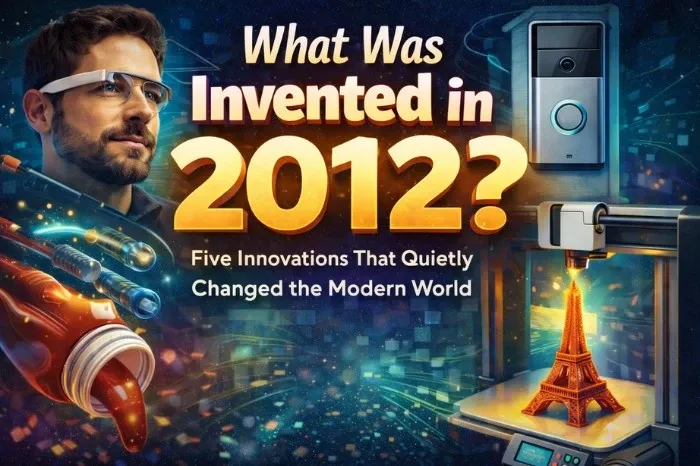
When people ask what the world-changing inventions are, they always seem to look back in time. Centuries ago, to the printing press, the steam engine, or electricity. But innovation is not something that only happens in the past. Sometimes, the most world-changing inventions happen quietly in one year. That changes the world before we even notice.
So, what was invented in 2012? Let’s get through the five major inventions of 2012 that are ever evolving like a simple mailbox.
1. Google Glass – The First Serious Step Toward Wearable Augmented Reality
When Google Glass first came to market in 2012, it looked like something straight out of science fiction. It didn’t succeed, but it was nevertheless an important technology.
Google Glass, for instance, was one of the first consumer products facing attempts to integrate Augmented Reality (AR), superimposing data and information over and above our real world by utilizing technology. The content, for example, is accessible by talking and tapping the frame, reflecting a broader shift toward hands-free digital interaction seen across major technology trends of the era.
What’s the reason for this? Well, almost all modern AR innovations, including medical smart glasses and industrial training headgear, can be traced back to the Google Glass conceptually. Chainsaws, for example, which began as medical tools and only became foresters’ best friends later, follow the same path as Google Glass – the first versions are always meant to be bad, just so the best versions can follow!
2. Ring Doorbell – Reinventing Home Security for the Smartphone Age
One of the most impactful inventions that the public envisioned for consumers in 2012 was the Ring Video Doorbell. Simply, it was a device that would provide you with the knowledge of what, or whom, was at your door when you were not home.
The invention did not stop at that. By integrating Wi-Fi technology, motion detection, HD video, and smartphone integration, Ring essentially gave a new meaning to home security. It managed to transform the traditional doorbell into an interactive security system.
There is a long tradition of everyday items improving along with the world, just as peanut butter started as a medical snack and evolved into a mainstay product due to innovation and accessibility.
Ring didn’t just introduce a gadget; it normalized smart homes.
3. LiquiGlide – A Scientific Coating That Eliminated Waste
In 2012, scientists at MIT introduced LiquiGlide, a revolutionary non-stick coating that allows liquids to slide effortlessly out of containers. Think ketchup bottles that actually empty completely.
While it may sound trivial, LiquiGlide addressed two major global concerns:
- Food waste
- Packaging efficiency
This invention combined material science and sustainability, indicating an understanding of how micro-scale engineering can drive macro-scale impact. LiquiGlide technology has been applied to various sectors such as food, medicine, industry, and cosmetics.
History is full of the most powerful innovations that are rarely dramatic; they’re actually quite practical. LiquiGlide quietly changed how industries thought about waste, efficiency, and design, reflecting the kind of understated progress often associated with long-term medical and scientific advancements.
4. MakerBot Replicator 2 – Bringing 3D Printing to the Public
While 3D printing was possible prior to 2012, the desktop 3D printer MakerBot Replicator 2, introduced during the year, made 3D printing accessible to the general creators at large. This 3D printing technology moved from the industrial space to households and businesses.
The Replicator 2 allowed users to:
- Print custom tools
- Prototype inventions
- Create art and mechanical parts
- Learn engineering through hands-on experimentation
In much the same way as a democratization of access opened doors to events that changed history, this same spirit of democratization continues to be seen in 3D printers, which continue to make distinctions between consumer and producer irrelevant.
It was not just a machine; it was a mindset shift.
5. NASA’s Carbon Nanotube Chemical Sensors – Engineering at the Invisible Scale
On the scientific end of the scale, 2012 also witnessed the emergence of NASA’s chemical sensors made based on carbon nanotubes. These extremely light chemical sensors were meant for detecting minute quantities of toxic chemical traces in space.
Their significance lies in their versatility:
- Space exploration safety
- Environmental monitoring
- Medical diagnostics
- Industrial hazard detection
Engineering at this scale is the future, as it gives a new meaning of innovation at a molecular level. Just as the previous inventions made new meanings of physical labor or communications, these sensors make new meanings of the ways in which we trace invisible threats and react to them.
Why 2012 Still Matters in the History of Invention
So, what was invented in 2012 that truly mattered? The answer isn’t one single device; it’s a pattern.
2012 was a year of:
- Subtle revolutions
- Foundational technology
- Cross-disciplinary innovation
From smart homes and AR to sustainable materials and nano-engineering, the inventions of 2012 laid the groundwork that today’s technologies continue to build upon. They remind us that innovation doesn’t always arrive with noise. Sometimes, it comes quietly and stays forever.