

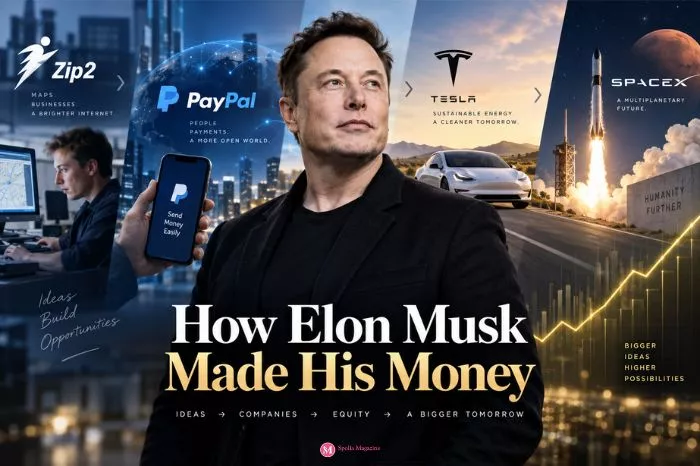
Elon Musk made his fortune primarily through business ownership, not salary. He received about $22 million when Compaq bought Zip2 in 1999 and later nearly $170 million from eBay’s acquisition of PayPal. He then reinvested substantial amounts of that capital into much larger ventures, particularly SpaceX and Tesla.
As those companies became dramatically more valuable, the value of Musk’s ownership stakes rose with them.
His wealth-building path can be summarized simply:
Zip2 → PayPal → reinvestment → Tesla and SpaceX equity → massive growth in company value
The key distinction is that Zip2 and PayPal generated money Musk could reinvest. Tesla and SpaceX later created wealth on an entirely different scale through the increasing value of his ownership.
How Elon Musk Made His Money at a Glance
| Stage | What Happened | Why It Mattered |
|---|---|---|
| Zip2 | Musk co-founded an internet software company that Compaq bought in 1999 | Created his first multimillion-dollar payday |
| X.com and PayPal | He reinvested much of his early capital into online financial services | PayPal’s sale produced a much larger financial windfall |
| SpaceX | Musk founded and heavily financed the aerospace company | His retained ownership eventually became enormously valuable |
| Tesla | He became a major early investor, chairman and later CEO | Tesla’s rise transformed the scale of his wealth |
| Equity appreciation | Musk retained large positions as his companies grew | Rising valuations, rather than ordinary salary, drove most of his later fortune |
Zip2 Gave Elon Musk His First Major Payday
Musk’s first major financial success came from Zip2, an internet software company he co-founded with his brother Kimbal Musk during the 1990s.
Zip2 provided internet-based business directories and city information during the early years of commercial web publishing.
In 1999, Compaq acquired the company, and Musk received approximately $22 million for his stake, according to Forbes’ account of his early business career.
That made Musk a multimillionaire, but it was only the first stage of his wealth-building journey.
The more important decision came afterward.
Instead of simply preserving the money, Musk committed a substantial portion of his new capital to another technology venture.
PayPal Turned Millions Into Much More Capital
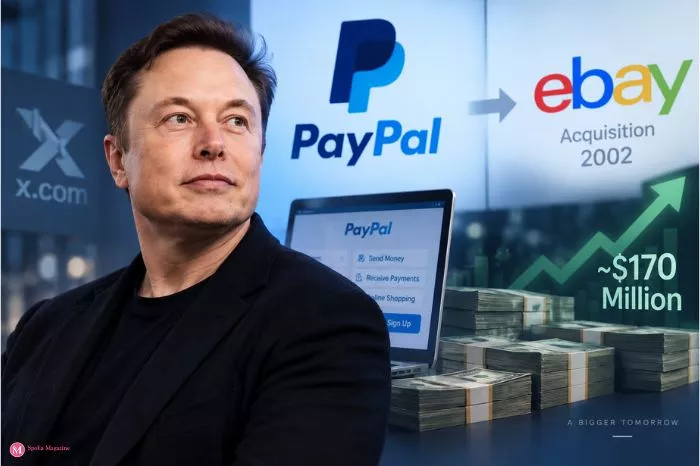
After Zip2, Musk founded X.com, an online financial-services company.
X.com later merged with Confinity, whose payment product developed into PayPal. Musk did not remain chief executive, but he retained a substantial ownership position in the combined business.
When eBay acquired PayPal in 2002, Musk received nearly $170 million in eBay stock, according to Forbes.
That transaction was much more important than simply making him richer.
It gave Musk the financial capacity to pursue businesses that required significantly more capital than a conventional internet startup.
Zip2 created his first serious pool of capital. PayPal multiplied it.
What Musk did with that money next ultimately explains how a multimillion-dollar fortune grew into wealth on an entirely different scale.
Musk Reinvested His PayPal Money Into Bigger Bets
Rather than placing all of his PayPal proceeds into diversified investments, Musk committed substantial amounts of his capital to new businesses.
The two most important were SpaceX and Tesla.
That changed the wealth-building model from:
Sell company → keep proceeds
to:
Sell company → reinvest proceeds → retain ownership → benefit if the new company becomes much more valuable
It was an unusually concentrated strategy.
Rocket development requires enormous spending on engineering, manufacturing, testing and launches. Building an electric-vehicle company also requires far more capital than starting a typical software business.
Either company could have failed.
But retaining meaningful ownership also meant that if the businesses succeeded, Musk would capture a significant share of the resulting increase in value.
That is the central financial mechanism behind his later fortune.
Tesla Transformed the Scale of Musk’s Wealth
Tesla became one of the most important drivers of Musk’s wealth.
Musk did not build the company from scratch. He became a major early investor in 2004, joined its board and later became chief executive.
According to Tesla’s official investor profile for Elon Musk, he has served on the company’s board since April 2004 and as CEO since October 2008.
The important financial point is that Musk’s exposure to Tesla came primarily through equity ownership and equity-linked compensation, not an ordinary executive salary.
Consider a simplified example.
If someone owns 20% of a company worth $10 billion, the stake is theoretically worth about $2 billion.
If that same company later becomes worth $100 billion while the person retains a similar ownership position, the stake could be worth about $20 billion.
The owner did not need to receive the extra $18 billion as salary.
The underlying asset simply became more valuable.
Tesla applied that principle on a dramatically larger scale.
As the company’s market value rose, so did the value attached to Musk’s stake. That connection between company valuations and Elon Musk’s net worth is also why estimates of his fortune can change by billions even when he has not sold an equivalent amount of stock.
SpaceX Became Another Major Pillar of Musk’s Fortune
Musk founded SpaceX in 2002 and has led the aerospace company since its early years. Tesla’s corporate biography also records his leadership of SpaceX beginning in 2002.
The company developed businesses and technologies including:
- Falcon rockets
- Dragon spacecraft
- Starlink satellite internet
- Starship
SpaceX is part of a much wider pattern of ambitious Elon Musk inventions and ventures, but its importance to his fortune comes from something more straightforward: Musk retained a very large ownership interest while the business grew substantially in value.
An August 2026 filing with the U.S. Securities and Exchange Commission reported Musk’s beneficial ownership at 48.4% of the relevant SpaceX share class under the filing’s methodology.
That figure helps explain why SpaceX became such a major component of his wealth.
The underlying mechanism is straightforward:
large ownership stake + large increase in company value = large increase in personal net worth
Cash Events vs. Paper Wealth
One of the easiest ways to understand Musk’s financial journey is to separate realized proceeds from increases in the value of assets he still owns.
| Event | Type of Wealth |
|---|---|
| Zip2 acquisition | Realized proceeds from selling his stake |
| PayPal acquisition | Major liquidity event |
| Tesla shares rising in value | Primarily equity wealth until shares are sold |
| SpaceX ownership rising in value | Primarily equity wealth until shares are sold |
| Executive salary | Relatively minor compared with the value of his ownership |
This distinction matters because saying a billionaire “made” billions in a day does not necessarily mean billions of dollars arrived in cash.
If Tesla or SpaceX rises sharply in value, Musk can become billions of dollars wealthier on paper without receiving the same amount in a bank account.
The same distinction is important when calculating how much money Elon Musk makes per second. Those figures translate the scale or movement of his fortune into units of time; they are not a literal paycheck being deposited every second.
How Did Elon Musk Become a Billionaire?
Musk became a billionaire because the value of his ownership positions eventually grew far beyond the money generated by his first startup exits.
The progression was relatively simple:
Zip2 gave him initial capital.
PayPal multiplied that capital.
He reinvested heavily into SpaceX and Tesla.
Those companies became dramatically more valuable.
His retained ownership increased in value with them.
The early exits made Musk wealthy.
The later equity appreciation created wealth on a much larger scale.
This ownership-driven model is also common among the richest people in the world, whose fortunes are typically dominated by company shares and business interests rather than salaries or cash holdings.
Which Company Made Elon Musk the Most Money?
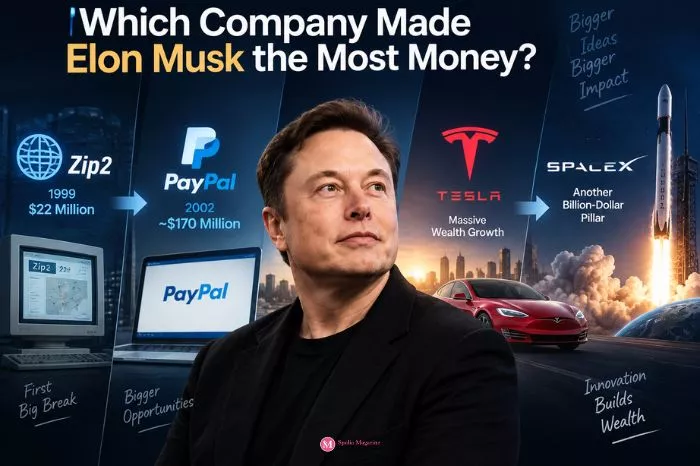
There is no single company that explains every stage of Musk’s fortune.
Each major business played a different financial role.
1. Zip2 Created His First Significant Capital
The roughly $22 million Musk received for his Zip2 stake gave him the resources to pursue another startup.
Without that first exit, his ability to finance subsequent ventures would have been far more limited.
2. PayPal Dramatically Increased His Investment Capacity
PayPal’s acquisition generated nearly $170 million in eBay stock for Musk.
That was a significantly larger pool of capital and allowed him to pursue businesses where the costs and potential rewards were much greater.
3. Tesla Transformed the Scale of His Wealth
Tesla’s increase in value turned Musk’s ownership position into an asset worth vastly more than the proceeds from his early startup exits.
This was no longer primarily a story of selling a company and receiving a payout.
It was a story of retaining ownership in an asset whose value kept increasing.
4. SpaceX Became Another Enormous Source of Equity Wealth
SpaceX followed a similar pattern.
Musk retained a large position while the company expanded across launch services, spacecraft and satellite internet.
The value attached to that ownership eventually became one of the most important components of his overall fortune.
So Musk’s financial history is better understood as a sequence rather than the result of one company:
Zip2 created capital → PayPal multiplied it → Musk reinvested it → Tesla and SpaceX multiplied the value of his ownership
Did Elon Musk Make Most of His Money From a Salary?
No.
A traditional employee often builds wealth through:
Salary → savings → investments → accumulated assets
Musk’s path was much closer to:
Business ownership → company exit → reinvestment → retained equity → rising company valuation
That difference is fundamental.
Someone can have an enormous net worth without receiving anything close to that amount as annual income.
Musk’s fortune is therefore better understood primarily as ownership wealth, rather than money accumulated through wages.
Why Can Elon Musk’s Net Worth Change So Quickly?
Because much of his fortune is tied to company equity.
Imagine someone owns shares worth $100 billion.
If those shares rise by 10%, their estimated value increases by approximately $10 billion.
The owner does not need to sell anything for their reported net worth to increase.
The reverse is also true.
If those holdings fall by 10%, billions can disappear from the person’s estimated fortune without an equivalent amount of cash physically leaving a bank account.
This is why Musk’s current net worth can fluctuate dramatically while the historical answer to how he built that wealth remains largely unchanged.
The Real Reason Elon Musk Became So Wealthy
Musk’s fortune was not created by one enormous paycheck or one lucky company sale.
It developed through a chain of increasingly larger business bets.
Zip2 gave him his first serious capital.
PayPal multiplied it.
He then reinvested substantial amounts into SpaceX and Tesla.
Most importantly, Musk retained meaningful ownership while those companies became far more valuable.
That is the core of his wealth story:
Early exits created capital. Reinvestment created larger opportunities. Retained ownership captured the upside. Rising company valuations created the fortune.
Frequently Asked Questions
Musk made his first major fortune through Zip2. After Compaq acquired the company in 1999, Musk received approximately $22 million for his stake, according to Forbes.
When eBay acquired PayPal in 2002, Musk received nearly $170 million in eBay stock, according to Forbes.
Musk became a major early Tesla investor in 2004 and joined its board that year. Tesla’s official corporate profile states that he has served as CEO since October 2008.
Musk became a billionaire largely because the value of his ownership interests in companies such as Tesla and SpaceX grew far beyond the millions generated by his earlier Zip2 and PayPal exits.
PayPal made Musk much wealthier and provided substantial capital for his later investments, but it does not by itself explain the scale of his eventual fortune. The enormous growth in the value of his Tesla and SpaceX ownership became much more important.
Tesla has been one of the biggest contributors to Musk’s wealth, but SpaceX has also become extremely important. Their relative contribution can change as company valuations and share prices move.
No. Much of Musk’s wealth consists of ownership stakes in companies. Net worth represents the estimated value of assets minus liabilities, not cash sitting in a bank account.