

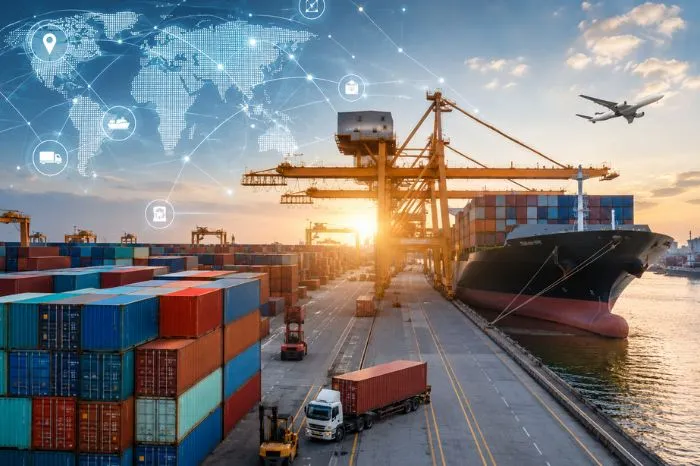
Shipping tends to get treated as a back-office concern, something handled by logistics staff and noticed only when it fails. That framing works until a delayed container idles a production line, a damaged shipment costs a key account, or a customs error triggers penalties nobody budgeted for.
For businesses operating across borders, shipping isn’t a support function. It’s the mechanism that determines whether products reach customers at a workable cost and on a predictable schedule. Companies that treat it accordingly tend to outperform those that treat it as an afterthought.
The Scale of Global Container Movement
The volume of goods moving by sea puts individual shipping decisions in perspective.
According to Food Circle, 20 million shipping containers cross our oceans every year. That figure represents a system operating continuously across thousands of ports, vessels, terminals, and inland connections.
The scale of that magnitude cuts both ways. It creates capacity, competitive pricing, and established routes connecting nearly every commercial region. It also means individual shipments compete for space within a system that experiences congestion, weather disruption, labor actions, and geopolitical interference on a regular basis.
Businesses with functional shipping arrangements navigate those disruptions with contingency routing and established carrier relationships. Businesses without them discover their vulnerability at the worst possible time, typically when capacity tightens and spot rates spike.
Standardization Creates Predictability Worth Building Around
Container shipping works because of an agreement most people never think about: the containers themselves are largely interchangeable.
According to Container Home Hub, 85% of all shipping containers worldwide are standard containers. That consistency is the foundation of modern intermodal transport. A box loaded at an inland facility can move by truck, transfer to rail, load onto a vessel, and continue to a final destination without ever being unpacked.
For a business, standardization translates into planning advantages. Loading patterns can be optimized because dimensions are known in advance. Costs become predictable because pricing follows standard units. Equipment is available at nearly any port because the same containers circulate globally.
It also means packaging and palletization decisions carry real financial weight. Products designed to fit standard container dimensions efficiently ship at meaningfully lower per-unit cost than those that waste space. Companies that address this at the product design stage capture savings on every shipment thereafter.
Specialized equipment—refrigerated units, open tops, flat racks, and tank containers—remains available for goods that don’t fit standard parameters. Those options cost more and require longer lead times, which is exactly why fitting standard equipment is worth engineering toward when possible.
Infrastructure Investment Reflects Long-Term Demand
The equipment underlying global trade represents a substantial ongoing capital commitment.
According to Archive Market Research, the global shipping container market is valued at $5,551 million in 2025. Investment at that level signals sustained expectation of demand, which matters for businesses making multi-year logistics decisions.
Practical implications follow. Container availability shifts by region and season, and businesses shipping from areas with chronic equipment shortages face both higher costs and longer lead times. Understanding those patterns allows for advance booking rather than scrambling for space at spot rates.
Ownership decisions factor in as well. Most businesses lease container space through carriers or freight forwarders, but companies with consistent high volume sometimes find owning or long-term leasing equipment produces better economics and better availability during tight markets.
Documentation and Compliance Determine Whether Goods Move
The physical movement of freight is often the simplest part of international shipping. Paperwork causes most delays.
Commercial invoices, packing lists, bills of lading, certificates of origin, and product-specific documentation all must be accurate and consistent. Discrepancies between documents trigger customs holds, and holds generate storage charges that accumulate daily while the issue gets resolved.
Classification carries direct financial consequences. Harmonized System codes determine duty rates, and misclassification produces either overpayment that goes unnoticed or underpayment that surfaces later as a penalty assessment with interest.
Regulatory requirements vary substantially by product and destination. Food, pharmaceuticals, electronics, chemicals, and goods containing wood packaging each face specific rules. Trade agreements offer duty reductions but require documentation to claim them, and businesses frequently pay full rates on goods that qualified for preferential treatment simply because nobody filed correctly.
Visibility Enables Decisions Rather Than Reactions
Knowing where freight is and when it will arrive changes what a business can do about problems.
Modern tracking provides milestone updates throughout transit: departure confirmation, vessel position, transshipment, arrival, customs clearance, and final delivery. That information allows inventory planning, customer communication, and production scheduling based on actual status rather than estimates.
When delays occur, early visibility creates options. A shipment flagged as delayed while still at origin can potentially be rerouted or expedited. The same shipment discovered late, after arrival was expected, leaves only damage control.
Systems integration multiplies the value. Shipping data connected to inventory and order management lets a business see downstream effects immediately rather than reconstructing them manually.
Cost Structure Extends Well Past Freight Rates
Comparing carriers on rate alone misses most of what shipping actually costs.
Terminal handling, documentation fees, customs brokerage, duties, inland transport, demurrage, detention, insurance, and currency fluctuation all contribute. A low base rate paired with high accessorial charges frequently costs more than a higher rate with fewer add-ons.
Businesses that model landed cost—the full delivered expense per unit—make better sourcing and pricing decisions than those working from freight quotes alone. That visibility is what turns shipping from a fixed cost of doing business into a lever worth managing.