
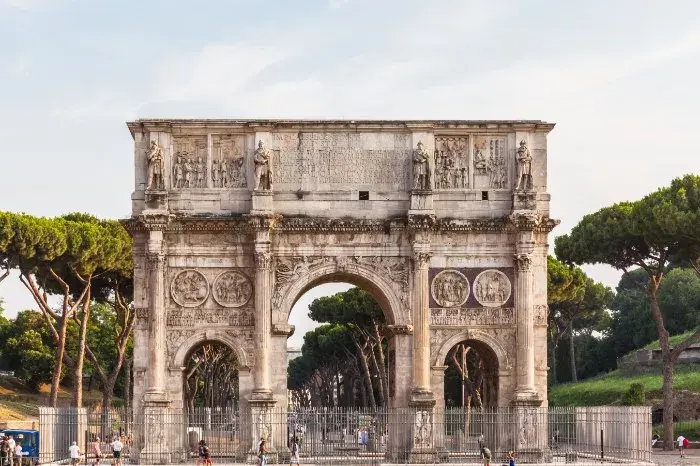
Standing between the broken grandeur of the Colosseum and the whispers of the Palatine Hill, the Arch of Constantine tells a story not just of victory, but of an empire learning to remember.
Splash back to Rome in 315 AD, and you would see a city superimposed with centuries of stone memory. The Colosseum, already over two centuries old, dominated the skyline, though time and earthquakes had begun their slow work of transformation. As historian Edward Gibbon observed in The Decline and Fall of the Roman Empire (1776),
“The various modes of worship which prevailed in the Roman world were all considered by the people as equally true; by the philosopher as equally false; and by the magistrate as equally useful.”
This was the world Constantine stepped into: a city full of monuments fighting for attention, where the past was both a weight to carry and a gift to build on.
The Arch of Constantine was constructed here not only as another independent structure, but also as the connection between various periods. It was on the road of triumph, a sacred highway on which successful generals had been passing since the Republic. This was appropriately located where the military strength of Rome and its political centre were united.
I. Battle of Tiber and Arch of Constantine
October 28, 312 AD. The Milvian Bridge, passing over the Tiber, became the stage for one of history’s most consequential battles between Constantine and Maxentius. According to Eusebius of Caesarea, Constantine’s contemporary biographer, the emperor saw a cross of light above the sun with the words:
“In this sign, conquer” (In hoc signo vinces).
Some say it was heaven’s sight, others call it craft of mind, but Constantine carried the day. Maxentius met his end in the Tiber, dragged down by his own iron shell. The arch would later tell it fairer, naming it the freeing of Rome from a “tyrant.”
The Roman Senate, ever hard-headed, commissioned the arch between 312 and 315 AD on July 25, 315. As H.P. L’Orange, the Norwegian art historian who revolutionized our understanding of late Roman art, wrote:
The Arch of Constantine is the last great document of the ancient tradition and the first monument of the Middle Ages.
II. Appearance of the Arch
Physically, the dimensions of the Arch are as follows:
- Height: 21 meters (69 feet)
- Width: 25.9 meters (85 feet)
- Depth: 7.4 meters (24 feet)
- Central archway height: 11.5 meters
- Side archways height: 7.4 meters each
It is a triumphal arch still standing, topping by far the Arch of Titus (15.4m high) and the Arch of Septimius Severus (23m high and narrower). It is built in triple-bay, a broad central path between two narrow ones, which are held by four huge Corinthian columns of rare Numidian yellow marble (giallo antico).
In 1989-1990, the archaeologists of Soprintendenza Archeologica di Roma found out that the foundations of this arch are at a depth of five meters below the current surface. They are rooted in the ancient boundary of Rome, the sacred limit of the city, and it is evident how advanced Roman engineering has enabled the building to remain the same in 1,700 years.
III. The Inscription That Rewrites History
Carved prominently on both faces of the attic story, the dedication reads:
"IMP • CAES • FL • CONSTANTINO • MAXIMO • P • F • AVGVSTO • S • P • Q • R • QVOD • INSTINCTV • DIVINITATIS • MENTIS • MAGNITVDINE • CVM • EXERCITV • SVO • TAM • DE • TYRANNO • QVAM • DE • OMNI • EIVS • FACTIONE • VNO • TEMPORE • IVSTIS • REMPVBLICAM • VLTVS • EST • ARMIS • ARCVM • TRIVMPHIS • INSIGNEM • DICAVIT"
Translation:
"To Emperor Caesar Flavius Constantine, the greatest, pious, and blessed Augustus: because he, inspired by the divine, and by the greatness of his mind, has delivered the state from the tyrant and all his followers at the same time, with his army and just force of arms, [the Senate and People of Rome] have dedicated this arch, decorated with triumphs."
Notice what’s revolutionary here: instinctu divinitatis, “inspired by the divine.” Not the gods (plural), not Jupiter specifically, but an ambiguous “divine” that could mean the Christian God, the traditional gods, or simply divine providence. As Paul Stephenson, Byzantine historian, notes: “Constantine was a master of ambiguity, and his monuments reflect this calculated vagueness.”
The phrase deliberately avoids naming Maxentius, referring only to “the tyrant”—standard Roman practice for damnatio memoriae, but also political genius.
IV. Spolia: The Revolutionary Art of Recycling
Here’s where the Arch of Constantine grows most strange. Look closely, and you’ll see the stone pictures do not match. Some are old, some new, some large, some small, all set together on one arch, not by mishap but by will.
This technique is called spolia (Latin for “spoils”), and the Arch of Constantine represents its most ambitious use in Roman architecture. Approximately 60% of the decorative sculpture comes from earlier monuments:
From the Time of Trajan (AD 98-117):
- Eight large rectangular reliefs depicting military campaigns, originally from a monument in the Forum of Trajan to repurposed the Arch of Constantine
- These show traditional Roman military virtus: discipline, strategy, and conquest
From the Time of Hadrian (AD 117-138):
- Eight roundels (tondi) were repurposed on the Arch of Contantine depicting hunting scenes and sacrifices deities (Apollo, Diana, Hercules, Silvanus)
- Four additional tondi were reused on the east and west side in the 4th century which depicts Sol (rising Sun) on the East and Luna (the setting moon) on the West
- These Tondis’ originally commisioned by Hadrian represented him as the cultivated Hellenophile emperor-philosopher
From the Time of Marcus Aurelius (c. AD 176-180):
- Eight large panels on the attic story showing imperial ceremonies, military submissions, and acts of state
- Originally from a triumphal arch or monument, possibly near the Temple of Mars
The original portrait heads in all these scenes were re-carved to show Constantine’s face. This wasn’t vandalism; it was a transformation. As Richard Brilliant, Professor Emeritus of Art History at Columbia University, explains: “The reuse of earlier imperial imagery was not simply economical; it was ideological. Constantine literally inserted himself into the visual narrative of Rome’s greatest emperors.”
Italian art historian Ranuccio Bianchi Bandinelli (1900-1975), in his groundbreaking work Rome: The Late Empire (1971), argued that this represented “a conscious historicism, a desire to link the new empire with the glories of the second century.” The Italian scholar saw spolia not as artistic decline, but as sophisticated political semiotics.
Compare this to why we see the Colosseum which is “broken” today. The Flavian Amphitheater suffered from earthquakes (particularly severe ones in 847 and 1349 AD) and systematic spoliation for building materials.
V. The New vs. The Old: An Artistic Revolution
The Constantinian frieze, the original sculptural work created specifically for this arch, runs along the base and tells the story of Constantine’s campaign against Maxentius in four scenes:
- Constantine’s departure from Milan
- The Siege of Verona
- The Battle of the Milvian Bridge
- Constantine’s triumphal entry into Rome
Art historians immediately notice the difference. Where the Trajanic and Hadrianic reliefs show naturalistic, three-dimensional figures with individual expressions, the Constantinian scenes are:
- Frontal and hieratic (figures face forward, symmetrically arranged)
- Hierarchical in scale (Constantine is larger than the other figures)
- Less concerned with anatomical realism
- More symbolic than narrative
Bernard Berenson, the influential Italian Renaissance art critic, famously declared this represented the “decline” of classical art. But modern scholars like Jas Elsner (Oxford) argue differently:
"What we're seeing is not decline but transformation, a shift from classical idealism to late antique transcendentalism, from depicting the physical world to representing spiritual and political power."
The German archaeologist Johannes G. Deckers demonstrated through comparative analysis that the Constantinian style shows “deliberate archaization”, a return to earlier Italic and Roman Republican forms that emphasized frontality and symbolic clarity over Hellenistic naturalism.
VI. Location, Location, Location: The Urban Theater
The arch doesn’t stand alone. It exists in what archaeologists call a “monumental ensemble”:
To the West (300 meters): The Colosseum, completed in 80 AD by Titus. By Constantine’s time, this massive amphitheater which is 188 meters long, 156 meters wide, 48 meters high was already showing signs of the damage that would eventually reduce it to the romantic ruin we know today. The fact is that from this period indicate it still hosted games, though perhaps not with the frequency of earlier centuries.
The question “why is Colosseum broken?” has a complex answer: repeated earthquakes (especially in 442, 508, and 847 AD), fires, and systematic quarrying for materials. Interestingly, a 2010 study by engineers at the University of Rome “La Sapienza” found that the Colosseum’s elliptical design made it more vulnerable to seismic activity than the rectangular forums.
To the North: The Roman Forum, with the Arch of Septimius Severus (203 AD) seen afar, setting one triumph stone to speak with another.
To the South: The Palatine Hill, home of kings since Augustus. From his arch, Constantine could look upon his own hall.
To the East: The Meta Sudans fountain (pulled down in 1936) and the stand of Nero’s great image.
This placement was planned. Any who came into Rome by the triumph way would meet this arch first, before the heart of the town.
VII. What the Arch Reveals About Constantine
As a Renaissance author and a politician, Machiavelli did not speak directly about the arch of Constantine, but his comments on how the rulers apply the symbols of continuity and at the same time redefine power are not obsolete. In his book The Prince, he wrote in 1532: “A wise ruler ought never to keep faith when by doing so it would be against his interest… But it is necessary to know well how to disguise this characteristic.”
Constantine’s arch is a craft of show. It looks like the old Roman triumph stone, with Senate thanks and praise of forefathers. Yet small signs point towards change.
- The ambiguous “divine” in the inscription
- The absence of traditional sacrifice scenes in the Constantinian frieze (earlier panels show them, but not the new work)
- The frontality and hieratic style anticipate Byzantine art
- The very use of spolia suggests that the present cannot match the past and must literally rebuild from it
In his collection of essays on the city of Rome, Le città invisibili (Invisible Cities) of 1972, the Italian author Italo Calvino wrote: The city, however, does not tell its past, but carries it within the lines of a hand, know how to read the palm.
VIII. Archaeological Discoveries and Modern Understanding
Recent scholarship has revolutionized our understanding:
1980s-90s: The polychromy of the original was discovered. There were traces of gold leaf, purple, blue, and red, showing that the arch was at one time brilliantly coloured, not white marble as we see it today.
2016: Laser scanning by the Politecnico di Milano created millimeter-precise 3D models, revealing that the spolia pieces were carefully reshaped to fit their new context, not just slapped on, but architecturally integrated.
2019: The columns were found to be of quarries at Simitthus (today Tunisia). They were moved over 500miles, which shows that imperial logistics continued to function even in the middle of the political crisis.
Archaeologist Amanda Claridge notes in Rome: An Oxford Archaeological Guide (2010): “The arch stands at the crossroads of Roman history, looking back to the Antonine golden age while standing at the threshold of late antiquity. No monument better embodies Rome’s ability to transform while claiming continuity.”
IX. Comparison with Other Triumphal Monuments
The Arch of Titus (81 AD)
- Height: 15.4 meters
- Single bay design
- Entirely original sculpture
- Celebrates foreign conquest (Jewish War)
- Interior relief shows spoils from the Jerusalem Temple
Difference: Titus’s arch celebrates external victory; Constantine’s celebrates internal reunification
The Arch of Septimius Severus (203 AD)
- Height: 23 meters
- Triple bay (like Constantine’s)
- Four large relief panels showing Parthian campaigns
- Original sculpture throughout
- More detailed, naturalistic carving
Difference: Severus’s arch represents the peak of classical style just before its transformation; Constantine’s shows that transformation complete
The Column of Trajan (113 AD)
- Height: 35 meters (including pedestal)
- Continuous spiral frieze: 200 meters long
- 2,662 human figures
- Narrative detail unprecedented
Difference: Trajan’s column is pure propaganda through documentation; Constantine’s arch is propaganda through appropriation
X. The Arch Through the Ages
Medieval Period (500-1400 AD): The arch became part of the Frangipane family fortress. Its survival probably owes to this fortification, too useful to destroy, too massive to steal completely.
Renaissance (1400-1600): Italian author and humanist Francesco Petrarca (Petrarch) wrote about visiting Rome’s ruins in his Familiares letters, describing them as teachers of virtue and mortality. Though he didn’t specifically mention Constantine’s arch, his attitude typifies how Renaissance thinkers viewed Roman monuments as moral exemplars.
18th Century: Edward Gibbon stood before this arch while conceiving The Decline and Fall, supposedly inspired “while musing amidst the ruins of the Capitol.”
Modern Era: The arch survived World War II intact (though a photo from 1944 shows it surrounded by sandbags). Today, it receives approximately 4 million visitors annually, second only to the Colosseum itself.
XI. Why This Monument Still Matters
The Arch of Constantine represents something profound: the moment when Western civilization learned to build the future from the fragments of the past.
Each Renaissance building incorporating classical styles had lent a hand to the arch of Constantine. Every public building of the American government for which Roman colonnades were needed, and every period in which “tradition” is spoken of while actually innovating, is really substituting what Constantine has perfected.
British archaeologist and art historian Jás Elsner perfectly captures this: “The Arch of Constantine is not merely a monument at the end of antiquity. It is the first monument of a new historical consciousness—one that understands the past as a resource to be actively deployed in the construction of the present.”
Stand before it today, and you’re seeing:
- The last great monument of classical Rome
- The first monument of Christian Rome (though barely noticeable)
- A masterclass in political messaging
- An architectural palimpsest: something written, erased, and rewritten
- A 1,700-year-old reminder that all powerful symbols are collages
Conclusion:
The Italian semiotician Umberto Eco, in his essay “Function and Sign: The Semiotics of Architecture” (1997), proposed that buildings are texts we read even when we don’t realize it. The Arch of Constantine is perhaps the most complex text in Rome, a monument that says “nothing has changed” while everything has.
Constantine himself would continue to rule for 22 more years, establish Constantinople as the capital of the Roman Empire, convene the Council of Nicaea, and die as Rome’s first Christian emperor (although baptized on his deathbed). But that day in 315, as he stood at the base of this arch for its dedication, he accomplished something even more unusual than mere military triumph: He made radical change feel like conservative restoration.
It is the contradictions that have made the arch survive, rather than overcoming them. To put it another way, it is highly Roman, a civilization that subjugated the world not only through armies, but also through its ability to induce other people to desire to be Roman.
As you walk from the Colosseum toward the Roman Forum, stop for a moment at this spot. If the guards allow, touch the stone. Look up at the faces carved above, emperors reshaped into Constantine: Trajan, Hadrian, Marcus Aurelius, all turned into him. And think about this: every generation builds on what came before. The real question is, do we create monuments that honor the past while also pointing us toward change?
Constantine’s arch does both. That’s why, 1,700 years later, we’re still reading what it has to say.