
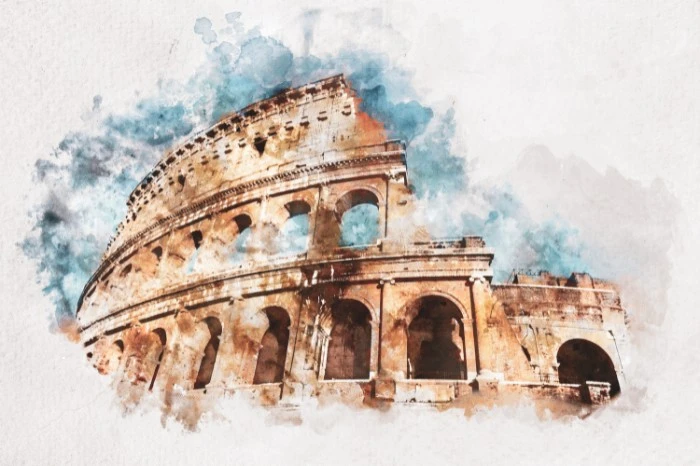
The Colosseum is one of the most durable symbols of ancient history of the Roman Empire which reflects their ambition, engineering brilliance, and social life of that time. As a history lover ho enjoys studying how Roman buildings evolved, I see that true meaning of the Colosseum goes beyond stones and mortar. It was the beating heart of Rome, a place where engineering prowess met the concrete display of the games like animal hunts, and public dramas for 50,000+ spectators.
But there’s so much more to this ancient wonder than most people know. Let me share the fascinating facts about this 2,000-year-old building still worthy today.
1. When Was the Colosseum Built?
A frequent question asked from the historian about its contruction timeline; when was the Colosseum built? Construction started around 72 CE by the Emperor Vespasian who was the founder of the Flavian dynasty. According to UNESCO World Heritage records, Vespasian built the amphitheater on the site of Nero’s Golden House, specifically over an artificial lake that had been part of the tyrant emperor’s private palace. This was a symbolic gesture to return public land to Roman citizens.
After his death, his son Titus accomplished its structure in 80 CE. The opening ceremonies lasted 100 days and featured gladiator fights and animal hunts. An historical author Suetonius wrote that approximately 5,000 animals were killed during these inaugural games.
Later further modifications were added by successive Emperor Domitian between 81-96 CE. The structural advancements belonged to him include the fourth-story gallery and most importantly the hypogeum which was the underground complex that changed how spectacles were performed.
Remarkable Construction Speed:
The massive Colosseum structure was completed in less than 10 years which was an extraordinary feat for its size. According to research from the German Archaeological Institute in Rome, this rapid construction was possible because of:
- Specialized workers: Jewish prisoners of war that were captured during the First Jewish-Roman War and the Siege of Jerusalem in 70 CE provided much of the labor.
- Multiple construction crews: Four separate teams worked at the same time on different sections of the building.
- Close material sources: A dedicated road was constructed from travertine quarries near Tibur (modern Tivoli) to transport the massive amounts of stone needed.
2. How Old Is the Colosseum?
The Colosseum is nearly 2,000 years old as of now which makes it one of the pristine (somehow) and well-preserved ancient monuments in the world. Despite several earthquakes, its survival tells us the endurance of the Roman architect’s methods.
3. How Many People Did the Colosseum Hold?
Another jaw-dropping fact about the Colossuem it was able to accomodate 50,000 to 80,000 spectators at a time. Most experts agree on around 65,000 for typical events.
Professor Kathleen M. Coleman of Harvard University, a leading expert on Roman spectacles in a 10-minutes podcast about the Paradoxes of the Roman Arena confirms:
“The entire community was evidently expected to be represented, including the upper classes.”
He furtherly said: the seating was strictly based on social rank which are described as below:
- Podium (ground level): Reserved for senators, magistrates, and the emperor
- Maenianum primum (first tier): For wealthy Romans and equestrians
- Maenianum secundum (second tier): For ordinary Roman citizens
- Maenianum summum (top level): For women and the poorest citizens
4. Colosseum’s Dimensions and Material Used
Based on archaeological surveys from Soprintendenza Archeologica di Roma and the German Archaeological Institute, the overall Dimensions of the Colosseum structure are:
- Length: 189 meters (615 feet) which is about 2 football fields long
- Width: 156 meters (510 feet)
- Height: 48 meters (157 feet) which approximates a 15-story building
- Base area: 24,000 square meters (about 6 acres)
- Perimeter: 545 meters (1,788 feet)—over a third of a mile to walk around it
- Depth: The foundation of Amphitheatre was 400 feet deep
Arena Floor:
- Length: 87 meters (287 feet)
- Width: 55 meters (180 feet)
- Wall height around arena: 5 meters (15 feet) to protect spectators from animals
Materials Used:
The material used in the construction are as follows:
- Travertine limestone: Over 100,000 cubic meters (3.5 million cubic feet), quarried from Tivoli
- 45,000 cubic meters just for the outer wall
- Set without mortar at first
- Iron clamps: 300 tons used to hold travertine blocks together (most were stolen in medieval times)
- Volcanic tuff blocks: Similar amounts to travertine used for interior walls
- Roman concrete: Revolutionary building material used for vaults and foundations
- Brick: Used throughout for wall structures
- Marble: For decorative elements and seating surfaces
5. The Use of Spolia in the Colosseum
One less familiar fact about its historical aspects is Colosseum became the source of Spolia (a technique here stones are taken from some old structure to reuse building material for new constructions and decorative things) in the middle ages when Travertine and other stones were repurposed for churches.
The buildings and churches made by repurposing Colosseum’s stones are:
- St. Peter’s Basilica
- Palazzo Venezia
- Palazzo Barberini
- Multiple churches across Rome
Do you know: The 300 tons of iron clamps were melted down and reused. Marble decorations were took off to reuse in palaces. Unexpectedly, this "destruction" kept the structure maintained and in use, which eventually helped preserve what remains today.
6. The Colossuem was Ahead of its Time
The Colosseum’s design was way revolutionary from its time. It had a complex system of arches, vaults, and corridors that let thousands of spectators enter and exit efficiently. With a complex system of arches, vaults and corridors that allowed thousands of spectators to enter and exit efficiently.
But the real engineering marvels were hidden to most of the visitors never see i.e. there was a Hypogeum beneath the arena’s floor where animals and gladiators were housed to amazed the audiences. The hypogeum built below the water table, which required:
- Multiple layers of hydraulic concrete
- Lead sheeting for waterproofing
- Ceramic drainage systems
- Connection to Rome’s broader sewer network
- Ventilation shafts to maintain air quality
Heinz-Jürgen Beste, scientific advisor at the German Archaeological Institute in Rome, calls it:
"the most innovative feature, creating the world's most sophisticated stage machinery."
In an inyerview, Beste explained to a Magazine:
"The hypogeum allowed the organizers of the games to create surprises and build suspense. A hunter in the arena wouldn't know where the next lion would appear, or whether two or three lions might emerge instead of just one."