

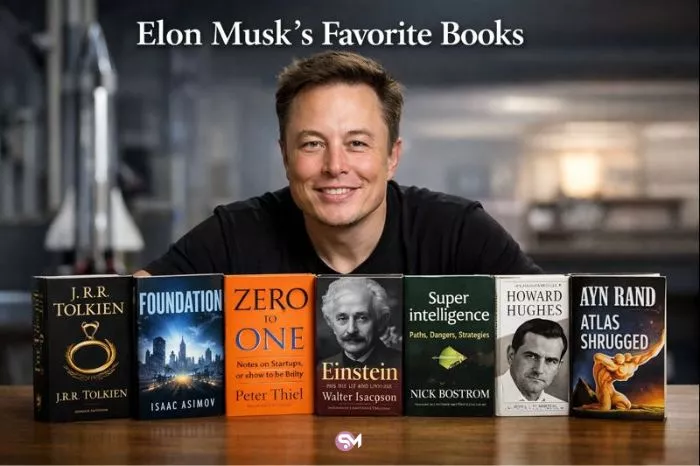
Elon Musk is a name in the business world that needs little introduction. The world’s richest entrepreneur builds rockets at SpaceX, makes electric cars at Tesla, and is not afraid to tackle problems most people dodge. He is a person who remains in the headlines for one reason another. Whether it is about becoming the first person who crossed $500 billion fortune, making more money every second than anyone else or being nominated for noble peace prize, Musk always finds a place on the front pages of news channels. Lately you might have seen his name in stories about AI, legal fights, or Tesla’s latest hardware push as well as new launches like the Robotaxi, Cybertruck, and Roadster, and sometimes he’s seen driving a Model S Plaid.
So what makes him different from others to grab those top headlines? Well, when you question him how he came to know how to do the things he does, he gives you a brief, obstinate reply: “I read books.”
This well known sentence is simple and true. It informs you of how he learned complicated subjects without a road map.
Why Musk’s reading is significant?
Yes, Musk’s knowledge comes from two bachelor’s degrees he earned some time back. But he also reads extensively. Fiction, history, biographies, engineering manuals, philosophy, economics. He treats books like tools. Read much, he says and you will get a mental map of the world. That map allows you to connect the dots to solve a puzzle.
This is not a humblebrag. It is a method. He employs fiction to broaden the imaginable. Biographies help him to study problem solving in the real world. He refers to technical literature to master the nuts and bolts. All that explains how a curious kid went to creating all-electric cars and running rocket launches, and becoming successful at most of them. His success is evident from his increasing net worth. In 2025 Elon Musk’s fortune rose by roughly $200 billion (Bloomberg) to $244 billion (Forbes). It leaves his end-of-year net worth in the $630 billion to $726 billion range depending on the source, making him the most affluent person in the world.
Much of that financial success came through business ownership, with Musk’s path to building his fortune progressing from Zip2 and PayPal to much larger equity positions in Tesla and SpaceX.
Five books recommended by Elon Musk
These are the books Elon Musk mentioned in his conversations frequently.
1. Science Fiction – Foundation by Isaac Asimov
The Foundation series has been described by Musk as one of the all time classics of science fiction sagas. This series is about the survival of humans in the long term. It aligns with Musk’s dream of helping us live on other planets so that our story keeps going forever. When discussing the future and long-term planning he has mentioned Asimov a number of times.
“In terms of sci-fi books, I think Isaac Asimov is really great. I like the Foundation series, probably one of the all-time best.” – Musk
Why he liked it: Foundation shows you that a civilization works like a giant, predictable machine. Musk employs such systems thinking when strategizing projects like Starship and Starlink.
2. Science Fiction / Philosophy – The Hitchhiker’s Guide to the Galaxy by Douglas Adams
According to Musk, this book helped him understand that the question is usually more important than the answer. He read it at a young age when he was in an existentialist state of mind and the tone came as a surprise relief to him. Although the combination of humor and cosmic viewpoint by Adams did not make him a young billionaire, yet it aided in shaping the habit of posing blunt, weird questions.
“I read Hitchhiker’s Guide to the Galaxy and basically what Douglas Adams was saying is: we don’t really know what the right questions are to ask…. – Musk
Why he liked it: It reinvents the way of asking questions. Musk takes good questions as half the answer.
3. Technical / Engineering – Ignition! by John D. Clark
When individuals inquire how Musk studied rocket science, he refers to books such as this one. Ignition! is an unofficial history of liquid rocket propellants. It is down to earth and geeky, the type of book that tells you what really goes on in an engine. It has been suggested by Musk as a fun, useful read for anyone interested in knowing how rocket fuel and combustion works.
“There is a good book on rocket stuff called ‘Ignition!’ by John Clark, that’s a really fun one.” – Musk
Why he liked it: It teaches applied detail. Musk takes in the background mechanics and builds upon them.
4. Business / Startups – Zero to One by Peter Thiel
Musk has lauded this book as an example of how to develop companies that make new things rather than imitate old ones. Zero to One is a book about discovering one idea and developing a future around it. Musk has discussed the Thiel way of thinking in his talks on mind-boggling inventions and competitive advantage.
“Peter Thiel has built multiple breakthrough companies, and ‘Zero to One’ shows how.” – Musk
Why he liked it: It obliges one to seek original solutions. Musk considers this an essential aspect of startup strategy.
5. AI / Existential Risk – Superintelligence by Nick Bostrom
When talking about the dangers of artificial intelligence, Musk has mentioned the Bostrom’s book several times. He has cautioned that uncontrolled AI could be very dangerous and Superintelligence provides the conceptual map against that fear. The themes of Bostrom are reflected in Musk’s public comments regarding AI policy and safety.
“We need to be super careful with AI,” he tweeted in 2014, saying it’s “potentially more dangerous than nukes.” – Musk
Why he liked it: It puts the issue of advanced AI in a perspective that alters your future planning.
How Musk Reads?
Musk is not a speed-reader who skims superficially. He reads for scaffolding. He reads widely in order to take the lay of the land. And then he goes deep to subjects which pique his curiosity. Science fiction enables him think big. Biographies help him observe how creative individuals go about solving messy problems. Technical manuals enable him to get practical skill. He employs fiction to broaden his imagination. Philosophy and ethics create new questions for him. The quote “I read books” is the approach to that combination.
It is easier to replicate the habit knowing those bins. Want to learn like Musk? You have to alternate between fantasy and non-fiction. Add a biography occasionally. Read a book to broaden your perspective. Read one more to know how things are really built.
Final Thoughts
Musk is one of world’s famous figures, who is controversial at times. He provides something helpful, too. His reading habit is a low-tech switch, which you can pull. The books on his list are not spells. They are tools. They provide context, frameworks and techniques. When you agree to that, you can make reading a conscious exercise, rather than a hobby. People often seek a shortcut to Musk’s brain. There is no secret shortcut. There is a pattern. Ask big questions, read broadly, learn the details, and stitch those parts together. Start there. “I read books” may sound obvious. But it beats waiting for a shortcut.
You Might Also Interested: How Much Does Jeff Bezos make a Day?