

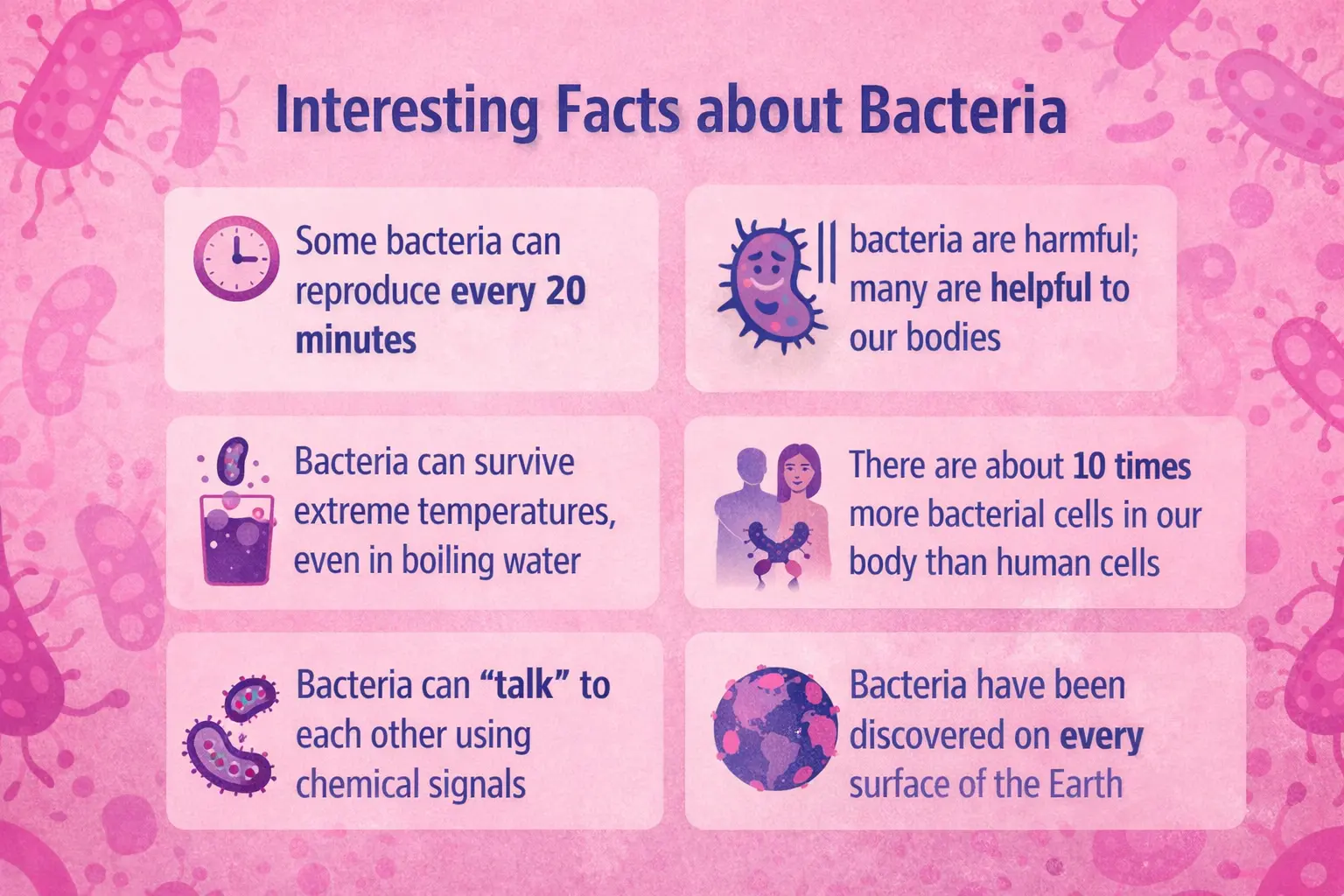
Bacteria are the microscopic living organisms that are unicellular which is why they are called Bacterium. Bacteria are also called prokaryotes because they have single cell without any nucleus and membrane-bound organelles. There are millions or even billions of different types of bacteria including spherical (cocci), rod-shaped (bacilli), and spiral forms. They are present everywhere around us from our skin to our digestive system. Bacteria have often been unfairly relegated to the role of “germs.” While in reality, these single-celled prokaryotes are the true catalysts of our biosphere. This guide explores the facts about bacteria that we might not know about.
1. Bacteria are the Cause of Rainfall Formation
Certain bacterial species, such as Pseudomonas syringae, possess “ice-nucleating” proteins on their cell membranes that are responsible for the formation of snow and rainfall. According to a study, these proteins allow water to act as a seed for snowflakes in clouds, enabling them to freeze at high temperatures and result in snowfall. Without these airborne microbes, many agricultural regions would face serious droughts.
2. The Alchemists of the Microbial World
The bacterium Cupriavidus metallidurans has a literal “Midas touch.” Research published in Applied and Environmental Microbiology (2017) demonstrates how it thrives in solutions of toxic heavy metals, processing dissolved gold into solid, microscopic 24-karat nuggets as a detoxification strategy. This biomineralization process is currently being researched for its potential in sustainable, “green” mining.
3. Bacteria are Apex Predators
Not all bacteria are passive; some are apex predators. Vampirococcus is an epibiotic predator that attaches to larger prey and “sucks” out their internal fluids. Another predator, Bdellovibrio bacteriovorus, is a specialized hunter. According to National Institutes of Health (PMC), it drills into other Gram-negative bacteria at speeds of 100 cell lengths per second and make it one of the fastest organisms on the planet relative to its size.
4. Bacteria Communicate through Ion channels
Biologists at UC San Diego discovered that bacteria also communicate and socially interact with each other. Nature study says that Bacteria communicate through electrical signaling mechanisms just like neurons in the human brain. These electrical signals are like proteins called “ion channels”.
5. Deinococcus radiodurans is the World’s Toughest Bacterium
The bacterium Deinococcus radiodurans nicknamed “Conan the Bacterium,” is listed as “the world’s toughest bacterium” in Guinness Book of World Records It can survive 10,000 times the dose of radiation that would be lethal to a human or any other organism. As detailed in Nature Reviews Microbiology, it achieves this by having multiple copies of its genome and an elite team of repair proteins that can reassemble its DNA even after it has been shattered into hundreds of fragments.
6. Revival of Bacterium after 250 Million Years
In 2000, researchers reported the successful “revival” of a bacterium found in a salt crystal located 1,850 feet underground. The species, Virgibacillus sp. 2-9-3, had been in a dormant state for 250 million years which means it existed during the Permian period and was brought back to life in a modern laboratory.
7. Antonie van Leeuwenhoek was the First man to Discovered the Bacteria
Antonie van Leeuwenhoek was the first man to discover the bacteria in the late 17th century, which he named them “animalcules” or “little animals” by using high quality microscopes. From deep-sea hydrothermal vents to the complex human digestive system, microorganisms like bacteria represent the most resilient and diverse life forms on Earth.
8. Soil Mites Disperse the Bacteria in Soils
In topsoil, tiny creatures known as soil mites often act as “taxis” for bacteria. While soil mites are generally beneficial for decomposition, they can inadvertently carry pathogenic bacteria into indoor environments. Understanding these ecological layers is essential for preventing unwanted bacterial interactions from soil mites in domestic settings.
| Bacterium Species | Unique “Superpower” | Why it Matters |
|---|---|---|
| P. syringae | Weather Control | It acts as the “seed” for rain and snow. |
| C. metallidurans | Gold Production | It turns toxic waste into solid 24k gold. |
| D. radiodurans | Nuclear Survival | It can survive radiation levels 10,000x higher than humans. |
| T. magnifica | Visible Growth | It is the size of an eyelash (visible to the naked eye). |
| V. sp. 2-9-3 | Biological “Time Travel” | It “woke up” after a 250-million-year nap in a salt crystal. |