

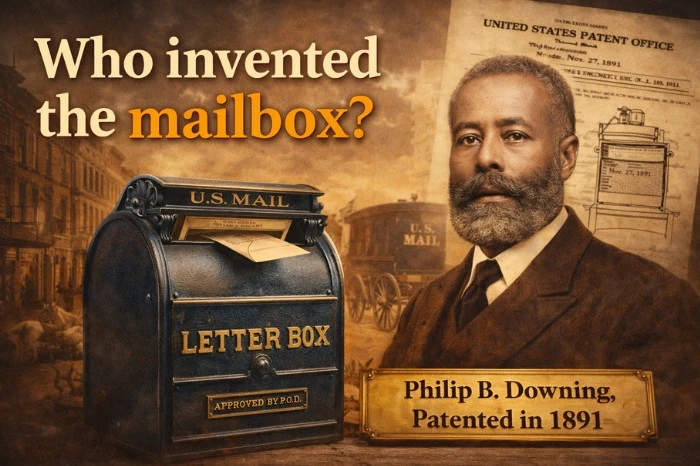
Imagine a freezing winter morning in 1880. You wrote a letter which might be a confession of love or a critical business proposal and to send it, you had to trek miles through slush and snow to the nearest central post office. In the late 19th century, “mailing a letter” wasn’t a quick job; it was an expedition. If you missed the clerk, your message stayed in your pocket.
The invention of the mailbox wasn’t just about a metal box; it was about travel back to the past. It was the birth of the original “Send” button. Technically, the mailbox had to solve a complex engineering riddle: it needed to be waterproof to protect paper, fireproof to deter vandals, and designed with a specialized “gravity-feed” or “chute” system that allowed a person to drop a letter in, but prevented a thief from reaching back in to pull it out.
The Vision of Philip B. Downing
Many contributed to the postal system, the modern “blue box” silhouette we know today owes its soul to a prolific Black inventor named Philip B. Downing. Before his intervention, “street letter boxes” were used where often clunky, unreliable, and easily tampered with.
In 1891, Philip B. Downing, the mailbox inventor, patented a design that revolutionized urban life. His “street letter box” featured a hinged door with a mechanical closing device. When you opened the outer lid to drop your mail, an internal metal plate protected the mail already sitting in the bottom of the box. This simple yet brilliant mechanical interlocking system ensured that your private correspondence remained secure until a postal worker arrived with a key.
A Tale of Two Boxes: Collection vs. Delivery
To understand who “invented” the mailbox, we have to look at the two different sides of the story i.e. how we send and how we receive.
- The Collection Box (The “Street Box”): As mentioned, Philip B. Downing was the towering figure here. His design focused on the public’s ability to deposit mail safely on any street corner. Before him, Albert Potts had patented a box in 1858, but it was essentially a small cast-iron pedestal that was difficult to use and easy to break into.
- The Home Mailbox (The “Breadloaf”): For a long time, mail was delivered directly to your hand or simply left on the porch (often blowing away in the wind). It wasn’t until 1923 that the U.S. Post Office actually mandated that every household have a mailbox or a door slot. The iconic “tunnel” shape with the red flag which was technically known as the Joroleman Box, was designed by a post office employee named Roy Joroleman. He used his engineering background to create a shape that shed snow and rain effortlessly.
Why the Design Hasn’t Changed
Have you ever wondered why the mailbox looks almost the same as it did 100 years ago? It’s a masterclass in “if it ain’t broke, don’t fix it.” The curved top isn’t just for aesthetics; it’s a structural curve that prevents water from pooling and strengthens the metal against physical impact.
Whether it’s the heavy-duty street boxes designed by Philip B. Downing or the humble tin box on a wooden post in the suburbs, these inventions represent a bridge between people. They turned the act of communication from a luxury for the mobile and healthy into a utility available to everyone.
Fun Fact: The Color of Mail
Did you know that before they were the iconic blue we see today, US mailboxes were painted bright red or emerald green? They were changed to blue in the 1970s to make them more visible against city backgrounds, but the mechanical heart of the box and the secure drop-slot still mirrors the original 1891 vision of Philip B. Downing.
You Might Also Like: