

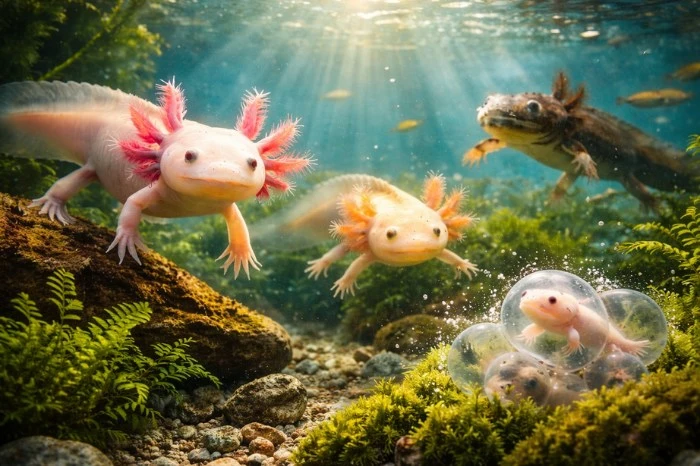
Do you know anything about the axolotls? These wide-mouthed, feathery-gilled salamanders live in the canals of Xochimilco near Mexico City. Often called Mexican walking fish or water monsters, these amphibians are a symbol of Mexico’s natural and cultural heritage.
Mostly kept as pets, this creature is popular in scientific research due to their regenerative capabilities (more on it later). Unfortunately, for decades, this species is disappearing. In 2024, experts predicted its extinction in a year’s time.
However, thanks to new research and hard work we have seen in 2025, we are having a new hope. Scientists have started releasing captive-bred axolotls back into clean, protected wetlands, and the results were surprisingly good for everyone. We cannot term these results as a quick rescue but it shows us a path out of decline.
Why Axolotls Vanished and Why They Matter?
Finding out why this matter now require you to look at why axolotls started dying out. The wild axolotls grow up only in the old water systems of Lake Xochimilco. With the development of Mexico City, pollution rose up and people started adding fish like carp and tilapia to the water. These fish brought harm by eating the axolotls’ eggs and babies.
While we just look at axolotls as a cute creature, they are in fact a living science lab. What I am going to tell might surprise you; they can regrow their legs, their spines, and even parts of their brains!
Surely, these traits make them an attractive amphibian for tourists and researchers from all over the world. If we save them, we will save the complete wetland and the local farming way of life.
What Changed in 2025 for Axolotls?
Some studies and pilot releases gave scientists an insight into bringing up the axolotls in labs in a better way. It made the animals tough enough to survive in the wild. For a test, scientists released them into small, safe ponds and restored farm areas.
Studies found out that these lab-raised axolotls figured out how to find food and stay safe. The success here gave experts a confidence to release even more of them in 2025 and this year as well. The secret formula is actually very simple; before sending the animals in the water, fix its home.
Fixing the Home: The “Farm Refuge” Plan
The experts learned some hard lessons in the last ten years. They got to know that putting animals into a broken environment is a waste of time. Therefore, they designed the projects in 2025 and 2026 around habitat. They took the job of cleaning up the water channels, replanting reeds, and using natural filters to scrub the water.
It would not have been possible without the help of local farmers (called chinamperos) to make sure the land did not turn into soccer fields or party spots. By the efforts of expert teams and community, the released axolotls actually have a place to hide, have babies, and grow the population. Experts and institutions titled it a restoration led reintroduction model.
How Many Axolotls are Left? Numbers We’re Watching
Let me share some data that shows just how hard this fight is. History tells us there were thousands of axolotls in the 90s and that count dropped to only 36 axolotls per square kilometer in 2014.
The recent surveys are focusing more on environmental DNA, which basically inspects the water for small signs of these axolotls, to find the ideal places for releases. This data was of great assistance to experts who now know exactly where they should put the new axolotls in 2026.
What’s Working and What’s Still Scary
Well, good planning is working right now. Rather than sending the aquarium pets into the wild, labs are raising wild-style axolotls. They use soft releases, which means they let the animals get used to the water slowly in protected cages first. Early reports from 2025 show these axolotls are surviving for months, which is a huge win!
What’s still scary? The size of the problem. Mexico City is huge and keeps growing. Finding enough money and political support to fix such a big area is tough. The “invader” fish are still there, and pollution is hard to stop. If we don’t keep funding these projects and working with the locals, these wins might not last.
How you Can Help?
The work being done right now shows that regular people can help by supporting groups that clean up the wetlands or by backing local farming projects. Even if you don’t live in Mexico, youcan donate to conservation groups or make sure you aren’t buying axolotls from the illegal pet trade. Just talking about it helps keep the pressure on politicians to protect Xochimilco.
A Realistic “Hope”
“Hope” doesn’t mean the problem is solved. It means that science and community teamwork are finally showing real results. If we keep fixing the axolotl habitat and releasing animals carefully, we might keep seeing that famous axolotl “smile” in the wild where it belongs.
It’s going to take a lot of patience. The alternative is seeing axolotls only in museums, which would be a tragedy. The work done in 2025 and 2026 has given us a second chance. Now, it’s up to all of us to finish the job.
Frequently Asked Questions
This freshwater salamander, native to Mexico, is unlike most amphibians that never fully leaves its larval form. Keeping its gills for life, it lives in water completely. The unique thing about this species is its ability to regenerate body parts, including limbs and parts of its nervous system.
Wild axolotls are found only in the canals and wetlands of Lake Xochimilco in Mexico City.
It is mainly due to habitat loss. As the city grew, Xochimilco’s water system got polluted and drained. Moreover, fish like tilapia and carp started eating axolotl eggs and babies. Water quality declined as sewage and agricultural runoff increased. All these reasons contributed to endanger this species.
The rarest Axolotl in the world is Mosaic axolotl.